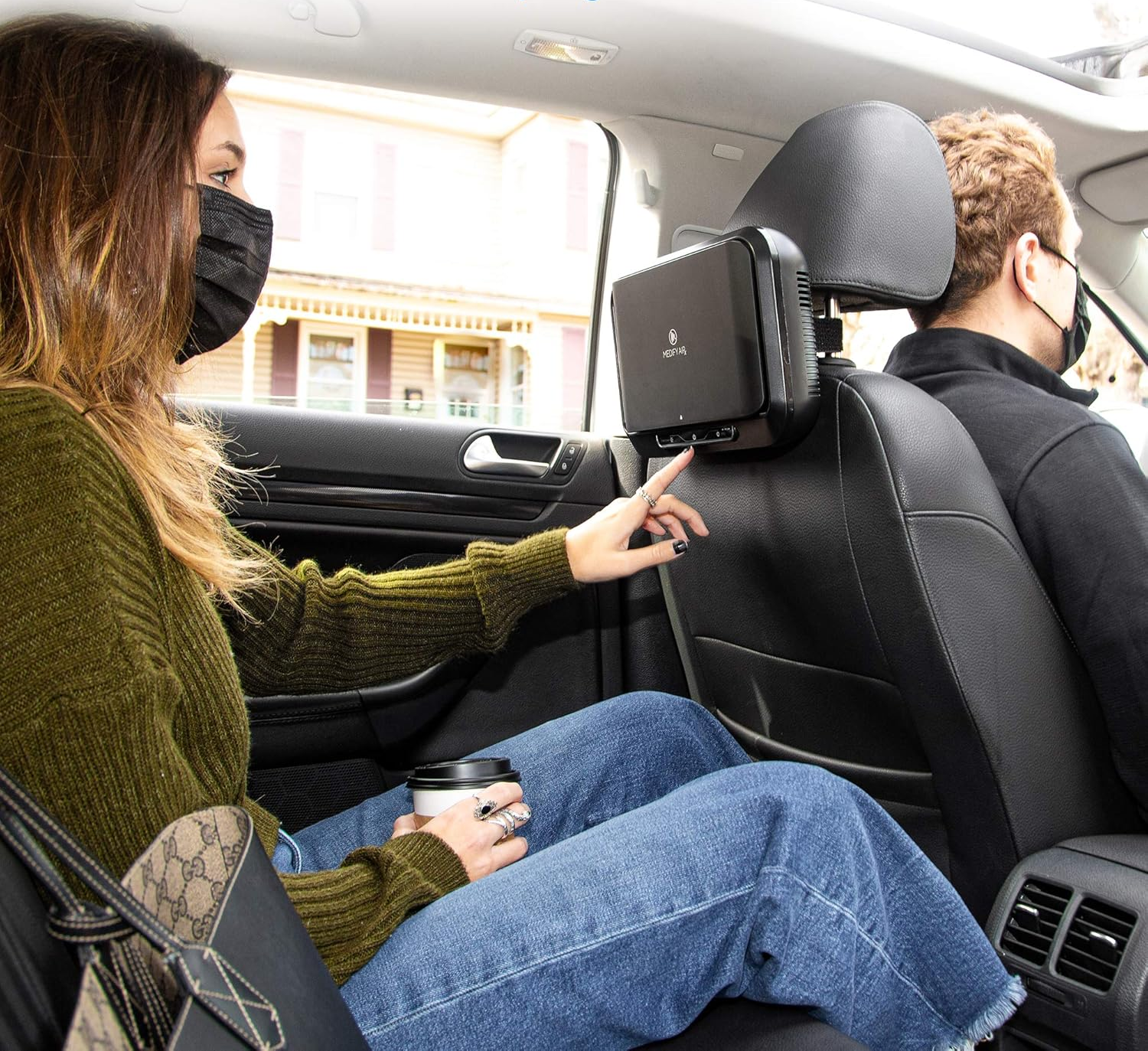
Your morning commute shouldn’t feel like a battle against sneezing, watery eyes, and congestion. Yet for millions of allergy sufferers, the confined space of a vehicle becomes a concentrated chamber of airborne irritants that make every drive uncomfortable.
Here’s what most people don’t realize: your car’s standard cabin air filter only handles incoming air from outside. It does nothing to clean the air already circulating inside your vehicle—air that’s often loaded with pollen, dust mites, pet dander, and other microscopic allergens that trigger your symptoms.
Why Your Car Needs More Than Just a Cabin Filter
Cars create the perfect storm for allergen accumulation. The enclosed environment traps particles that enter through doors, windows, and ventilation systems. Meanwhile, occupants constantly shed skin cells, hair, and clothing fibers that become airborne.
The Technology That Actually Removes Allergens
Not all air purification technologies work equally well for allergy relief. Understanding the differences helps you avoid wasting money on ineffective solutions.
HEPA Filters: The Gold Standard
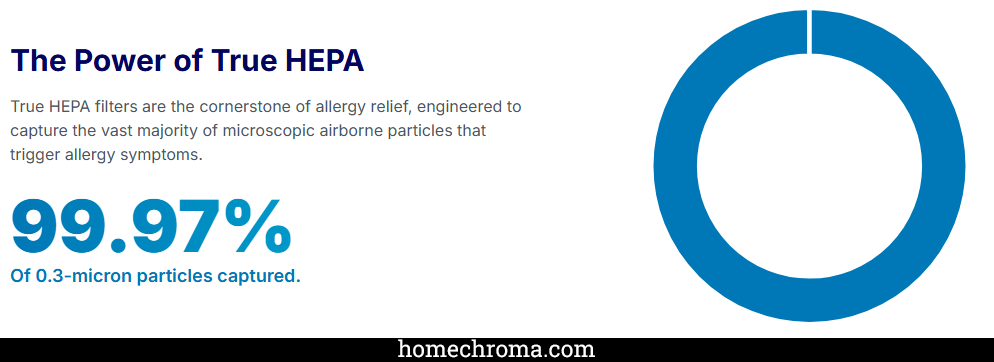
True HEPA (High Efficiency Particulate Air) filters remove 99.97% of particles 0.3 microns and larger. This includes virtually all common allergens:
• Pollen (typically 5-100 microns) • Dust mite allergens (0.5-50 microns) • Pet dander (0.5-100 microns) • Mold spores (1-30 microns)
Important: Avoid products labeled “HEPA-like” or “HEPA-style.” These don’t meet true HEPA standards and will leave significant amounts of allergens in your air.
Activated Carbon: For Odors and Gases
Activated carbon filters excel at removing: • Volatile organic compounds (VOCs) • Vehicle exhaust odors • Chemical smells from new car materials • General unpleasant odors
However, carbon filters cannot remove particulate allergens. The pores are too small to trap larger particles like pollen or pet dander.
Air Ionizers: Why You Should Avoid Them
Ionizers don’t actually remove allergens—they make particles settle on surfaces where they can easily become airborne again. Worse, many ionizers produce ozone, a lung irritant that’s particularly dangerous for people with respiratory sensitivities.
Combination Systems: The Complete Solution
The most effective car air purifiers combine HEPA and activated carbon filtration. This dual approach removes both particulate allergens and gaseous pollutants for comprehensive air cleaning.
Critical Selection Factors for Allergy Relief
Clean Air Delivery Rate (CADR)
CADR measures how quickly a purifier cleans air in a specific space. For typical car interiors (roughly 80-150 cubic feet), look for units with:
• Minimum 20 m³/h for basic effectiveness • 40-60 m³/h for rapid air cleaning • Higher CADR means faster allergen removal
Noise Levels That Won’t Distract
Driving requires concentration, so noise matters. Quality units operate at:
• 35-45 dB for whisper-quiet operation • 45-55 dB for acceptable background noise • Avoid units exceeding 55 dB on normal settings
Essential Convenience Features
Auto-On Function: Units that automatically start with your ignition prevent forgotten operation and eliminate dangerous manual adjustments while driving.
Multiple Fan Speeds: Allow you to balance air cleaning power with noise levels based on current conditions.
Air Quality Monitoring: Advanced units detect pollution levels and automatically adjust fan speed for optimal performance.
Top Car Air Purifiers for Allergy Sufferers
Premium Choice: IQAir Atem
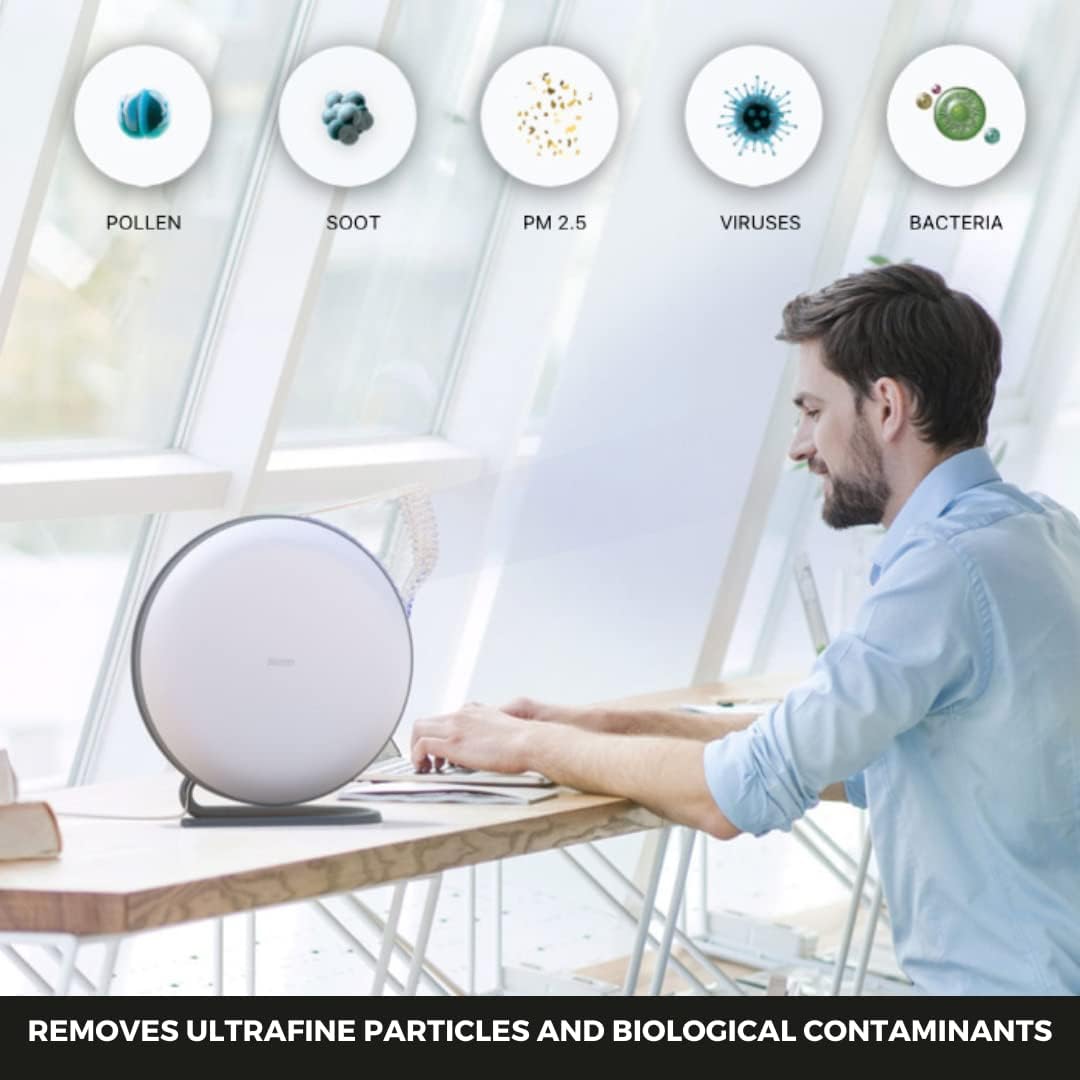
IQAir Atem Air Purifier [click to view…]
Price Range: $400-600 Best For: Maximum allergen removal and premium features
The IQAir Atem sets the standard for car air purification with its HyperHEPA Plus filter system capturing >99.95% of particles at the most penetrating particle size.
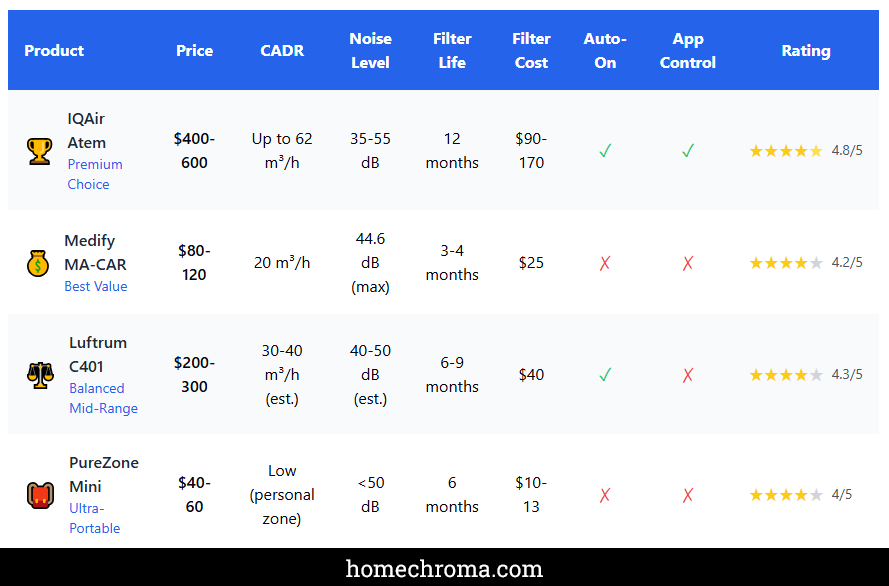
Key Specifications: • CADR: Up to 62 m³/h (customizable) • Noise: 35-55 dB across three speeds • Filter Life: Approximately 12 months • Auto-on: Yes • App Control: iOS and Android compatible
Strengths: • Exceptional allergen removal • Whisper-quiet operation • Comprehensive app control • Long filter life reduces maintenance
Considerations: • High upfront cost • Larger size may limit placement options • Cannot disable Bluetooth (concern for electromagnetic-sensitive individuals)
Best Value: Medify MA-CAR
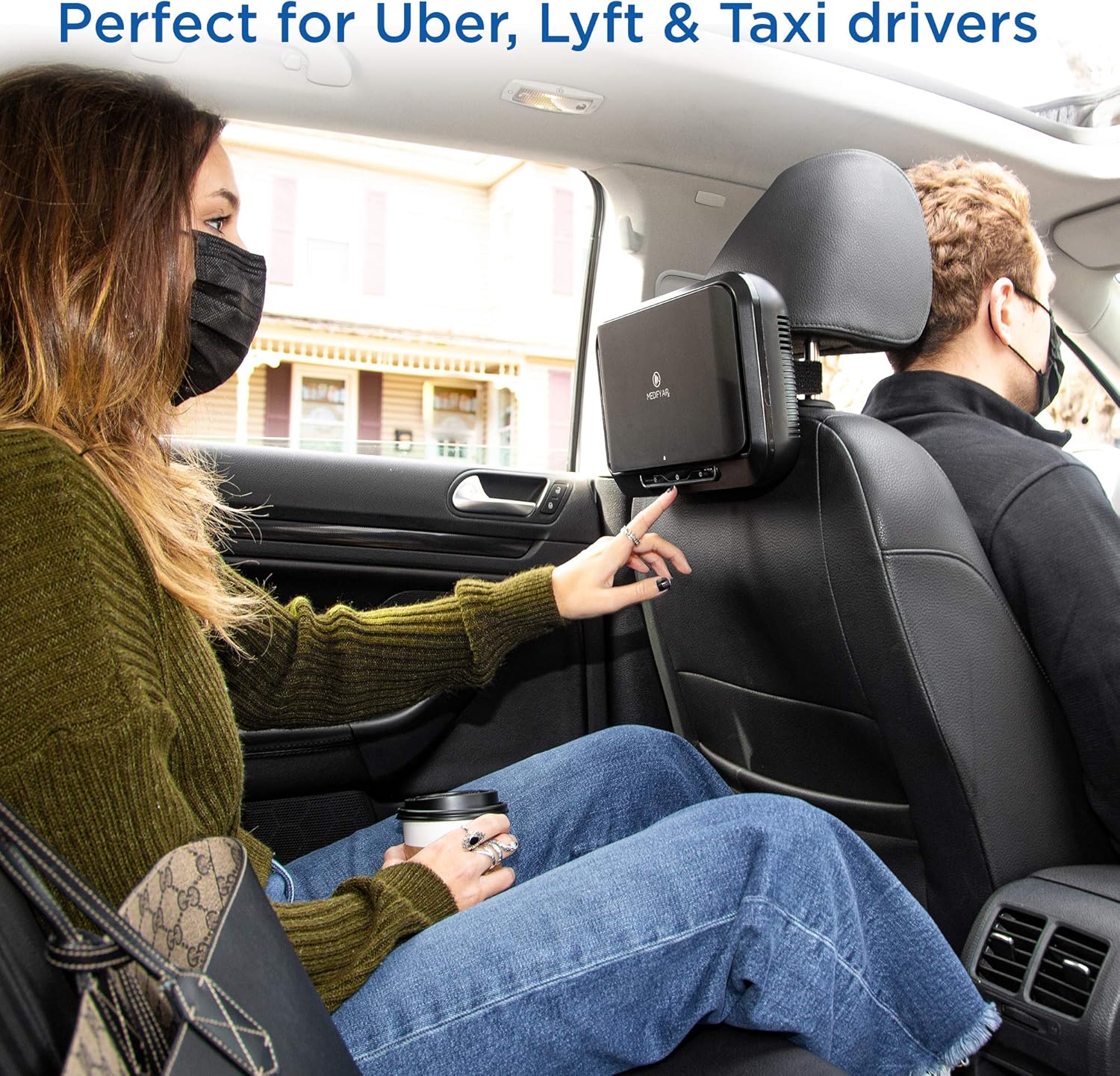
Medify Air MA-CAR Air Purifier [click to view…]
Price Range: $80-120 Best For: Effective filtration on a budget
The MA-CAR delivers solid True HEPA H13 performance with added carbon filtration at an accessible price point.
Key Specifications: • CADR: 20 m³/h • Noise: 44.6 dB at highest speed • Filter Life: 3-4 months • Compact: 4″ H x 10″ W x 14″ D • Weight: 3 pounds
Strengths: • True HEPA H13 + carbon filtration • Affordable replacement filters ($25) • Compact and lightweight • Lifetime warranty
Considerations: • No auto-on function (manual operation required) • Shorter filter life increases maintenance frequency • Some quality control issues reported
Balanced Mid-Range: Luftrum C401
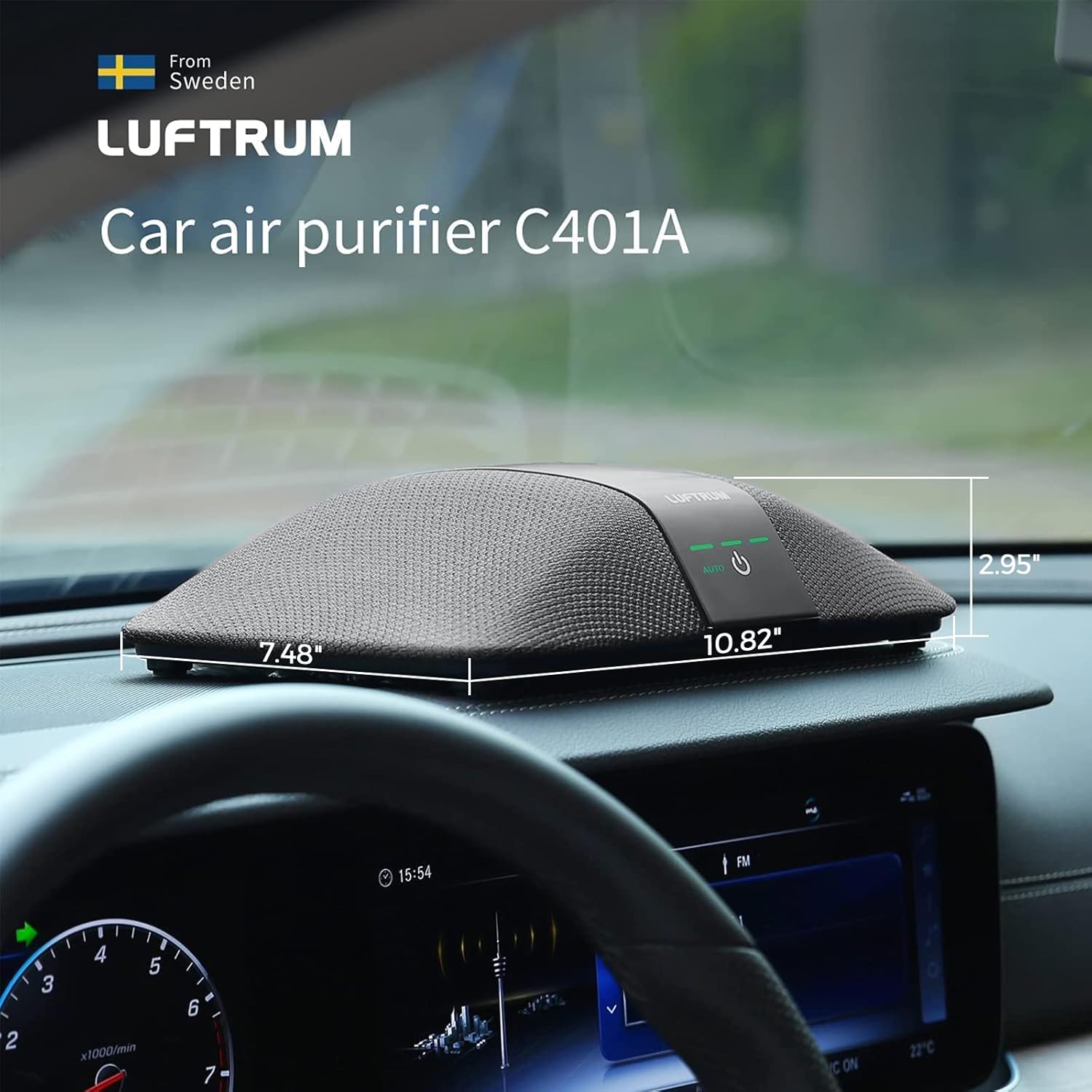
Price Range: $200-300 Best For: Automatic operation with air quality monitoring
This option bridges the gap between budget and premium with intelligent features and solid performance.
Key Specifications: • HEPA H13 with integrated gas adsorption • Auto-on function • Built-in air quality monitoring • Filter Life: 6-9 months • Replacement Cost: ~$40
Strengths: • Automatic fan speed adjustment based on air quality • Essential auto-on feature • Balanced performance and price • Longer filter life than budget options
Considerations: • Less established brand presence in car purifier market • Limited long-term support information
Ultra-Portable: Pure Enrichment PureZone Mini
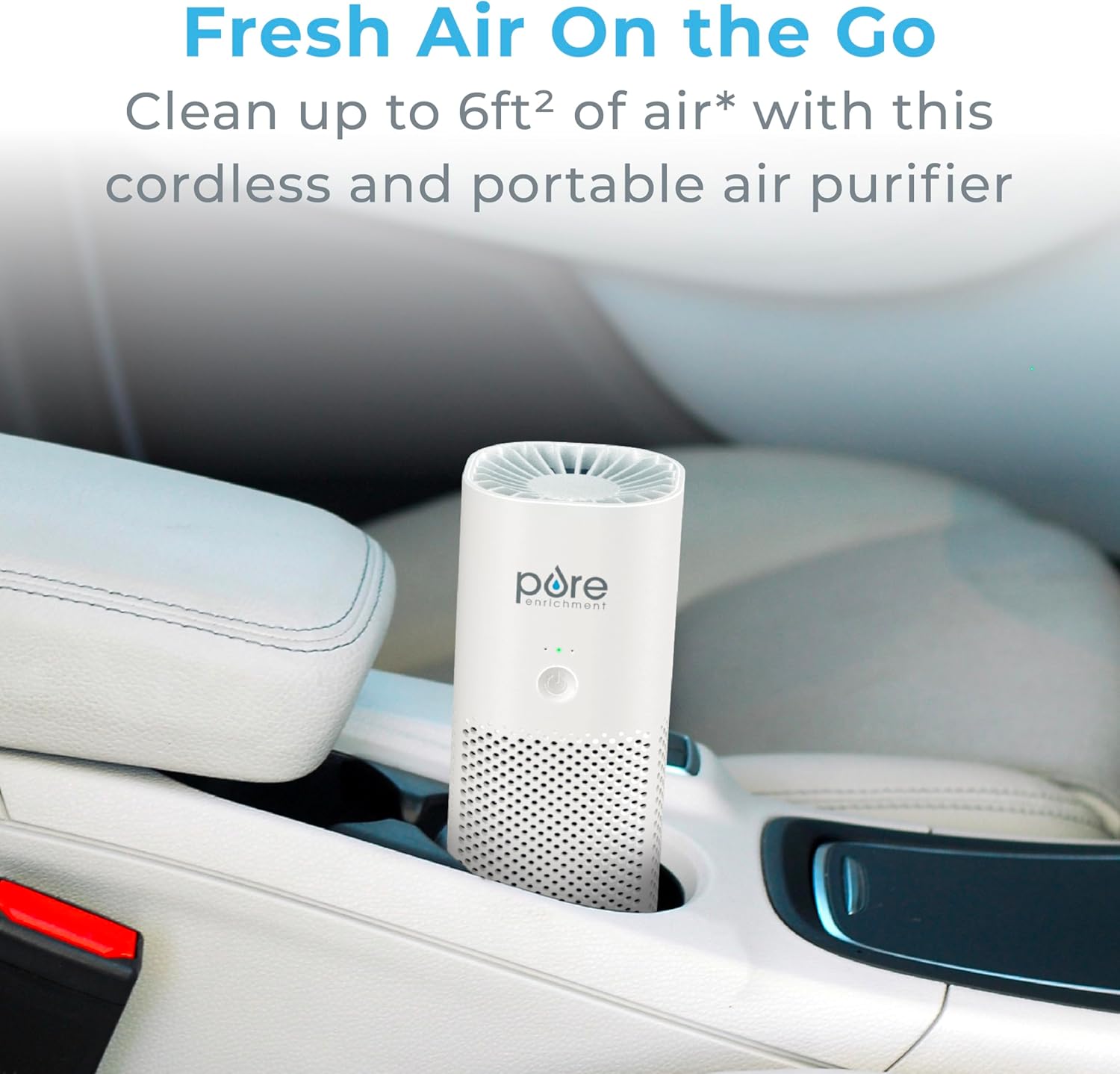
Pure Enrichment PureZone Mini Portable Air Purifier [click to view…]
Price Range: $40-60 Best For: Personal breathing zones and multi-use applications
Perfect for smaller vehicles or as a personal air cleaning solution that works beyond just cars.
Key Specifications: • True HEPA + carbon pre-filter • Weight: 0.6 pounds • Battery: 2.5-12 hours operation • Filter Life: 6 months • Replacement Cost: $10-13
Strengths: • Maximum portability • Battery operation for flexibility • Very affordable filters • Multi-environment use
Considerations: • Lower CADR suitable mainly for personal breathing zones • Less effective for whole-car air cleaning
Top Car Air Purifiers Comparison
Installation and Usage Tips
Optimal Placement
• Dashboard mounting provides best airflow distribution • Avoid blocking air vents or creating driving distractions • Secure mounting prevents damage during sudden stops
Maximizing Effectiveness
• Run purifier 10-15 minutes before entering vehicle when possible • Keep windows closed during peak pollen periods • Replace filters according to manufacturer schedules, not just when they look dirty
Managing CO₂ Buildup
Even the best HEPA filters don’t remove carbon dioxide. In recirculation mode, CO₂ from breathing can reach uncomfortable levels within 30 minutes. Periodically switch to fresh air mode or crack windows slightly to maintain healthy CO₂ levels.
Making Your Decision
For most allergy sufferers, a combination HEPA and carbon filter system provides the most comprehensive protection. Your choice depends on balancing effectiveness, convenience, and cost:
Choose the IQAir Atem if: You want maximum allergen removal, can afford the premium price, and value whisper-quiet operation with advanced features.
Choose the Medify MA-CAR if: You need proven HEPA performance at an accessible price and don’t mind manual operation.
Choose the Luftrum C401 if: You want automatic operation with air quality monitoring at a reasonable mid-range price.
Choose the PureZone Mini if: You prioritize maximum portability and multi-use functionality over whole-car air cleaning power.
Start Breathing Easier Today
The right car air purifier transforms your daily commute from an allergy ordeal into comfortable travel time. With proper HEPA filtration actively removing microscopic allergens from your breathing space, you can focus on driving instead of fighting symptoms.
Consider your specific needs, vehicle size, and budget to select the purifier that will provide years of cleaner, healthier air during every journey.
Dora Decora is a biophilic interior design specialist and passionate blogger. With a deep commitment to integrating nature into living spaces, Dora specializes in creating environments that foster human-nature connections through thoughtful design elements. Her approach emphasizes sustainable materials, natural lighting, and organic patterns that enhance wellbeing and reduce environmental impact.
This post (https://homechroma.com/best-car-air-purifier-for-allergies) was originally published by Dora Decora on Home Chroma. As an Amazon Associates partner, we are compensated for all qualifying purchases.