You’re standing at the edge of a decision. On one side: the fastest-charging portable power station on the market with technology that seems borderline science fiction. On the other side: warnings from real users about firmware crashes, software lockouts, and support nightmares.
This is the EcoFlow Delta dilemma.
The EcoFlow Delta series dominates the portable power station market with charging speeds that leave competitors in the dust. A full charge in 1.3 hours? Solar charging in under 4 hours? It’s real. But here’s what the marketing won’t tell you: that incredible complexity comes with a cost—one that might matter more than raw horsepower if you’re counting on this device when the power goes out.
This guide cuts through the hype. You’ll learn what EcoFlow’s Delta models actually deliver, which one fits your needs, and whether the performance payoff justifies the reliability risks.
What EcoFlow Did Differently (And Why It Matters)
Most portable power stations prioritize simplicity. EcoFlow took a different approach. Their Delta series focuses on two things: making power move as fast as possible and scaling that power to handle serious loads.
This strategy gave them three competitive advantages:
1. X-Stream Charging Technology
Standard portable power stations take 4-8 hours to charge. The Delta 2 Max does it in 1.3 hours. The Delta Pro Ultra hits 80% charge in just 50 minutes. That’s not just convenience—it’s strategy. During unstable power situations (rolling outages, storm-disrupted power), rapid recharge means your unit can capture power during brief grid windows and maintain backup for the next cycle.
2. X-Boost Power Delivery
Most units max out at their rated continuous output. EcoFlow’s X-Boost algorithm lets units surge beyond their rating for short periods. The Delta 2 Max, for example, carries a 2,400W continuous rating but can push 3,400W in bursts. That means it starts power-hungry appliances (air compressors, refrigerators, power tools) without shutdown.
3. Extreme Scalability
This is where Delta gets serious. A single Delta Pro unit starts at 3.6 kWh but can expand to 25 kWh. Stack multiple units with the Double Voltage Hub and you’re running 240V systems. The theoretical max? 90 kWh—enough to run most homes for days without sun.
The trade-off: all this power and flexibility requires sophisticated software to coordinate between multiple components. And that’s where problems emerge.
The Three EcoFlow Delta Models 
DELTA 3 Plus: The Practical Entry Point

EF ECOFLOW DELTA 3 Portable Power Station [click to view…]
Who it’s for: Campers, jobsite workers, emergency backup seekers on a budget.
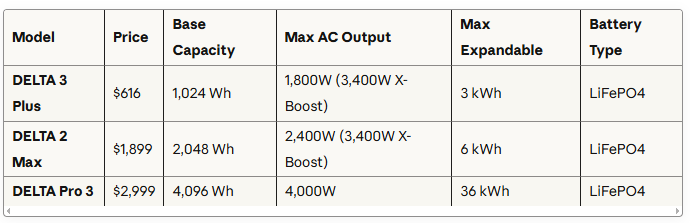
At $616, this is the gateway drug to EcoFlow performance. The 1,024 Wh base capacity runs laptops, phones, small appliances, and tools for hours. Pair it with solar panels and you’re charging during the day, running devices at night.
The real magic: X-Stream charging means you can grab 2-3 full charges from a wall outlet before you head out. For weekends away from home, this model hits the sweet spot between portability (it weighs 31 lbs) and capacity.
Expansion to 3 kWh through Smart Extra Batteries transforms it into genuine home backup for lights, refrigeration, and charging stations during outages.
Reality check: At 1,800W continuous output, it won’t run your air conditioner or electric dryer. It’s built for convenience, not whole-home coverage.
DELTA 2 Max: The Balanced Performer
Who it’s for: RV owners, small business operators, serious weekend adventurers.
The $1,899 price tag captures the performance sweet spot. Double the capacity (2,048 Wh), 2,400W continuous output, and the ability to expand to 6 kWh through two Smart Extra Batteries.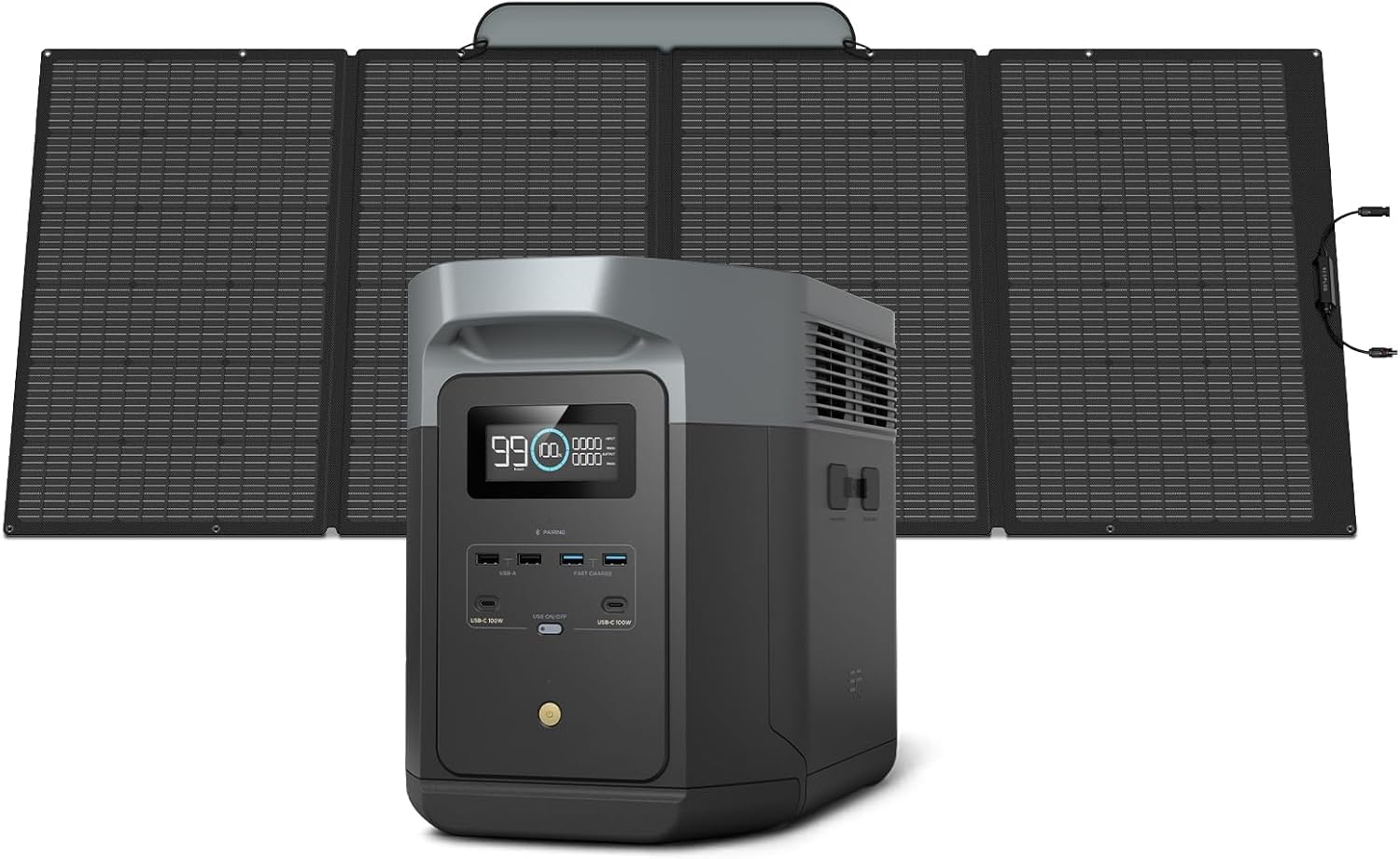
EF ECOFLOW Solar Generator DELTA 2 Max [click to view…]
This model powers multiple simultaneous loads. Refrigerator running? Laptop charging? Coffee maker heating up? The Delta 2 Max handles all three without flinching.
Real users report running their entire RV electrical system from this unit combined with solar panels. Job sites use it as a dedicated power source for tools and equipment all day long.
The charging speed is transformational: wall charge completes in 1.3 hours. Solar charging (with full panel kits) finishes in 4-5 hours.
Trade-off: At 62 lbs, it’s not as portable as the Plus model. But the extra capacity justifies the weight for most use cases.
DELTA Pro 3: The Powerhouse

EF ECOFLOW DELTA Pro 3 [click to view…]
Who it’s for: Homeowners needing serious backup, property managers, commercial jobsites, extreme off-grid living.
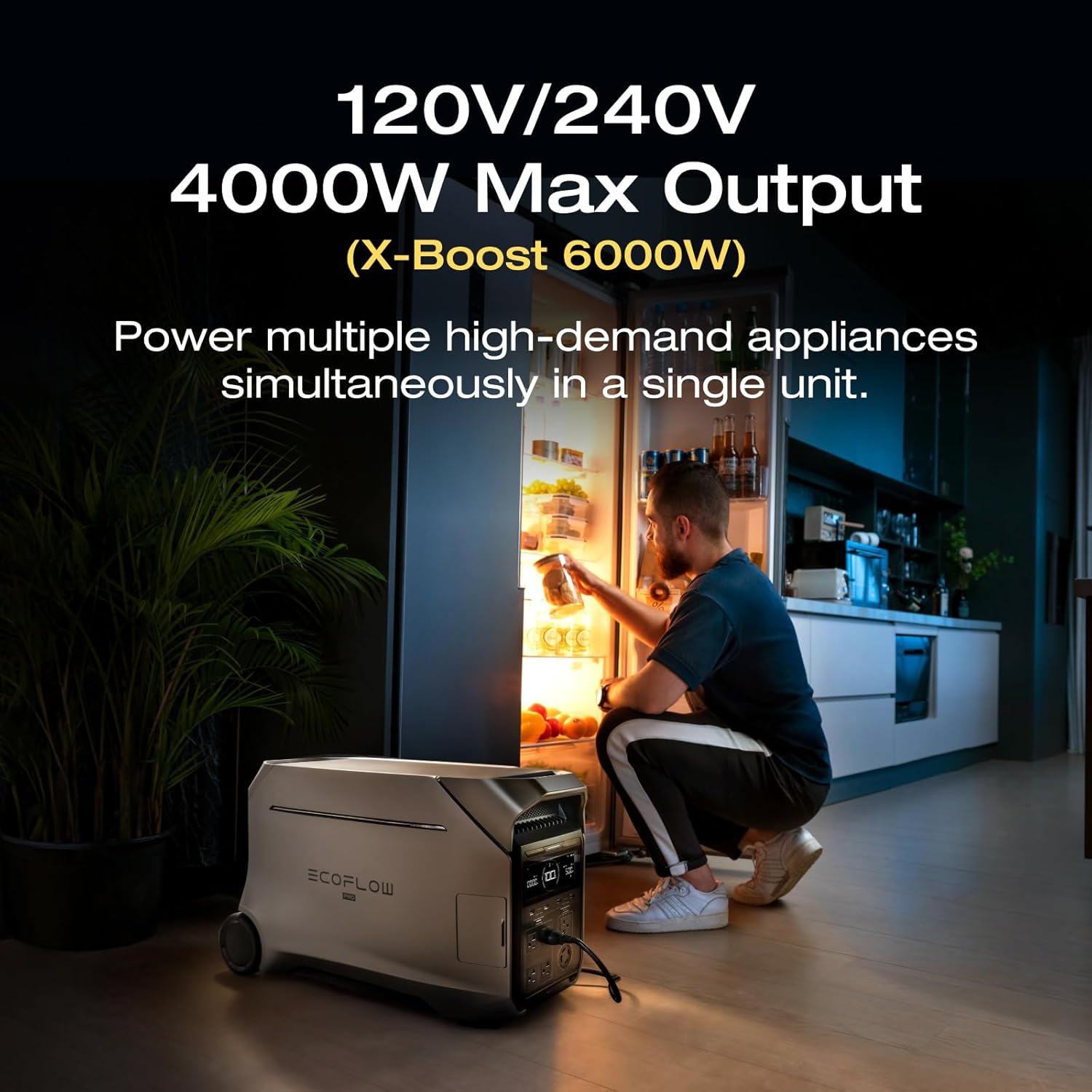
At 4,096 Wh base capacity with 4,000W continuous output, the $2,999 Pro 3 is a different category entirely. Pair it with the Smart Home Panel 2 and you’ve got a genuine home energy system—not a portable backup, but a primary power infrastructure.
Expansion goes to 36 kWh. Run your whole home (lights, refrigeration, heating, charging stations) through an outage. Link two units at 240V and push 7,200W—enough for demanding household equipment like electric dryers.
Real-world example: Users report powering their entire homes through extended outages with the Pro 3 plus solar panels.
The cost: Complexity. This system requires more setup, firmware updates matter more, and when something breaks, you’re coordinating multiple pieces.
The Performance Picture: What These Specs Actually Mean
Charging Speed: Not Just Fast, Strategically Fast
Standard wall charging times:
- Delta 3 Plus: 2.5 hours (AC power)
- Delta 2 Max: 1.3 hours (AC power)
- Delta Pro 3: 3-4 hours (AC power)
During rolling blackouts or unstable power situations, this speed difference becomes critical. A 1.3-hour full charge means your unit is ready before the next outage wave hits. That tactical advantage only matters if you need it, but when you do, it’s transformative.
Solar charging (with appropriate panel kits):
- Delta 3 Plus: 8-10 hours (with 400W solar)
- Delta 2 Max: 5-6 hours (with 800W solar)
- Delta Pro 3: 3.8 hours (with 1,600W solar, optimal conditions)
Power Output: Surge vs. Continuous

The X-Boost feature creates some confusion. Here’s what actually happens:
Your refrigerator’s compressor draws 1,200W to start, then 600W to run. Standard specs list the 600W continuous rating. EcoFlow’s X-Boost lets the unit deliver that 1,200W surge, preventing shutdown.
This means:
- Appliances start reliably (no unexpected shutdowns)
- Heavy tools run without power limitations
- Multiple devices operate simultaneously without cycling
Battery Chemistry: Why LiFePO4 Matters
All current EcoFlow Delta models use Lithium Iron Phosphate (LiFePO4) chemistry. This isn’t marketing noise—it’s the difference between a 5-year and 10-year lifespan.
LiFePO4 batteries:
- Survive 3,000+ charge cycles before dropping to 80% capacity
- Handle deep discharges without degradation
- Generate less heat during operation
- Carry intrinsic fire safety advantages
Translation: A Delta unit purchased today holds roughly 80% capacity after a decade of daily use. That’s residential solar system longevity in a portable device.
Older models used NCM chemistry. If you find a deeply discounted “Delta” unit that doesn’t specify LiFePO4, verify before buying. NCM units degrade faster and won’t last 10 years.
The Uncomfortable Truth: Performance Isn’t Reliability
Here’s where I separate from marketing copy. EcoFlow’s hardware engineering is genuinely excellent. The problem lives in software.
The Documented Issues
Across Reddit communities, product reviews, and support forums, three consistent problems emerge:
1. Firmware Update Failures
Multiple users report firmware updates that “brick” their units—rendering expensive power stations completely non-functional. Units lock into boot loops, refuse to charge, or fail to recognize battery packs.
Affected models include the Delta Max and older Pro units. Newer LFP models report fewer issues, but it still happens.
2. Cloud Dependency for Core Functions
The app requires internet connectivity for certain operations. In an actual power outage—especially one that takes down your internet—this creates awkward scenarios where the unit functions but lacks app control for advanced features.
3. Inconsistent Customer Support
The Better Business Bureau profile and Reddit threads reveal support experiences ranging from excellent to nonexistent. Response times vary wildly. Some users report getting help within hours; others wait weeks or get ignored entirely.
For a $2,000-3,000 device, this variability introduces real risk.
Who This Matters For
Low risk: Weekend camping, jobsite backup, attended use where you can troubleshoot.
High risk: Emergency home backup for medical equipment, climate control for animals/infants, critical systems running unattended.
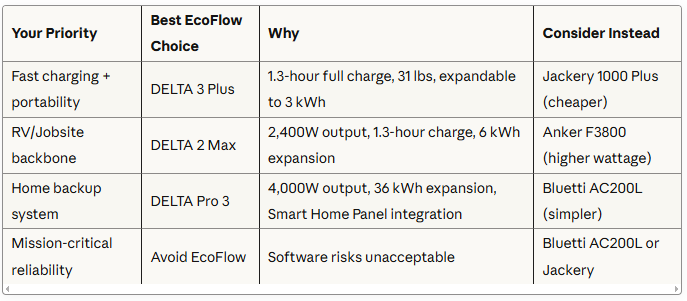
If your power station powers a CPAP machine keeping someone alive or a heating system protecting livestock, EcoFlow’s software vulnerabilities introduce unacceptable risk. Simpler competitors (Bluetti, Jackery) with less sophisticated software have fewer failure points.
What Type of User Should Buy EcoFlow Delta (And What Type Shouldn’t)
Buy EcoFlow Delta If:
✓ You camp or travel frequently and need compact, fast-charging backup ✓ You run a business where job sites need reliable daytime power ✓ You want the fastest charging among all available options ✓ You have an internet connection for app features ✓ You’re willing to monitor firmware updates and apply them promptly ✓ You don’t depend on this device for medical equipment or critical systems ✓ You value performance more than set-it-and-forget-it reliability ✓ You need to expand capacity gradually (Smart Extra Batteries system)
Avoid EcoFlow Delta If:
✗ You need this device to run unattended (like backup power for animals during your absence) ✗ You’re powering critical medical devices (CPAP, oxygen generators, refrigerated medications) ✗ You can’t guarantee reliable internet connectivity ✗ You want simple, proven technology with minimal support needed ✗ You need the absolute highest continuous wattage for power-heavy appliances ✗ You can’t handle troubleshooting if firmware updates cause problems ✗ You prioritize 10-year worry-free operation over cutting-edge performance
The Buying Decision: Your Recommendation Matrix
Before You Buy: Three Things to Verify
1. Confirm LiFePO4 Chemistry
Check the product listing explicitly states “LiFePO4” or “LFP” battery. Older NCM models still circulate. Don’t accept vague language.
2. Check the Warranty
EcoFlow typically offers 5-year warranties on newer models. Verify this is included with your specific unit. Some Amazon listings have different terms than EcoFlow’s direct store.
3. Review Latest Customer Feedback
Don’t rely on 1-2 year old reviews. Check posts from the last 30 days on the EcoFlow community subreddit and Amazon reviews. Software updates change unit behavior. Recent feedback reflects current reliability.
The Final Verdict: Power With Asterisks
EF ECOFLOW DELTA Pro 3 [click to view…]
EcoFlow’s Delta series represents genuine engineering excellence. The X-Stream charging technology works as advertised. The scalability is legitimately impressive. The power output handles real-world loads that other competitors struggle with.
But—and this matters—you’re buying cutting-edge complexity in exchange for that performance.
For recreational use, weekend travel, and attended scenarios, the Delta series delivers transformational value. You get the fastest charging, highest power output, and most flexible expansion in the portable power market. The premium pricing makes sense for people who benefit from those advantages.
For critical backup or unattended operation, the software vulnerabilities introduce risk that faster charging doesn’t offset. In those scenarios, simpler competitors with proven track records represent better value despite having less horsepower.
The question isn’t whether EcoFlow Delta is “good” (it is). The question is whether its specific strengths match your specific needs. Answer that accurately, and you’ll make the right choice.
Ready to Decide?
The EcoFlow Delta series sits on Amazon USA priced competitively for its performance tier. You can purchase directly from Amazon with standard return policies—use that to your advantage. Order the model that fits your budget. Test it for 7-10 days against your actual use case. If firmware updates worry you or simplicity matters more than speed, return it and order a Bluetti. If charging speed justifies the software risk for your situation, keep the EcoFlow.
Let the unit prove itself against your actual needs, not against marketing promises.
That’s how you make a $600-3,000 decision correctly.
Dora Decora is a biophilic interior design specialist and passionate blogger. With a deep commitment to integrating nature into living spaces, Dora specializes in creating environments that foster human-nature connections through thoughtful design elements. Her approach emphasizes sustainable materials, natural lighting, and organic patterns that enhance wellbeing and reduce environmental impact.
This post (https://homechroma.com/ecoflow-delta-solar-generator-reviews) was originally published by Dora Decora on Home Chroma. As an Amazon Associates partner, we are compensated for all qualifying purchases.