Your dog sits by the door, staring at you. Is he asking to go outside? Does he need water? Maybe he just wants to play? You’re left guessing, and sometimes you guess wrong. The frustration builds on both sides of this communication gap.
For thousands of years, we’ve relied on reading body language, interpreting barks, and hoping we understand what our dogs need. But what if your dog could actually tell you—using words you both understand?
Augmentative Interspecies Communication (AIC) buttons are changing everything. These recordable devices, originally developed for human speech therapy, give dogs a voice. And researchers at UC San Diego have analyzed over 260,000 button presses from 152 dogs to prove this isn’t just wishful thinking—dogs are genuinely communicating complex ideas.
What Are Dog Communication Buttons?
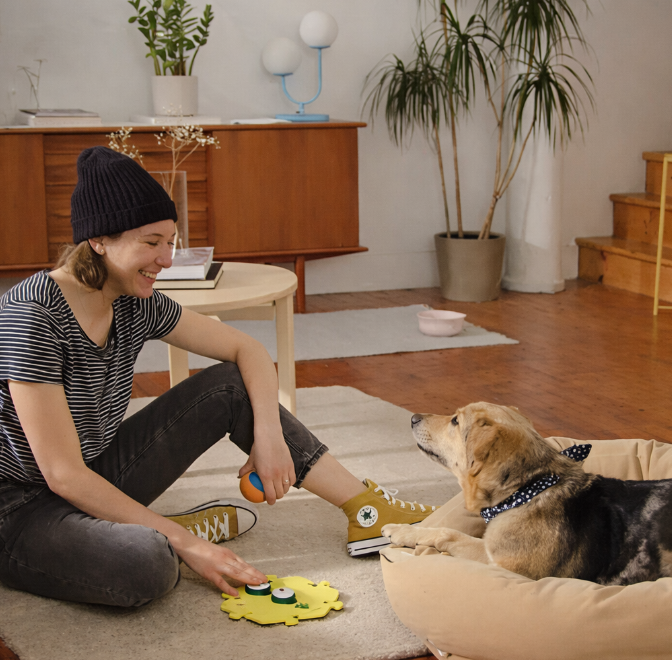
Dog communication buttons are pressure-activated recording devices that play a specific word when pressed. You might record “Outside” on one button, “Play” on another, and “Water” on a third. Your dog learns to press these buttons to make requests, report problems, and even share observations about their world.
The technology adapts human Alternative and Augmentative Communication (AAC) tools for animals. Each button requires between 0.2 to 0.5 pounds of pressure, making them accessible to dogs ranging from toy breeds to working dogs.
Three main systems dominate the market: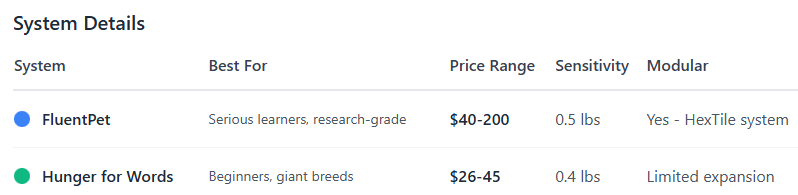
The difference between these systems isn’t just hardware—it’s methodology. FluentPet uses the Fitzgerald Key, organizing buttons by word type (nouns, verbs, modifiers) to help dogs build grammatical structures. Hunger for Words focuses on core vocabulary and clear training protocols developed by speech-language pathologist Christina Hunger. Mewoofun prioritizes accessibility and ease of setup.
The 5 Critical Things Your Dog Is Desperately Trying to Tell You
1. “I Need to Go Outside RIGHT NOW” – The Urgency You’re Missing
The Problem: Your dog’s silent signals are easy to miss. Standing by the door, staring at the handle, pacing near the hallway—these subtle cues get overlooked when you’re working, cooking, or absorbed in your phone. The result? Accidents, frustration, and a breakdown in trust.
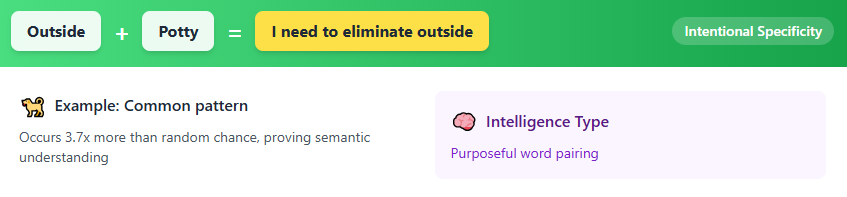
What the Research Shows: “Outside” and “Potty” buttons aren’t just the most frequently pressed—they’re used with remarkable intentionality. Dogs combine “Outside” + “Potty” at rates far exceeding random chance. They understand these buttons control their environment, providing the power to open doors and access the relief they desperately need.
Real-World Impact: A dog named Pepper had her “Outside” button strategically placed near the back door. Within two weeks, accidents stopped completely. The physical proximity reinforced the connection: button press = door opens = problem solved.
The Hunger for Words Talking Pet Doorbell takes this concept further. This single-purpose button is mounted at nose height near the exit. The psychological relief for the dog is immediate—instead of anxiety-inducing silence, they have a loud, clear voice that commands attention.
Key Benefits:
- Eliminates accidents from missed signals
- Reduces anxiety around elimination needs
- Provides audible confirmation of the request
- Builds trust in the communication system
2. “I Want to Play With YOU” – Beyond Basic Survival
Your dog’s need for social engagement runs deeper than most owners realize. The “Play” and “Walk” buttons reveal something profound: dogs don’t just want to burn energy—they want specific interactions with specific people using specific toys.
Precision in Play Requests: Research from the “They Can Talk” project shows dogs distinguish between different types of play. A dog might press “Ball” for high-energy fetch outdoors, but select “Squeaker” for gentle tug-of-war indoors. This precision suggests dogs maintain mental categories of their possessions and can retrieve the correct label for each.
The “Want” Revolution: Advanced learners use “Want” as a modifier, creating combinations like:
- “Want” + “Play” = general interaction request
- “Walk” + “Now” = immediate environmental change needed
- “Ball” + “Outside” = specific game in specific location
- “Friend” + “Hi” = greeting to known person or dog
This progression from reactive behavior to proactive request-making marks successful language acquisition. Your dog isn’t responding to a stimulus—they’re expressing an internal desire before the stimulus appears.
The Cognitive Exhaustion Effect: Owners report that 5-10 minutes of button training can tire a high-energy dog as effectively as a 30-minute walk. This mental enrichment addresses a critical need for urban dogs lacking sufficient environmental stimulation.
3. “I Need Help With This Problem” – Your Dog Knows Their Limits
The “Help” button represents the most cognitively demanding communication in the canine repertoire. Unlike “Outside” or “Food” with fixed outcomes, “Help” is a general-purpose concept requiring your dog to recognize an unsolvable problem and identify you as the solution.
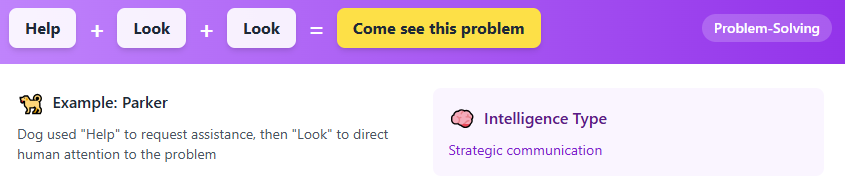
The Parker Experiment: Researcher Jack Terwilliger conducted a groundbreaking test. Parker, the subject dog, encountered a treat sealed inside a clear plastic box—physically impossible for him to open. After failed attempts, Parker walked to his soundboard and pressed “Help” followed by “Look, Look.”
This sequence demonstrates three cognitive layers:
- Recognition of Limitation: Understanding he cannot solve the problem alone
- Strategic Communication: Selecting a general concept to initiate assistance
- Directing Attention: Using “Look” to indicate visual perception is required
Real-World Applications:
Pet owners document dogs using “Help” for:
- Empty water bowls moved out of reach
- Toys trapped under furniture
- Doors closed when they want them open
- Gates blocking desired pathways
- Distress of other household pets
One documented case involved a dog pressing “Help” when their canine companion became trapped under furniture. This altruistic communication suggests high social intelligence extending beyond self-interest.
The Trust Factor: The “Help” button only works if you consistently respond. Dogs abandon the system if “Help” becomes “Help that never arrives.” This creates a feedback loop—reliable responses build trust, trust encourages more communication, more communication deepens the bond.
4. “Something Hurts” or “I’m Frustrated” – The Inner Life You’re Missing
Dogs instinctively hide pain to avoid appearing vulnerable. But AIC buttons provide a safe channel for reporting discomfort and expressing emotions previously accessible only through subtle (and often misunderstood) body language.
Pain Reporting Saves Lives: The “Ouch” or “Stomach” button offers significant veterinary diagnostic value. Case studies document:
- A dog pressing “Stomach” + “Ouch” repeatedly for 10 minutes before vomiting
- Another using “Leg” + “Ouch” to report limping before the owner noticed
- A third pressing “Ouch” + “Now” to indicate immediate pain requiring attention
Early pain reporting enables faster intervention, better treatment outcomes, and reduced suffering.
Emotional Expression: Stella, the famous Blue Heeler mix who helped popularize button communication, pressed “Mad” to express frustration when her routine was disrupted. Her morning snack was delayed because her owner didn’t leave the house as expected—a nuanced emotional response to violated expectations.
The “Love You” Paradox: UC San Diego research reveals humans press “Love You” to their dogs frequently, but dogs press it significantly less often. However, when dogs do use it, the context is remarkably appropriate—after intense bonding, during greetings, or as gratitude after receiving something desired.
Teaching Emotional Concepts: Kendra Baker, owner of Billi the cat, noted “Mad” was learned in only three examples because it was modeled during genuine frustration (being moved off a lap, denied food). The key: catch the animal in the natural emotional state and model the word immediately.
5. “I’ve Noticed Something Interesting” – Abstract Thinking You Didn’t Know Existed
The final frontier of canine communication is abstract observation—discussing things not immediately present, understanding temporal concepts, and creating novel word combinations to describe new experiences.
Temporal Concepts: Many trainers remain skeptical about dogs understanding “Later.” The concern: when an owner presses “Later” in response to a “Walk” request, the dog may perceive this as a broken promise, eroding trust in the system.
However, advanced learners like Bunny appear to have developed functional understanding of temporal boundaries, using “Later” to acknowledge delayed rewards or inquire about future event timing.
Linguistic Productivity – The Smoking Gun: The most compelling evidence for genuine intelligence in AIC is “productivity”—remixing known words to describe something lacking a specific button:
Documented Creative Combinations:
- “Water” + “Bone” = Ice: A dog named Silke lacked an “Ice” button but understood ice was a hard (bone-like) version of water
- “Squeaker” + “Car” = Ambulance: Multiple dogs pressed these buttons when ambulances with sirens passed, categorizing the siren as a “squeaker” and the vehicle as a “car”
- “Water” + “Outside” = Beach: When the “Beach” button was removed from a soundboard, the learner used these two words to summarize the missing concept
- “Friend” + “Love You” + “Help” = Request for owner to return from work: A complex three-word phrase expressing loneliness and desire for companionship
These combinations mirror early human language development, suggesting dogs engage in conceptual blending rather than simple stimulus-response memorization.
Environmental Observations: Dogs press buttons to comment on:
- Weather changes (“Water” + “Outside” for rain)
- Unusual sounds (“Ouch” + “Loud” for fireworks)
- Missing household members (“Where” + “Dad”)
- Changes in routine (“Walk” + “Now” + “Why”)
This level of abstract observation indicates dogs maintain mental models of their environment and can detect deviations from expected patterns.
Choosing the Right Button System
Your choice of hardware should match your commitment level and your dog’s needs.
FluentPet System:
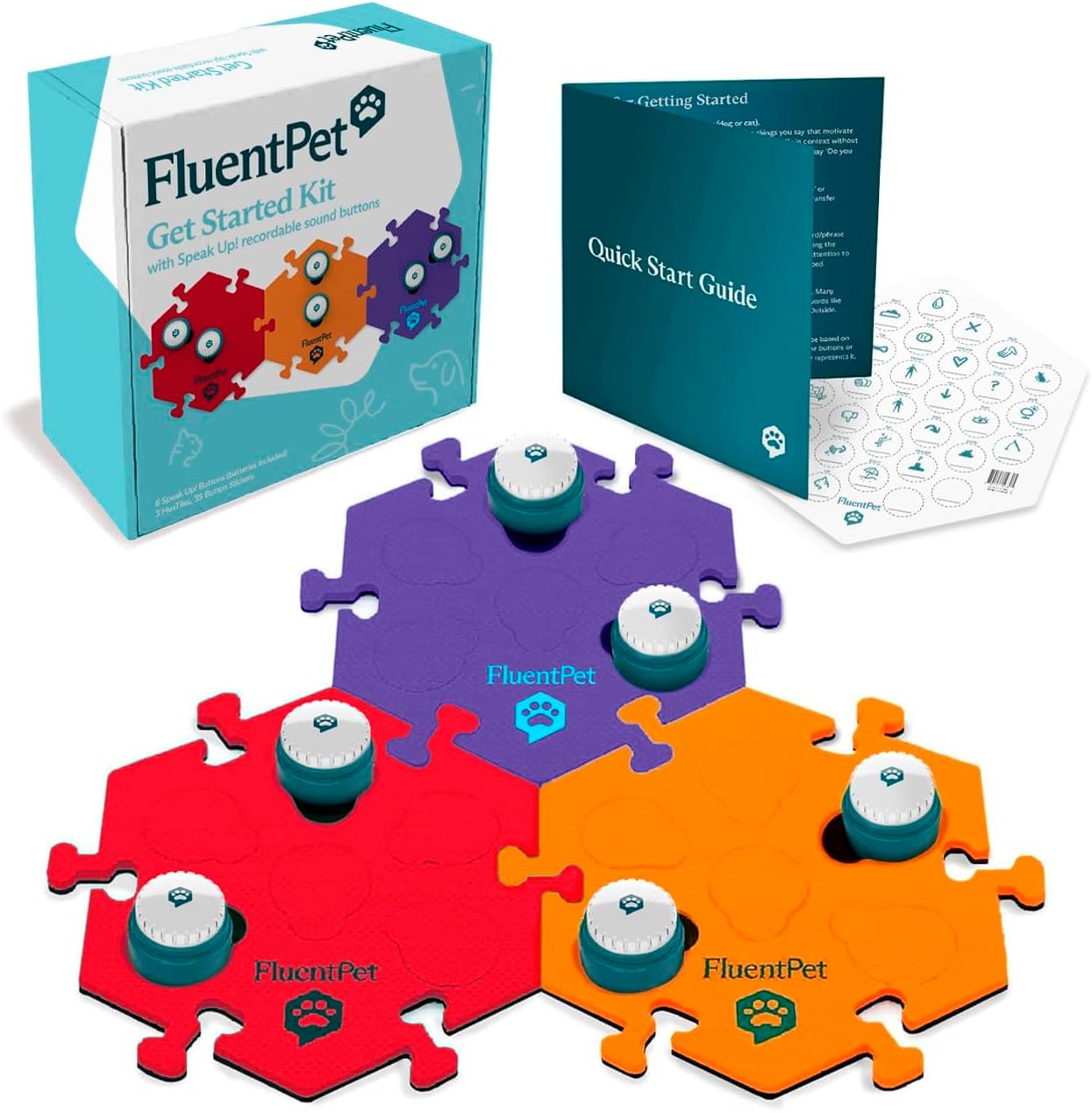
FluentPet Speak Up [click to view…]
Starter Options:
- Tester Kit: 2 buttons, 2 HexTiles, stickers, batteries ($40-45)
- Get Started Kit: 6 buttons, 3 HexTiles, labels ($75-85)
- Key Vocab Kit: 12 buttons, 6 HexTiles, labels ($140-160)
- They Can Talk Kit: 32 buttons, 12+ HexTiles, extensive labels ($180-200)
Key Features:
- Upward-facing speakers (no muffling on carpet)
- Modular HexTile organization
- Fitzgerald Key layout for grammatical structure
- 0.5 pounds activation pressure
Best For: Serious learners, research participation, building vocabularies of 20+ words
FluentPet Connect System:
- WiFi-enabled base station
- Automatic logging with timestamps
- High-fidelity speaker system
- App integration for tracking progress
Best For: Data enthusiasts, researchers, owners tracking communication patterns
Hunger for Words System:
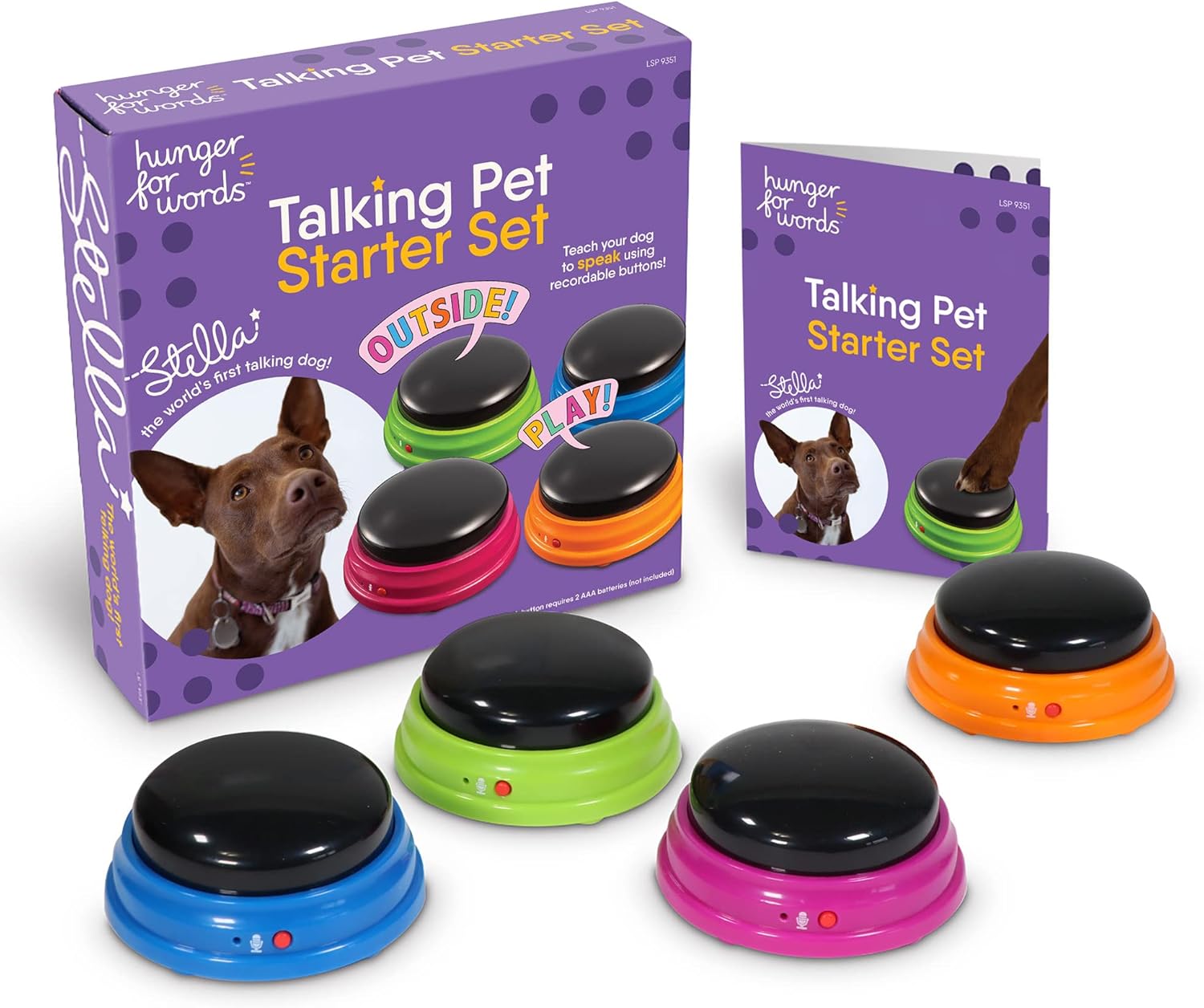
Hunger for Words [click to view…]
Options:
- Talking Pet Starter Set: 4 buttons, training guide ($26-35)
- Essential Words Set: 6 buttons ($32-45)
- Talking Pet Doorbell: Single button, mounting strip ($8-12)
- Next Words expansion packs: 3 buttons ($18-25)
Key Features:
- Large buttons (3.5″ diameter)
- Speech therapy-based training materials
- Clear, loud recording quality
- Owner creates custom labels
Best For: Beginners, giant breeds, owners wanting expert guidance
Training Your Dog to Use Buttons – The Method That Actually Works
The Fatal Mistake Most Owners Make: Treating button training like trick training. Rewarding button presses with treats creates “button abuse”—your dog pressing every button sequentially just to secure food rewards.
The Modeling Method (The Right Way):
Phase 1: Preparation (Week 1)
- Select 2-4 high-motivation words (Outside, Play, Water, Food)
- Place buttons near relevant locations (Outside button near door)
- Start with buttons your dog can see and access easily
Phase 2: Modeling (Weeks 2-4)
- YOU press the button before EVERY relevant action
- Going outside? Press “Outside” then open the door
- Filling water bowl? Press “Water” then pour water
- Starting play? Press “Play” then engage
Your dog observes hundreds of button presses paired with outcomes before making their first intentional press.
Phase 3: Targeting (If Needed)
- Some dogs are “paw-shy” and need physical training
- Use yogurt lid or post-it note as practice target
- Teach “Touch” command on neutral object
- Transfer skill to actual button
Phase 4: First Independent Press
- Will happen spontaneously after sufficient modeling
- Respond IMMEDIATELY with the outcome
- Press “Outside”? Go outside within 30 seconds
- Press “Play”? Drop everything and play
Phase 5: Vocabulary Expansion
- Add 1-2 new words per month
- Start with nouns (Ball, Squeaker, Walk)
- Progress to modifiers (Want, Now, Later)
- Advanced learners add abstractions (Help, Mad, Happy)
Critical Training Rules:
- Functional Rewards Only: The reward for “Outside” is going outside, not a treat
- Immediate Response: Delay destroys trust in the system
- No Forced Presses: Never physically push your dog’s paw onto buttons
- Patience: Average time to first intentional press: 2-6 weeks
- Consistency: Model daily, multiple times per day
The Science Behind Button Communication
UC San Diego’s “They Can Talk” Project: The largest-scale research initiative studying AIC, tracking over 152 dogs and 260,000+ button presses. The study moves into Phase 3 in 2025, involving controlled tests with opaque screens to eliminate human cuing possibilities.
Key Research Findings:
Finding #1: Dogs Show Intentional Communication Button combinations occur at rates far exceeding random chance. The pairing of “Outside” + “Potty” appears 3.7 times more frequently than would occur if dogs were pressing randomly.
Finding #2: Personality Predicts Success Better Than Breed Anxious dogs often become the most prolific button users. The theory: dogs lacking environmental control use buttons as a coping mechanism, providing predictable ways to secure attention and reassurance.
Bunny, the most famous AIC learner, is on anti-anxiety medication. Researchers suggest her high engagement (up to 90 presses daily) may help manage environmental stressors.
Finding #3: Dogs Understand Semantic Meaning When tested with incorrect outcomes (pressing “Outside” but receiving food), dogs show confusion and repeat the button press. This proves they expect specific outcomes tied to specific words.
Finding #4: No Evidence of the “Clever Hans Effect” Skeptics worried dogs were responding to unconscious human cues. But dogs continue using buttons correctly when:
- Owners leave the room
- Owners have their backs turned
- Multiple household members are present (dog selects appropriate person for request)
- Buttons are pressed via video monitoring with delayed owner response
The Anxiety Connection: Dogs prone to anxiety particularly benefit from button systems. The ability to ask “Who” is at the door or report being “Mad” about loud noises provides agency that reduces overall stress. For these dogs, buttons aren’t just communication—they’re emotional regulation tools.
The Deeper Bond You Didn’t Know Was Possible
Button communication doesn’t create thoughts your dog didn’t already have. It simply provides the voice for a mind that’s been communicating silently for millennia.
The famous AIC learner Stella didn’t suddenly become intelligent when buttons appeared. She was always intelligent. The buttons just made her thoughts visible to humans for the first time.
What Changes:
- You stop guessing what your dog needs
- Your dog stops feeling frustrated and unheard
- Anxiety decreases for both species
- Problem behaviors often resolve naturally
- The relationship deepens through mutual understanding
What Doesn’t Change:
- Your dog’s core personality
- Their existing intelligence
- The fundamentals of dog care and training
- The need for exercise, enrichment, and affection
This isn’t about creating a “talking dog” for social media fame. It’s about giving your companion the dignity of being heard.
Ready to Start? Your First Steps
Week 1 Action Plan:
- Select Your System: Based on dog size, commitment level, and budget
- Choose Starting Words: Pick 2-4 high-motivation words
- Strategic Placement: Position buttons near relevant locations
- Begin Modeling: Press buttons before EVERY relevant action
- Document Observations: Note when your dog watches button presses
- Maintain Patience: No expectations for independent pressing yet
The 2-Button Minimum: Start with “Outside” and “Play”—these cover the two most desperate communication needs.
The Reality: Your dog has been trying to tell you things for years. Buttons don’t teach them to think—they teach them you’re finally willing to listen.
The investment isn’t just in hardware. It’s in acknowledging that your dog has a perspective worth hearing, thoughts worth knowing, and frustrations worth addressing. After thousands of years of one-way communication, we finally have the technology to make the conversation two-way.
Your dog is already talking. The question is: are you ready to hear what they’ve been desperately trying to tell you?
Dora Decora is a biophilic interior design specialist and passionate blogger. With a deep commitment to integrating nature into living spaces, Dora specializes in creating environments that foster human-nature connections through thoughtful design elements. Her approach emphasizes sustainable materials, natural lighting, and organic patterns that enhance wellbeing and reduce environmental impact.
This post (https://homechroma.com/best-dog-communication-buttons) was originally published by Dora Decora on Home Chroma. As an Amazon Associates partner, we are compensated for all qualifying purchases.