Your disinfectant spray isn’t doing what you think it’s doing.
Read the fine print on most bottles of Lysol or Clorox wipes. There’s a line called “dwell time” — the period the surface must stay visibly wet to hit the advertised kill rate. For most common disinfectants, that’s 4 to 10 minutes. You spray, you wipe immediately, you move on. The pathogens stay.
UVC light doesn’t have a dwell time. It doesn’t bead up on a smooth surface or pool in a crack. It hits, it damages pathogen DNA, and the organism dies — often in under 60 seconds.
But here’s the catch: the consumer market is full of devices that do nothing. Cheap wands on sale for $20–$40 are frequently emitting UVA light — the same wavelength used to cure gel nails — not UVC. One published study tested the top two UV wands on the market against E. coli. Both claimed a 99.9% kill rate in 10 seconds. The actual results after 60 seconds: 23% and 47%.
This guide separates the devices that work from the ones that don’t — using verified lab data, EPA registrations, and independent third-party testing.
How UVC Light Actually Kills Pathogens
UVC light operates between 200 nm and 280 nm on the electromagnetic spectrum. Within that band, photons carry enough energy to penetrate a microorganism and damage its DNA or RNA. The damage targets the pyrimidine bases — cytosine and thymine in bacteria, cytosine and uracil in RNA viruses. This creates what scientists call pyrimidine dimers: physical kinks in the genetic strand that prevent replication.
The organism can’t reproduce. It’s effectively neutralized.
The historically cited peak of germicidal efficiency sits at 253.7 nm — the primary emission of low-pressure mercury vapor lamps used in hospitals for decades. Modern LED-based devices target 265–275 nm, which more closely aligns with the peak DNA absorption window and has the added benefit of being mercury-free.
The key variable is UV dose, defined as:
D = I × t
Where D is dose in millijoules per square centimeter (mJ/cm²), I is irradiance (mW/cm²), and t is time. A device that produces low irradiance simply cannot deliver a lethal dose in 60 seconds, regardless of what the box claims.
What “99.9% Kill Rate” Actually Means
The standard measurement for disinfection is log reduction — a mathematical way to express how much of a pathogen population has been eliminated.
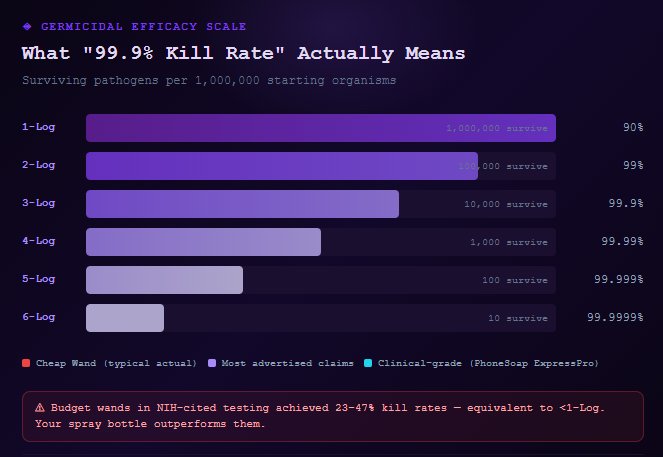
Most brands advertise 3-log (99.9%) reduction. The better devices achieve 4-log or higher. When a device fails to deliver sufficient irradiance, you might see a 1-log reduction (90%) while thinking 99.9% of pathogens have been eliminated. On a surface with millions of bacteria, that difference matters.
Why MRSA and E. Coli Are the Benchmarks
Not all pathogens are equally resistant to UVC. Two organisms are used as the primary benchmarks because they represent opposite ends of the difficulty spectrum — and both show up constantly on household surfaces.
Methicillin-resistant Staphylococcus aureus (MRSA) is a Gram-positive bacterium with a thick outer cell wall. It survives on dry surfaces for weeks. It’s resistant to many common antibiotics and tolerates alcohol-based disinfectants better than most pathogens. Killing MRSA with UVC requires a dose of roughly 15–25 mJ/cm² for 3-log reduction — meaning the device has to be powerful. MRSA is found on doorknobs, gym equipment, shared tablets, and towels.
Escherichia coli (E. coli) is a Gram-negative bacterium with a thinner cell wall but an additional outer lipopolysaccharide membrane. It’s the primary indicator of fecal contamination and a major concern for kitchen surfaces. E. coli is slightly more susceptible to UVC than MRSA, requiring 5–10 mJ/cm² for 3-log reduction — but cheap wands still fail to hit this threshold. One NIH-cited study found that a top-reviewed budget wand killed only 47% of E. coli after 60 seconds of exposure.
If a device can’t kill E. coli and MRSA, it can’t be trusted on any high-risk surface.
The 3 Best UVC Sanitizers for 60-Second Disinfection
1. UVCeed Mobile Disinfection Device — Best for Surfaces
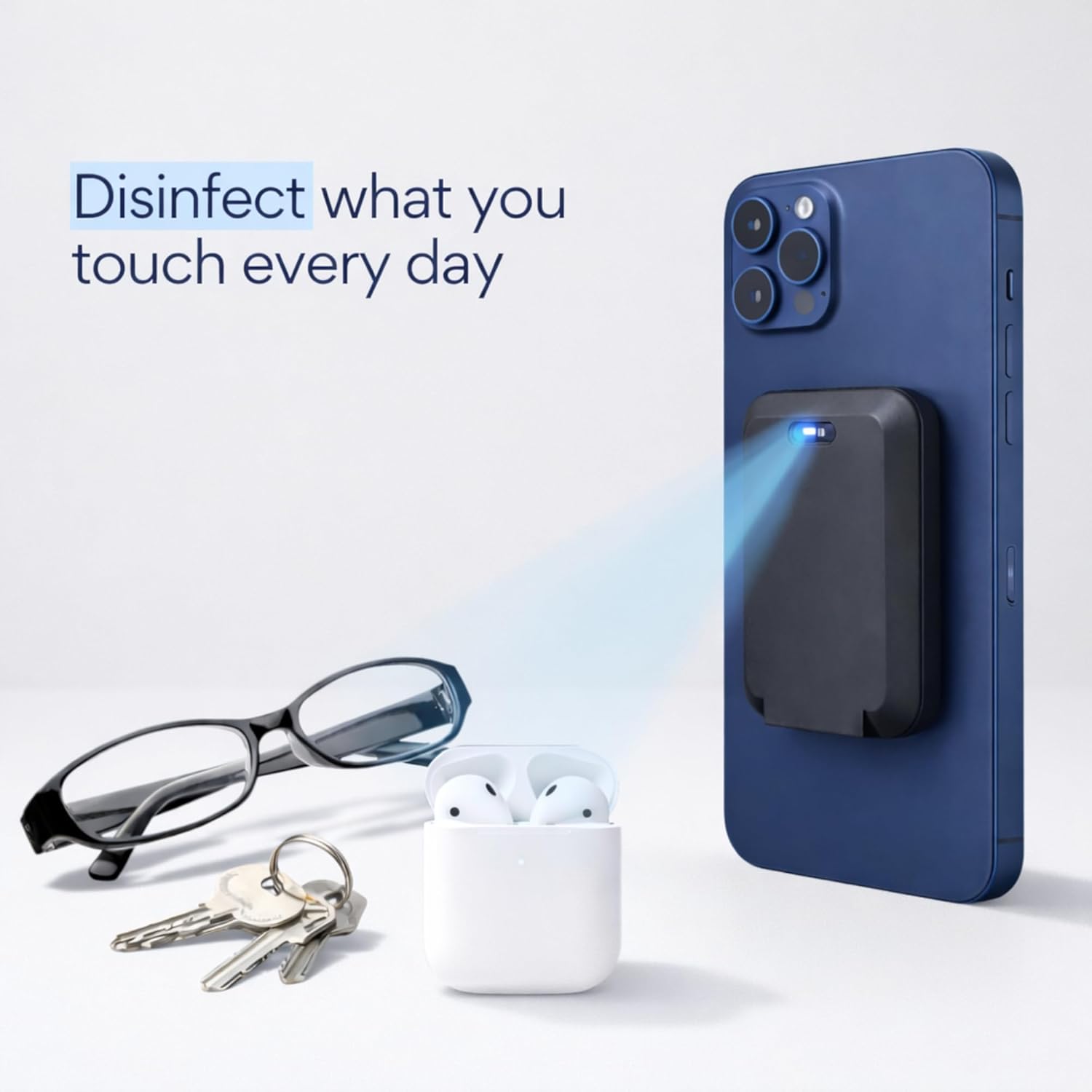
Price: ~$149.95
UVCeed is the most technically advanced portable UVC device available to consumers. It was invented by Dr. Peter Bonutti — a practicing surgeon and founder of a medical device incubator with over 400 patents — and it solves the biggest problem with handheld UVC wands: user error.
The device clips to the back of any smartphone and connects via Bluetooth to a free iOS/Android app. The app uses the phone’s camera and a time-of-flight sensor to map the surface in real time. As you move the device, the app tracks which areas have received a sufficient germicidal dose and which haven’t. You see, live, exactly where you’ve treated and where you haven’t.
This is the only consumer device that accounts for the inverse square law — the principle that UVC intensity drops with the square of the distance. If you’re holding the wand 4 inches from a surface instead of 1 inch, irradiance drops dramatically. UVCeed’s software compensates dynamically, adjusting the required exposure time based on distance.
Lab-tested results (independent testing):
- Staphylococcus aureus: 99.9% reduction in 15 seconds
- E. coli: 99.99% reduction in 24 seconds
- SARS-CoV-2: 99.9% reduction in 32 seconds
- Tested at 12.7 cm on hard non-porous surfaces
The device also includes machine-vision safety technology that automatically pauses the UV light if the camera detects a person or pet in the treatment area. Unlike every other wand on the market, you don’t have to manually cut power if your hand slips.
UVCeed is particularly effective on the surfaces that spray bottles physically can’t reach: keyboard keys, USB ports, phone charging ports, laptop vents, and the crevices around buttons on remote controls. Published research in PMC (National Center for Biotechnology Information) has validated both the efficacy and the AI-guided dosing approach.
Best for: Keyboards, phones, shared office surfaces, travel, hotel rooms
2. Munchkin 59S Mini Portable UV Sterilizer Plus — Best Enclosed Box
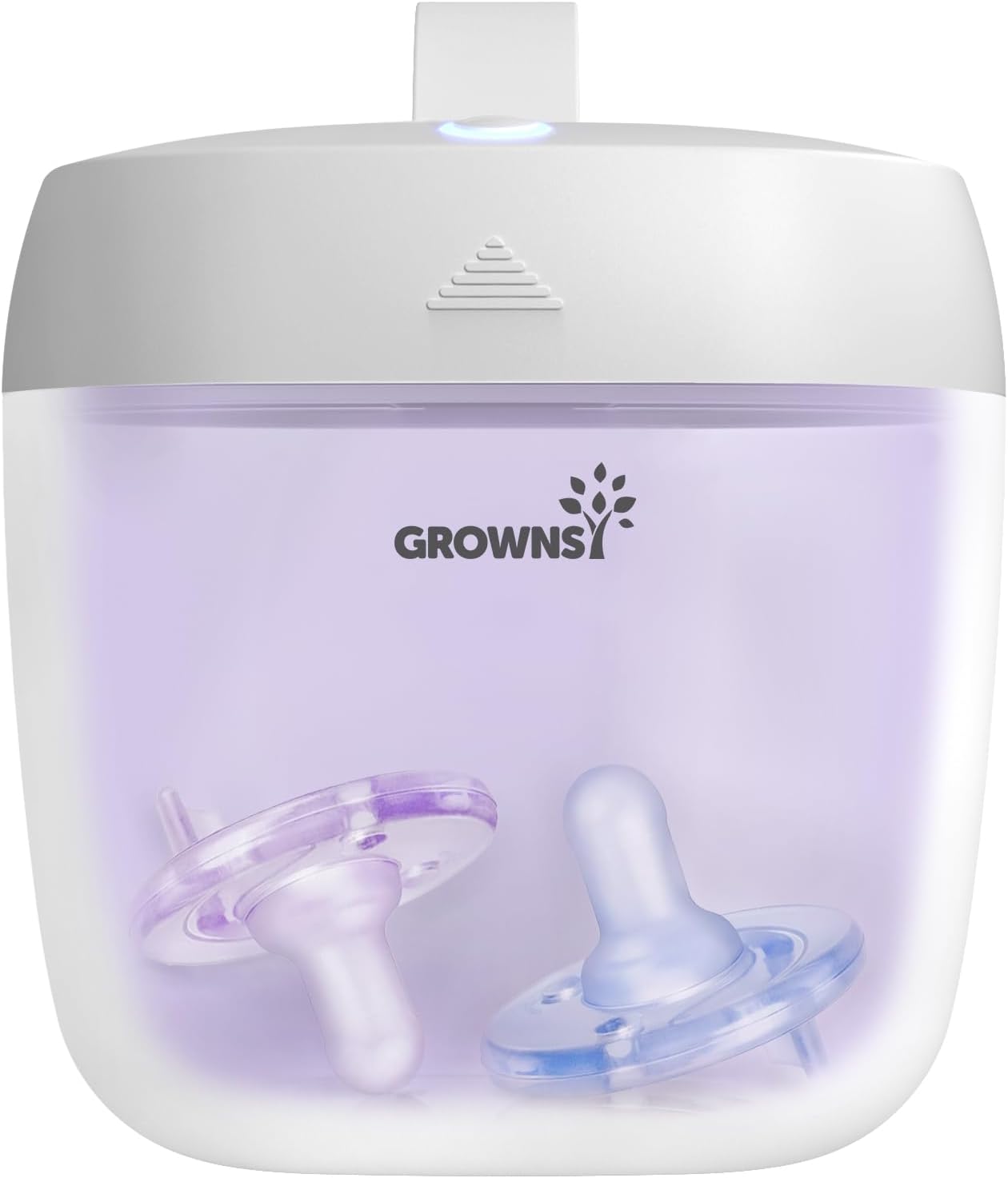
Price: ~$22–$30
The Munchkin 59S Mini is a collaboration between Munchkin and 59S — the latter being a specialized UV LED manufacturer. It’s primarily designed for baby items: pacifiers, bottle nipples, teethers, and small accessories. But its design principles make it one of the most reliable enclosed sanitizers at any price point.
The unit runs a 59-second cycle. Inside, four gold-plated hospital-grade UV-C LEDs illuminate a highly reflective chamber, delivering 360-degree coverage. Because the item sits in a fixed enclosed space, there’s no user error around distance or movement — the light reaches every surface at an optimal angle.
Verified pathogen coverage (independent lab testing):
- Staphylococcus (Staph)
- E. coli
- RSV
- Salmonella
- Klebsiella (Kleb)
- Influenza (seasonal flu)
- Human Coronavirus, Strain 229E
The 59S Mini Plus version is powered by a rechargeable lithium-ion battery (100+ uses per charge), while the original version runs on 3 AA batteries. Both carry:
- FDA Registered device status
- EPA Registered Establishment No. 95175-CHN-1
The auto-shutoff kicks in the moment the lid opens — essential for a device this powerful. An included strap clips it to a stroller, diaper bag, or backpack.
One note on surface materials from published research (Oxford Academic, Journal of Applied Microbiology): non-porous surfaces like glass and stainless steel reach near-zero bacterial counts in the 59-second window. Plastics like polypropylene may benefit from a longer exposure cycle — the same study found that plastic required approximately 75 seconds to reach the same threshold as steel or glass.
Best for: Pacifiers, teethers, bottle nipples, small baby items, travel accessories, keys, jewelry
3. PhoneSoap ExpressPro — Clinical-Grade Standard
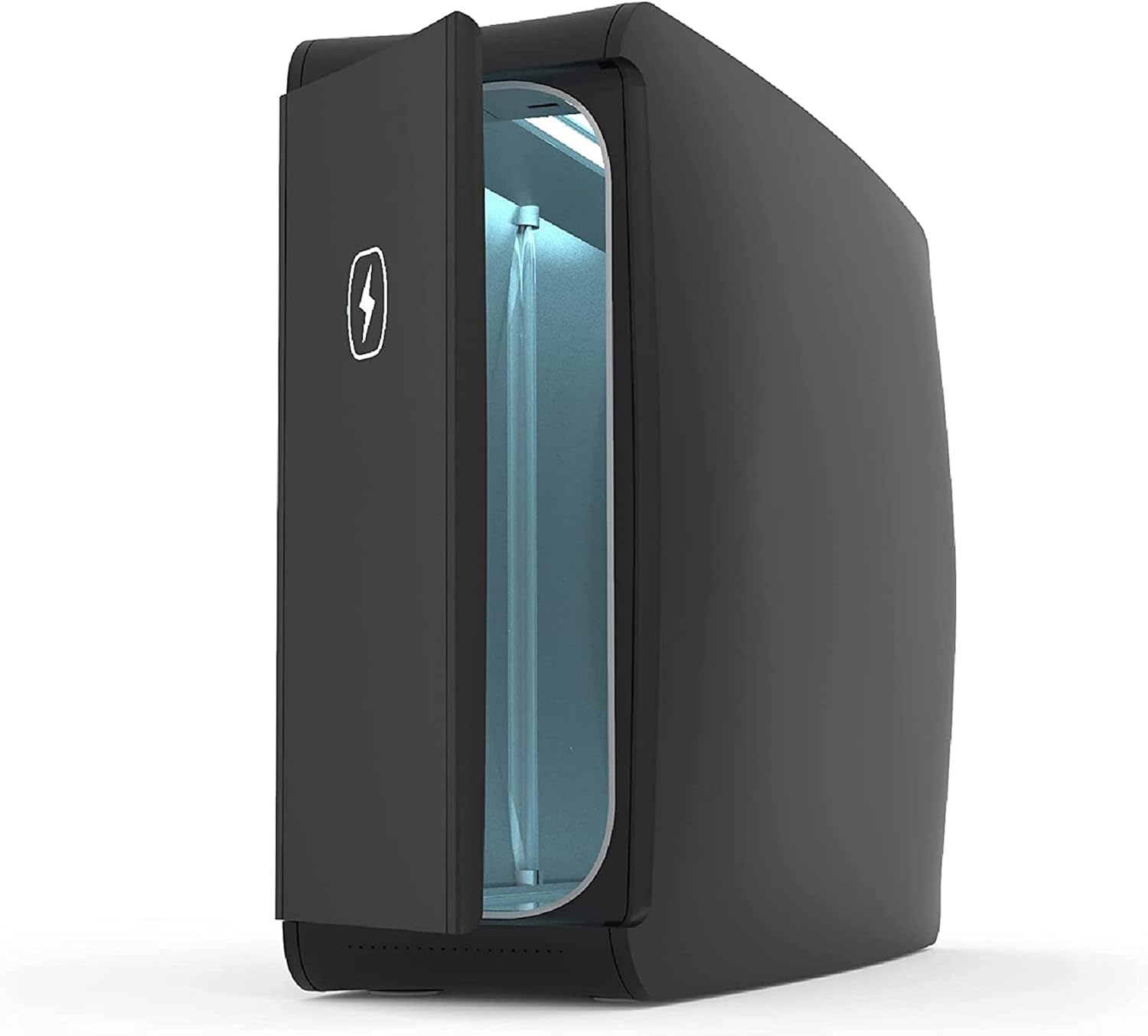
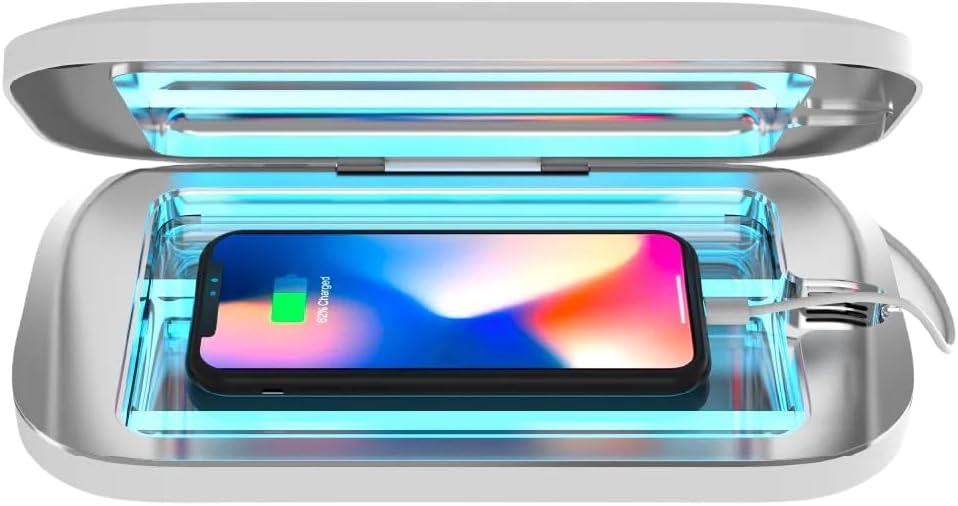
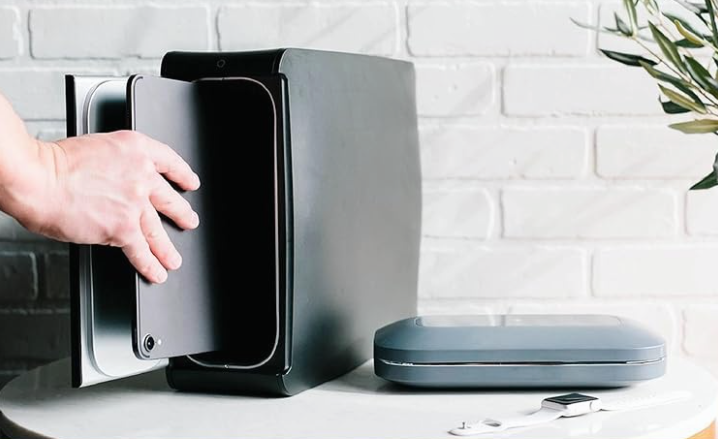
The ExpressPro is not a consumer product. It’s a commercial-grade disinfection station deployed in hospitals, nursing homes, and clinical workplaces. It’s included here because it represents the ceiling of what 60-second UVC technology can actually achieve — and because it was used in clinical validation studies at Brigham & Women’s Hospital, where it significantly reduced bacterial contamination on shared medical tablets between patient encounters.
The unit uses 16 UV-C bulbs in a highly reflective electroplated aluminum chamber. The standard cycle runs 30 seconds — shorter than the Munchkin 59S — but the irradiance is orders of magnitude higher. Disinfection time is adjustable via app from 15 seconds to 10 minutes.
Verified kill rates:
- 99.999% (5-log) reduction against MRSA per ASTM E3135 standard, which includes simulated soiling conditions
- 99.99% against C. difficile, SARS-CoV-2, and Coronavirus 229E
- Touchless operation via motion sensor — no buttons, no manual activation
The Infinity Bulb Technology PhoneSoap uses is rated for 25,000 hours — approximately 750,000 disinfection cycles, or about 7 years of 100 cycles per day.
At $1,500, it’s beyond the range of most households. But for small businesses, clinics, dental offices, or shared workplace environments where cross-contamination is a genuine liability, the cost per cycle — spread over 750,000 uses — is essentially negligible.
Why Cheap UV Wands Fail
The most important fact about the budget UV wand market: many of them don’t emit UVC light at all.
A common manufacturer tactic is to use UVA LEDs (395–405 nm) instead of UVC (254–280 nm). UVA is the wavelength used in nail curing lamps and blacklights. It’s cheap to manufacture, it glows purple (which looks impressive), and it does essentially nothing to bacteria and viruses.
The NIH-cited study referenced above tested two top-reviewed budget wands against E. coli:

Wand #1 actually got worse at 60 seconds compared to 30 seconds — consistent with thermal instability of underspec LEDs, not a measurement error. In no scenario did either device approach the advertised claim.
A Quantadose test card or a handheld UVC spectrometer will confirm whether a device is actually emitting germicidal radiation. Reddit users who’ve tested budget wands with spectrometers have repeatedly found zero UVC output.
Red flags when buying:
- No EPA Establishment Number listed
- No third-party lab test results (not “lab tested” claims — actual results with CFU counts)
- No wavelength listed, or only states “UV light” without specifying UVC
- Purple/violet glow (UVA) instead of the near-invisible UVC output
- Claims of 99.9% in 10 seconds without test data
The Shadowing Problem — Why You Still Need to Pre-Clean
UVC is not magic. Photons travel in straight lines. If a bacterium is covered by a dust particle, a dried food residue, or any organic matter, the light won’t reach it.
This is why professional UVC protocols always begin with a visual clean: wipe away visible debris first, then apply UVC. The same applies at home. On a sticky countertop or a phone with smudges, the physical barrier blocks germicidal exposure.
For enclosed box devices like the 59S Mini, the reflective interior helps bounce photons into some crevices. For open-surface devices, moving the light at multiple angles reduces shadowing risk significantly. UVCeed’s AR guidance is specifically designed to detect and alert you to areas that may have been missed.
UVC vs. Chemical Wipes: The Real Comparison
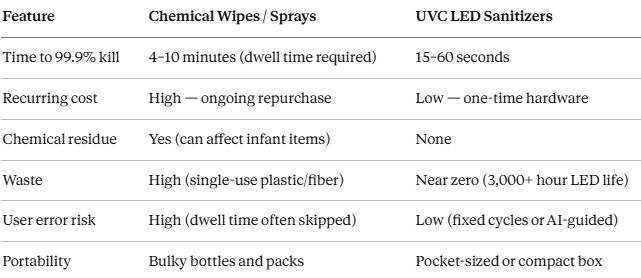
The math on cost per use is striking. The Munchkin 59S Mini (rechargeable) delivers 100+ cycles per charge. The UVCeed’s LED is rated for thousands of hours of operation. Once purchased, the marginal cost per disinfection cycle drops to fractions of a cent.
Disinfectant wipes require surface contact for 4–10 minutes to hit their advertised kill rates. Most people wipe and move on within 15 seconds. In practice, chemical wipes are primarily removing visible dirt — not killing pathogens.
Final Verdict
For most households: The Munchkin 59S Mini Plus is the easiest, most reliable choice for small personal items. The enclosed chamber, FDA registration, and verified pathogen data make it the safest entry point into UVC disinfection.
For surfaces, travel, and tech: The UVCeed is the right call. Its AI-guided dosing eliminates the guesswork that makes most wands ineffective. The independent lab validation covers the pathogens that matter most — MRSA, E. coli, and coronavirus strains.
For professional environments: The PhoneSoap ExpressPro is the standard. It’s not for everyone, but if shared devices in a workplace or clinical setting need 30-second turnaround and verified 5-log kill rates, nothing else comes close.
Stay away from unbranded wands priced under $50 that don’t list an EPA Establishment Number or provide independent lab data with actual CFU counts. The advertised claims are real — but only on devices built to back them up.
Dora Decora is a biophilic interior design specialist and passionate blogger. With a deep commitment to integrating nature into living spaces, Dora specializes in creating environments that foster human-nature connections through thoughtful design elements. Her approach emphasizes sustainable materials, natural lighting, and organic patterns that enhance wellbeing and reduce environmental impact.
This post (https://homechroma.com/best-uvc-light-sanitizer) was originally published by Dora Decora on Home Chroma. As an Amazon Associates partner, we are compensated for all qualifying purchases.