The playroom floor is covered in Legos again.
You just cleaned it three hours ago.
Your kid has no idea how any of this landed here — or so they claim.
Here’s the truth: the problem isn’t your child. It’s the storage system. Specifically, it’s the kind of storage that makes cleanup harder than it needs to be for a 4-year-old.
The right bins don’t just hold toys. They make putting toys away so simple that your kid does it on their own — no reminding, no negotiating, no bribing with screen time.
And you can set the whole thing up for under $45.
Why Your Current Setup Isn’t Working
Most parents start with a toy chest. It’s big. It holds everything. Problem solved.
Except it isn’t.
A toy chest is a black hole. Everything goes in. Nothing comes back out organized. Kids dump the entire thing to find one missing puzzle piece — and then walk away.
The issue is visibility and effort. If a child can’t see where something goes, they won’t put it there. If cleanup requires more than one physical move — open lid, lift, search, deposit — it’s already too hard for a toddler to do consistently.
The fix is simple: open-face bins at eye level. One motion. Drop and done.
The One-Step Rule (And Why It Changes Everything)
Child development research consistently shows that kids are far more likely to complete a task when it requires a single action. The more steps involved, the less likely they finish.
Traditional storage = multiple steps = mess stays on the floor.
Open bin organizers = one step = toy goes home.
For this to work, the unit also needs to sit at the right height. The sweet spot for toddlers aged 3–5 is between 28 and 33 inches tall. Any taller, and they can’t see into the top row — which means they’ll dump the bin instead of sorting through it.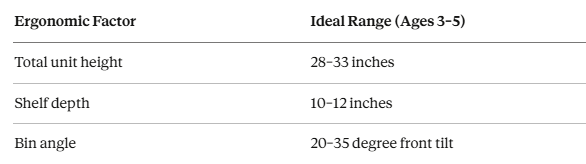
The 6 Best Toy Organizer Bins Under $45
1. Humble Crew 9-Bin or 12-Bin Organizer
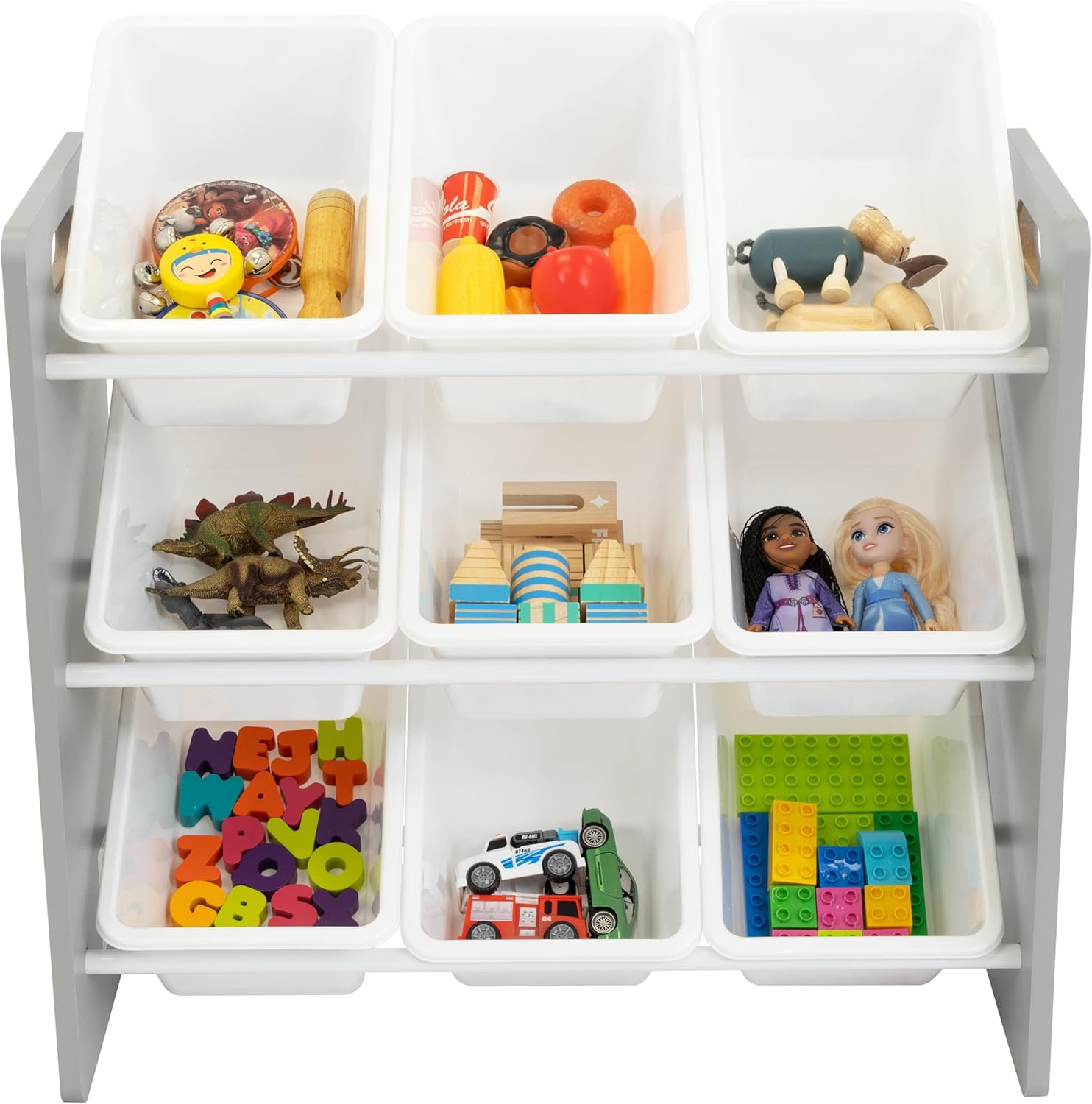
Best for: General toy storage, everyday use
This is the workhorse of budget toy storage. The frame is engineered MDF reinforced with steel dowels — not cheap plastic pegs that snap after three months of use. The bins are BPA-free polypropylene, dishwasher-safe, and impact-resistant.
Key specs:
- Height: ~31 inches (toddler-accessible top row)
- Stabilizer base: extends to 16 inches deep for anti-tip stability
- Bin capacity: 9 or 12 individual compartments
- Assembly tip: Use a power drill, not hand-tightening — it dramatically reduces wobble
The open-face design means kids can see every bin from across the room. Combined with picture labels (more on that below), cleanup becomes a matching game.
Wall anchor required for any unit over 24 inches — this one included.
2. Delta Children 6-Bin Design and Store Organizer
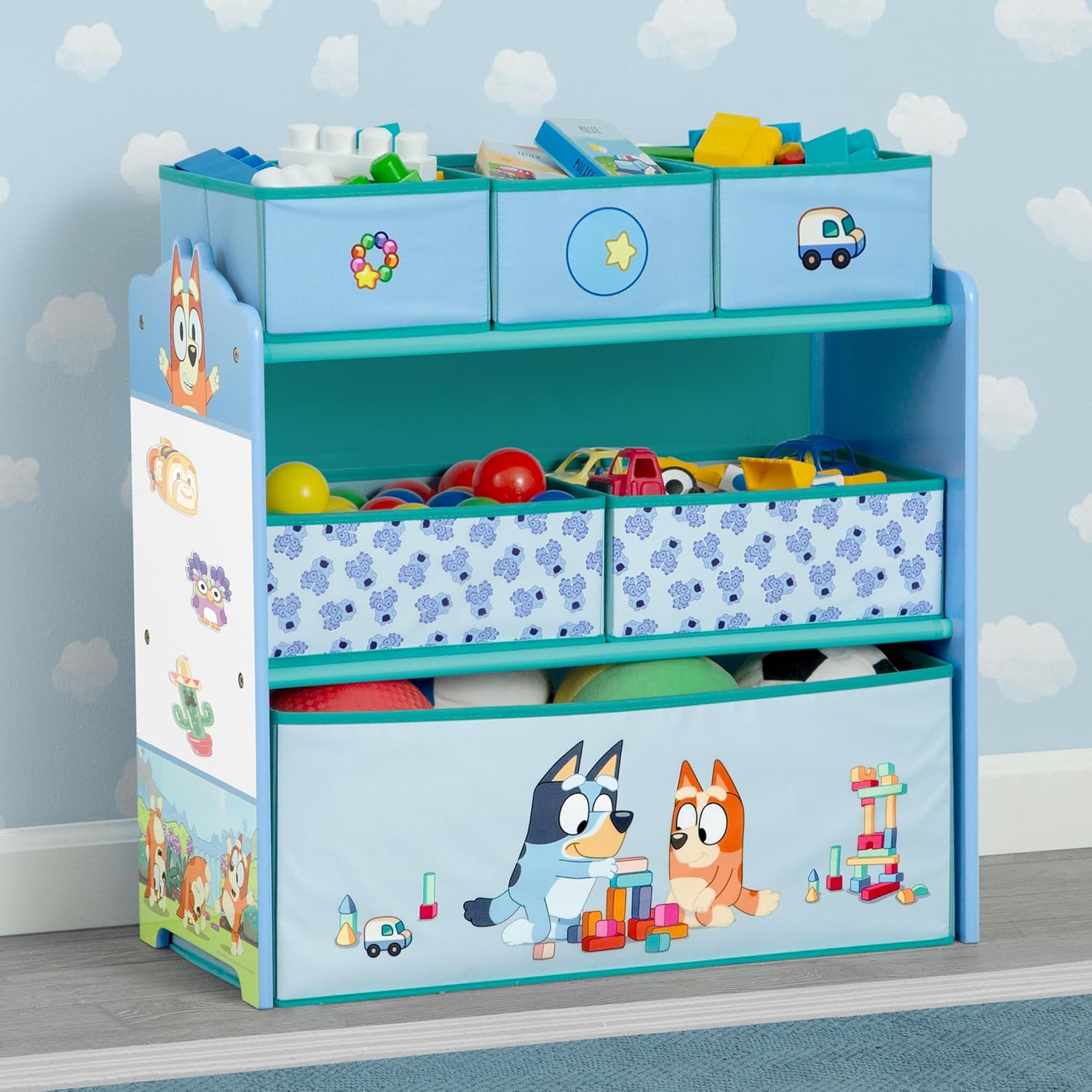
Best for: Toddlers, themed playrooms, Greenguard-certified safety
Delta Children builds their organizers with solid wood (not MDF) and fabric bins. That means two things: quieter cleanup (no plastic clatter) and lighter weight for rooms that double as living spaces.
What sets this apart: Greenguard Gold Certification. The furniture has been tested against over 10,000 chemicals and meets strict indoor air quality standards. For a room where young kids spend hours on the floor, this matters.
The character-themed versions come with reusable vinyl cling stickers. Kids decorate the organizer themselves — and research shows children consistently maintain spaces they feel ownership over. Suddenly tidying isn’t a chore. It’s taking care of their stuff.
3. Creative QT SlideAway Toy Storage Basket and Play Mat
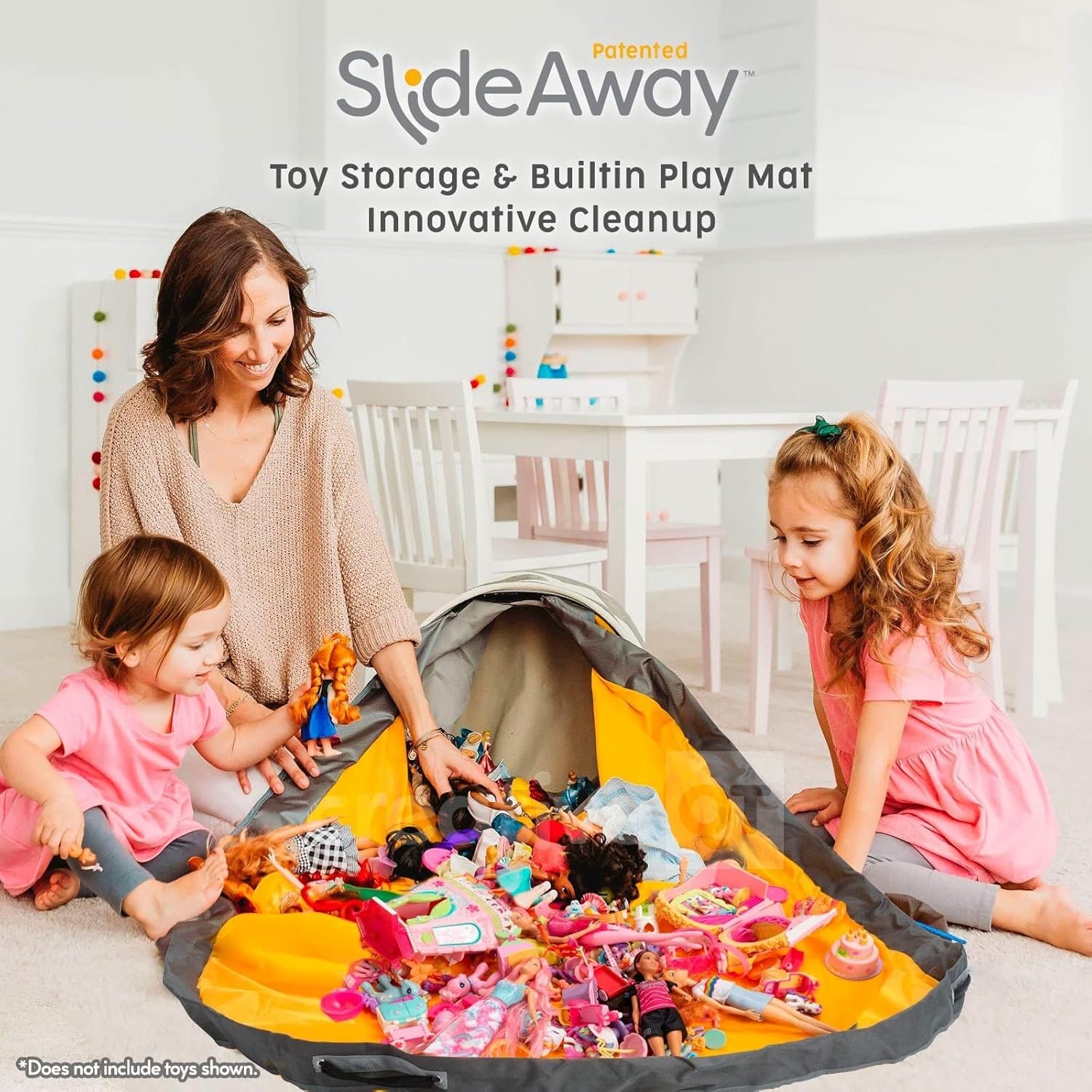
Best for: Legos, building bricks, small parts
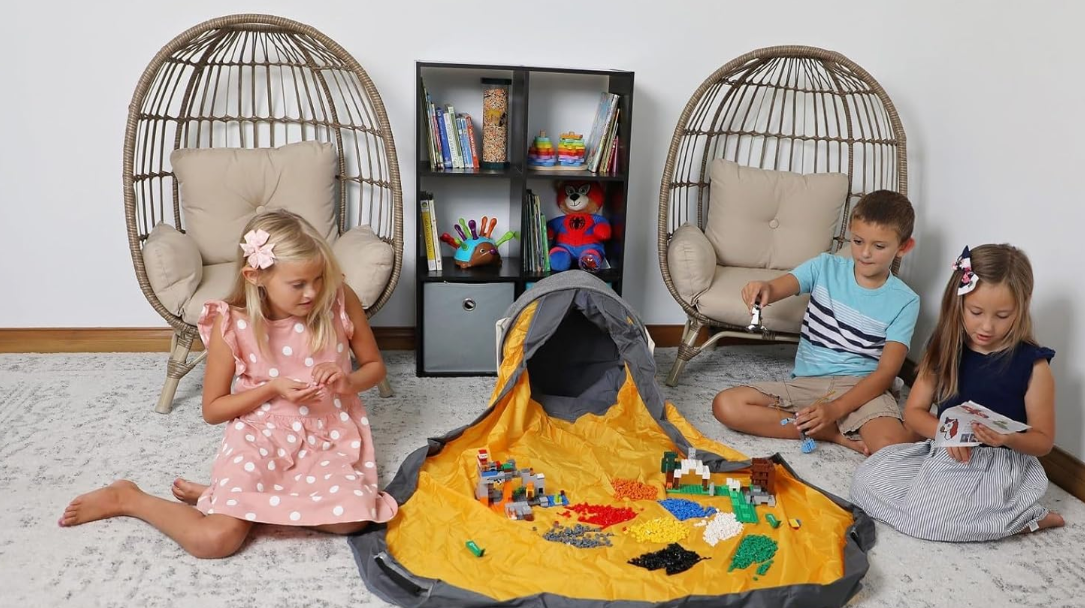
This is the one product that solves the Lego problem.
The SlideAway is a 52-inch circular nylon play mat attached to the rim of a fabric storage basket. Pull the mat out, dump the bricks on it, build. When play ends, lift the mat by its handles — gravity funnels every single piece back into the basket in about 5 seconds.
No picking up pieces one by one. No pieces hiding under the couch.
Key specs:
- Mat diameter: 52 inches (fits 2–3 kids playing simultaneously)
- Lip height: 3 inches (prevents rolling/scatter)
- Storage capacity: up to 9 lbs
- Material: heavy-duty nylon
For families with large Lego collections, this replaces 20 minutes of cleanup with a single lift.
4. Lumikrypt 6-Pack Clear Toy Storage Bags
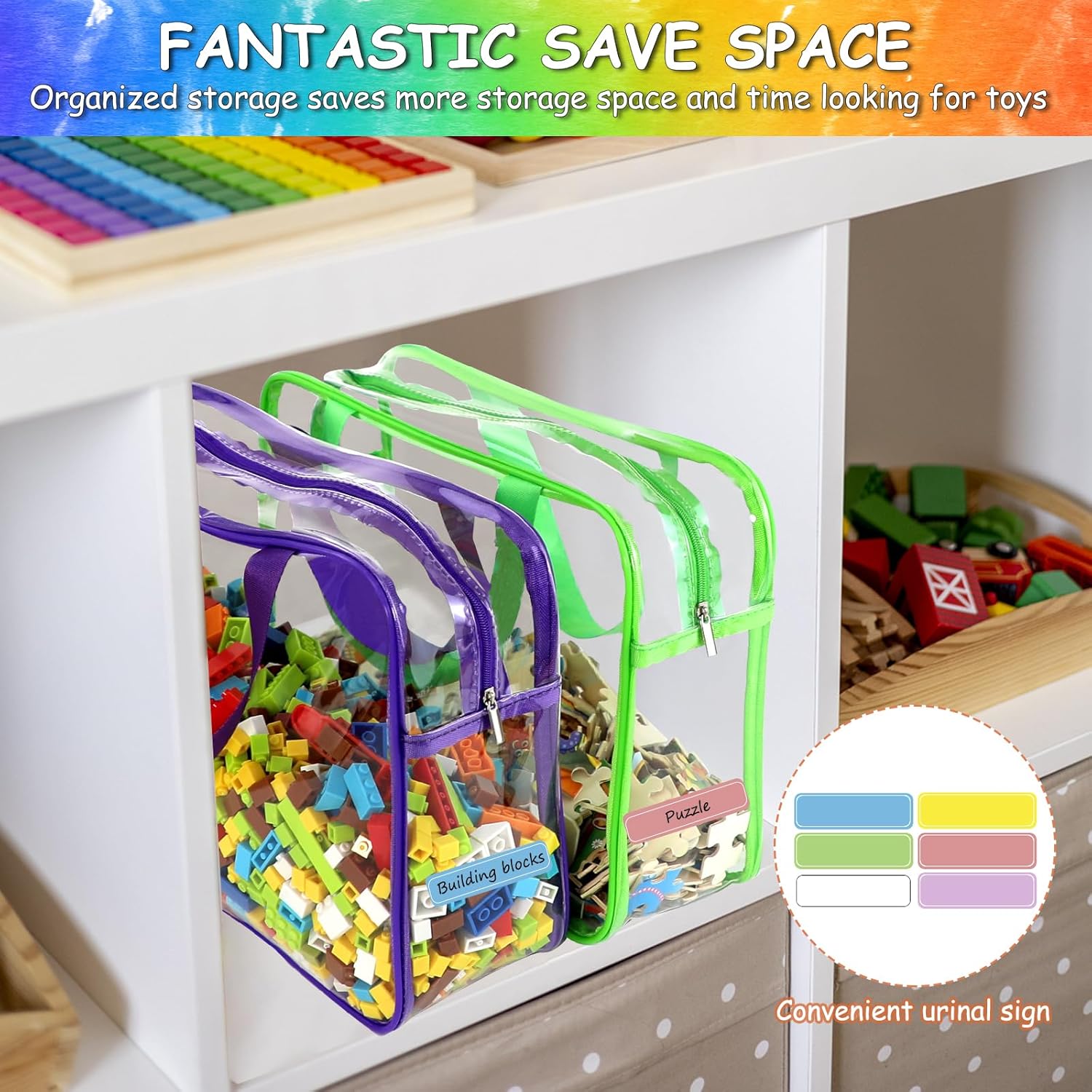
Best for: Board games, puzzles, card games
The original cardboard boxes for board games and puzzles are almost always the first thing that breaks — and the worst thing to store. They tear, lose their lids, and take up three times the shelf space of the actual game.
The Lumikrypt bags are heavy-duty, waterproof PVC with a zipper closure and a name-tag window on the front. Transfer the contents of a bulky game box into one of these bags and you cut the storage footprint by up to 70%.
Six bags per pack. Fully transparent. Kids can see exactly which game is which at a glance.
5. Stuffed Animal Zoo (Aichozo or LazySpin)
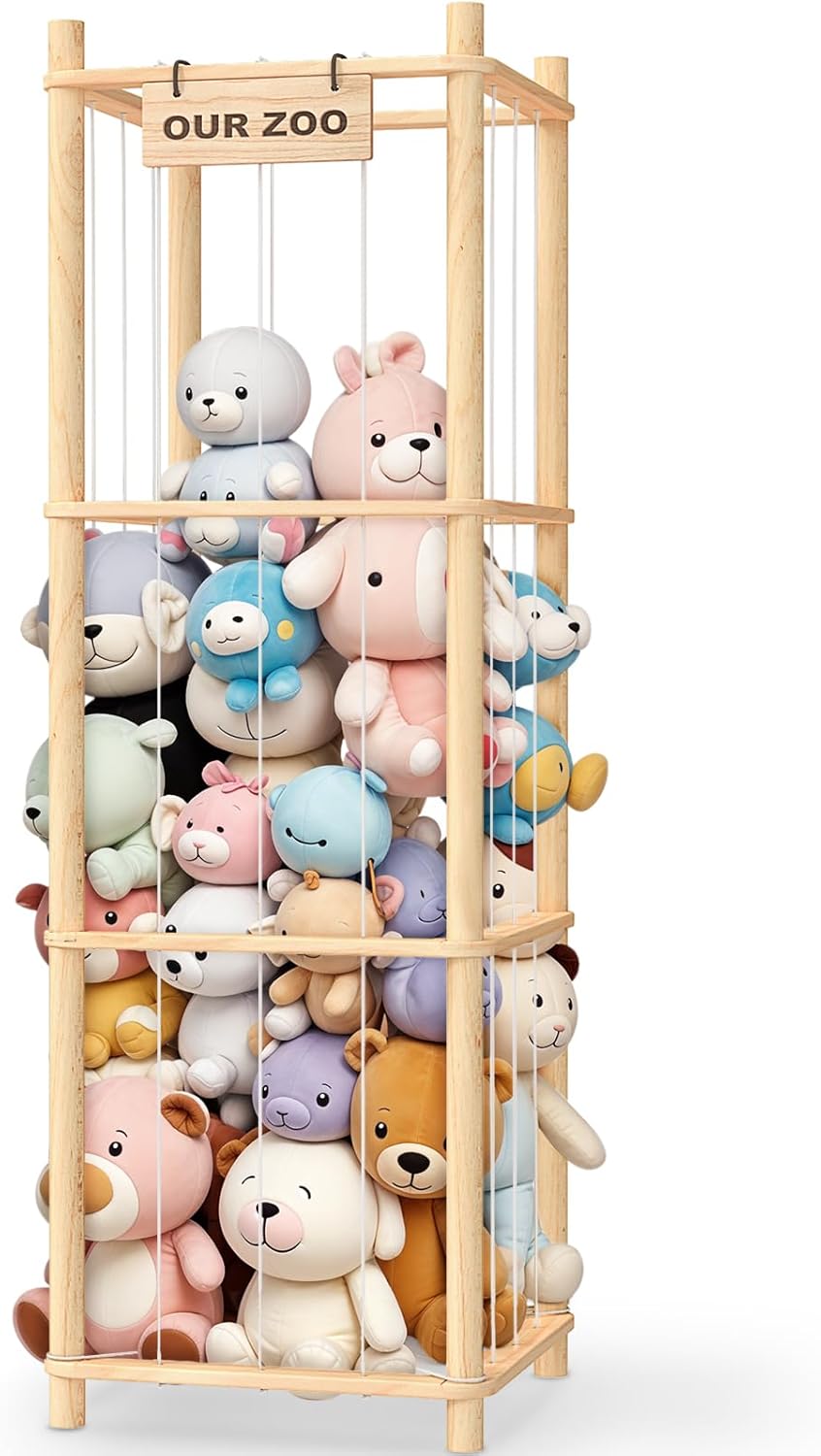
Best for: Plush toys, stuffed animals
Stuffed animals are the hardest category to store well. They can’t be stacked. They take up enormous volume. And when piled into a bin, the favorite bear is always at the bottom.
The Stuffed Animal Zoo solves this with elastic cord “bars” that hold plushies upright in a vertical cage. Every animal is visible. Any animal can be pulled out from any position — top, middle, or bottom — without disturbing the others. No dumping required.
- Holds up to 200 stuffed animals
- Material: flame-retardant PVC (critical for nurseries)
- Includes anti-tip mounting hardware (non-negotiable for tall, narrow units)
- Priced under $45 for most configurations
The “zoo” framing turns bedtime tidying into a game: “Time to put the animals in their cages.”
6. Amazon Basics 6-Cube Wire Grid Shelves
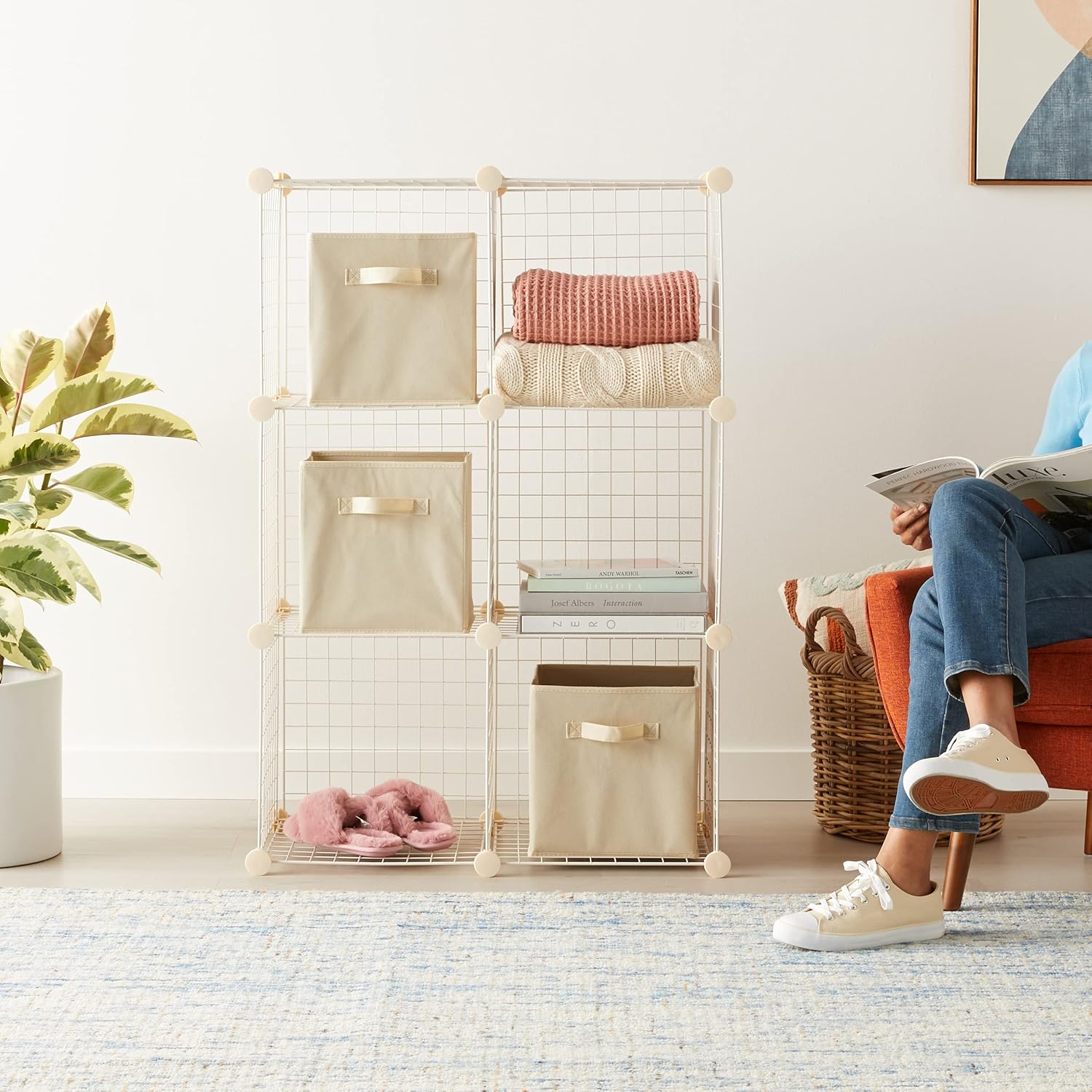
Best for: Older kids, modular/flexible storage needs
If your storage needs keep changing as your kids grow, a modular wire grid system offers flexibility the other units don’t.
These 14″x14″ powder-coated steel panels snap together with plastic corner connectors. Build it wide for a toddler room. Rebuild it tall when floor space gets tight. Add zip-ties at the connectors for extra rigidity.
Pair with collapsible fabric storage cubes that fit the 14-inch frame exactly — and give small hands a built-in handle to pull.
- Weight limit: 10 lbs per cube
- Material: alloy steel (durable in high-humidity rooms)
- Total weight: 11.4–15.9 lbs (light enough to reposition for cleaning)
How to Make Any System Last
The bins are the hardware. These strategies are the software. You need both.
Toy Rotation
Too many toys out at once leads to shorter play sessions and bigger messes. Professional organizers recommend running two inventories:
- Active inventory — what fits in the bins, nothing more
- Backup inventory — stored in large, clear latching totes in a closet or garage
Every 30 days, swap 50% of the active toys with backup items. The “old” toys feel new again. Kids engage longer. Mess shrinks.
Picture Labels
Text labels don’t work for kids who can’t read yet. Take a photo of the toys that belong in each bin and tape it to the front. A picture of dinosaurs on a bin means the triceratops always has a home — no guessing, no friction, no “where does this go?”
The Natural Break Strategy
Cleanup works best when it’s tied to something the child already wants:
- Give a 5-minute warning before cleanup time — kids resist less when they can reach a stopping point
- Frame cleanup as the prerequisite for the next good thing: “As soon as the cars are parked, we can go eat lunch”
- Be consistent — if cleanup only happens 50% of the time, kids will test the other 50%
A consistent daily routine eliminates the need to ask at all. Within a few weeks, toys put themselves away.
Safety Checklist Before You Set Up
- [ ] Wall anchor any unit over 24 inches tall — secure to a wall stud, not just drywall
- [ ] Store heavy items on the bottom row — books, wooden blocks, and metal cars lower the center of gravity
- [ ] Check for Greenguard Gold Certification on units used in rooms where kids sleep or spend extended time
- [ ] Install anti-tip hardware on tall, narrow units like stuffed animal zoos
- [ ] Verify BPA-free and phthalate-free plastics on any bin young kids will handle regularly
The Bottom Line
A clean playroom that stays clean isn’t about discipline or constant reminding. It’s about designing a system that works with how kids actually think and move.
Open bins. Eye-level access. One motion to put things away.
Add picture labels, a rotation schedule, and one or two problem-specific solutions — the SlideAway for Legos, the Zoo for plushies — and the playroom runs itself.
Every product on this list lands under $45 and ships to your door. Pick the ones that match your biggest pain points and set them up this weekend.
Your feet will thank you the first time you walk across the playroom in the dark.
Dora Decora is a biophilic interior design specialist and passionate blogger. With a deep commitment to integrating nature into living spaces, Dora specializes in creating environments that foster human-nature connections through thoughtful design elements. Her approach emphasizes sustainable materials, natural lighting, and organic patterns that enhance wellbeing and reduce environmental impact.
This post (https://homechroma.com/best-toy-organizer-bins) was originally published by Dora Decora on Home Chroma. As an Amazon Associates partner, we are compensated for all qualifying purchases.