He already has the watch. The boots. The jacket that cost more than your rent.
So what do you get him?
Here’s the thing most people miss: a great leather wallet isn’t an accessory. It’s a daily tool — one that gets handled hundreds of times a year, jammed into pockets, sat on, and sweated through. The wrong one looks great on day one and falls apart by year two. The right one gets better every year, developing a patina that tells a story only he can write.
The difference comes down to 8 specific, measurable features. Get all 8 right, and you have a wallet that outlasts jobs, relationships, and smartphones. Get them wrong, and it ends up in a drawer by spring.
Why Most Wallets Fail
Walk into any department store and you’ll see shelves of wallets labeled “genuine leather.” That phrase sounds premium. It’s actually the second-lowest grade of leather on the market — just above bonded leather, which is essentially leather dust glued together with plastic.
These wallets fail within 12–24 months. The surface peels. The stitching unravels. There’s no fixing it. The material itself has reached its end.
The wallets that last a decade — or a lifetime — share a specific set of construction principles. Here’s exactly what to look for.
The 8 Features That Define a 10-Year Wallet
Feature 1: Full-Grain Leather — The Only Grade That Matters
Leather has four grades. Only one holds up for a decade.
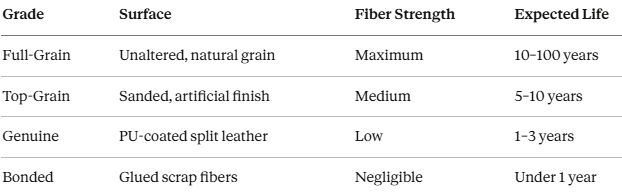
Full-grain leather uses the outermost layer of the hide — the part the animal evolved to protect itself with. It’s never sanded or buffed. The natural grain stays intact, along with the densely interwoven collagen fibers that give it its strength.
These fibers compress and stretch without separating. The leather breathes through micro-pores, staying supple for decades. And over time, it develops a patina — a natural darkening and polishing that makes each wallet completely unique to its owner.
That’s not a cosmetic feature. The patina is a protective layer that builds up through use.
Feature 2: Vegetable Tanning — The Old Way Still Works Best
Raw hide rots. Tanning stabilizes it. But how it’s tanned determines whether it ages well or just ages.
Vegetable tanning uses natural tannins from tree bark — oak, chestnut, mimosa. The process takes anywhere from several weeks to several months. The result is a leather that starts firm, develops a memory for its owner’s habits, and builds that signature patina over time. It’s also biodegradable and non-toxic.
Chrome tanning takes 24–48 hours using chromium sulfate. It produces soft, pliable leather that holds vibrant dyes. But it doesn’t develop a patina. Over time, it fades and loses shape rather than gaining character. It also leaves a significant environmental footprint.
For a wallet meant to last 10+ years, vegetable-tanned full-grain leather is the only combination worth considering.
Feature 3: Saddle Stitching — The Stitch That Doesn’t Unravel
Most wallets are sewn by machine using a lockstitch. Two threads — one on each side — interlock in the middle of the leather. If either thread breaks (and in a high-friction pocket environment, it will), the seam can unravel from that point outward.
The saddle stitch works differently. One thread runs through every hole twice, creating two independent rows that cross over each other. If the thread breaks on one side, the other side holds. The seam stays structurally intact.
Top artisan workshops use Ritza 25 Tiger Thread — a braided polyester thread that’s lightly waxed, nearly impossible to break by hand, and resistant to UV degradation and skin oils. This is the thread in wallets that come with 100-year warranties.
Feature 4: Burnished Edges — The Detail That Exposes Cheap Construction
Check the edges of a wallet. Right now. That’s where quality hides.
Cheaper wallets use edge paint — a rubbery coating applied to raw cut leather. It looks clean when new. Within a year or two, it cracks, peels, and strips away in flakes. Once it’s gone, the raw edge starts fraying.
High-quality wallets have burnished edges. The raw edge is sanded smooth, then friction-polished with a hardwood tool and a natural agent like beeswax or gum tragacanth. The heat fuses the leather fibers together into a smooth, glassy finish. There’s nothing to peel because the edge itself is the finish.
If a burnished edge gets scuffed after years of carry, a bit of wax and a cloth brings it back. Edge paint offers no such recovery.
Feature 5: All-Leather Interior — No Fabric, No Shortcuts
Fabric linings — silk, polyester, nylon — feel smooth and look premium. They also have a fraction of the abrasion resistance of leather.
The sharp corners of credit cards will eventually cut through a fabric lining. Once that happens, cards slip behind pockets and get lost inside the wallet’s structure. The wallet is effectively done.
A wallet built for 10 years uses an all-leather interior, or at minimum a pigskin lining. Pigskin is actually tougher than cowhide in tensile strength — it’s a legitimate upgrade, not a downgrade. Saddleback Leather uses pigskin linings specifically because they outlast the exterior.
Plastic ID windows are another weak point. They yellow, scratch, crack, and leach color from cards within a few years. Heritage brands often acknowledge this openly — some offer a 5-year warranty on plastic components versus a 100-year warranty on the leather itself. The best wallets skip the window entirely.
Feature 6: Solid Hardware — Brass and Steel Only
Any wallet with metal closures, snaps, or rivets should use non-ferrous metals. Ferrous metals (those containing iron) corrode in the humid environment of a pocket.
Solid brass and stainless steel don’t rust. They hold their finish even if the plating wears. American Bench Craft, for example, uses solid brass rivets to mechanically bond their wallets — hardware that will outlast the leather itself.
For minimalist designs with magnetic closures, neodymium (rare earth) magnets provide serious clamping force in a small profile. The key is how they’re secured: magnets that are stitched into a reinforced leather pocket stay put for life; magnets that are glued eventually work free.
Feature 7: Front-Pocket Carry Design
The back pocket is the worst environment for a leather wallet. The wallet endures the full weight of the body, compressed between the body and a chair for hours every day. This grinding force crushes the leather, strains the seams, and produces the rounded, frayed corners you see on cheap wallets after a year.
Sitting on a thick wallet also tilts the pelvis. Chronic lower back pain from this posture — sometimes called “wallet sciatica” — is a well-documented phenomenon.
Front-pocket wallets solve both problems. They’re designed thinner, sit in a low-stress pocket, and are significantly more secure against accidental loss or theft. Wallets built for front-pocket carry encourage carrying only essentials, which prevents the overstuffing that permanently deforms leather pockets.
Feature 8: The Warranty as a Quality Signal
A manufacturer’s warranty is the most honest thing on the product page.
A 90-day warranty says the maker expects the product to fail within 90 days. A lifetime warranty — or a 100-year warranty — says the maker is confident the materials and construction will hold.
Brands like Saddleback Leather, Hanks Belts, and Main Street Forge offer 100-year or lifetime warranties. That’s only possible because they use full-grain hides and high-tensile threads that are physically capable of lasting that long. These wallets are built to be passed down.
The 8 Best Men’s Leather Wallets Available Right Now
Based on the 8 features above, here are the wallets that actually hold up.
1. Saddleback Leather Medium Bifold

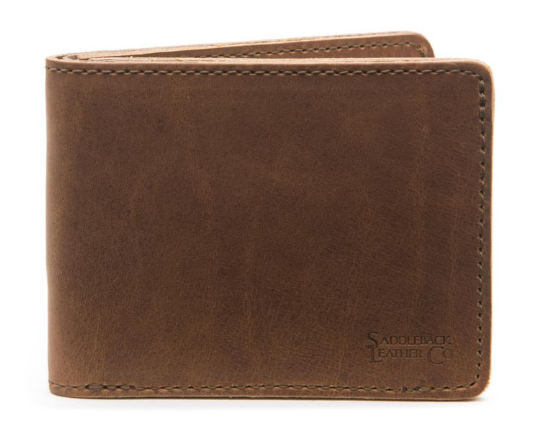
The most over-engineered wallet in production. Full-grain cowhide exterior, pigskin interior, no fabric, no glue, no foam. Marine-grade polyester thread. Backed by a 100-year warranty. Heavy at ~90 grams — it feels like a piece of gear, not an accessory. Requires a break-in period of several months, after which it molds permanently to the owner’s pocket.
Best for: Maximum durability, heirloom carry.
2. Popov Leather Traditional Bifold
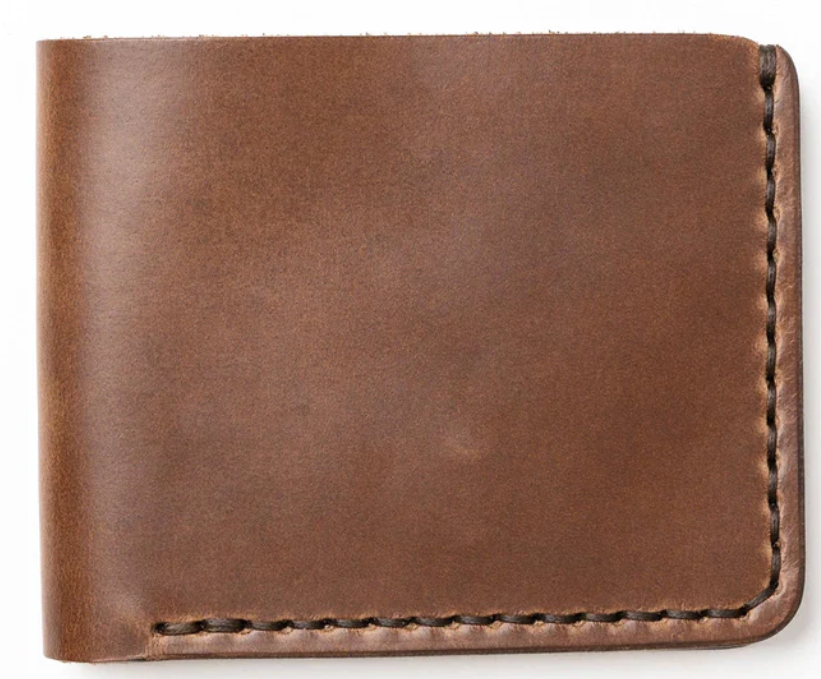
Handmade using Horween Derby full-grain leather from Chicago’s Horween Tannery — one of the most respected tanneries in the world. Hand-sewn with Ritza 25 Tiger Thread in a true saddle stitch. Develops a spectacular patina within the first year. Minimal, raw-edge aesthetic. Lifetime warranty.
Best for: Artisan craftsmanship, the leather purist.
3. Hanks Belts Legend Bifold
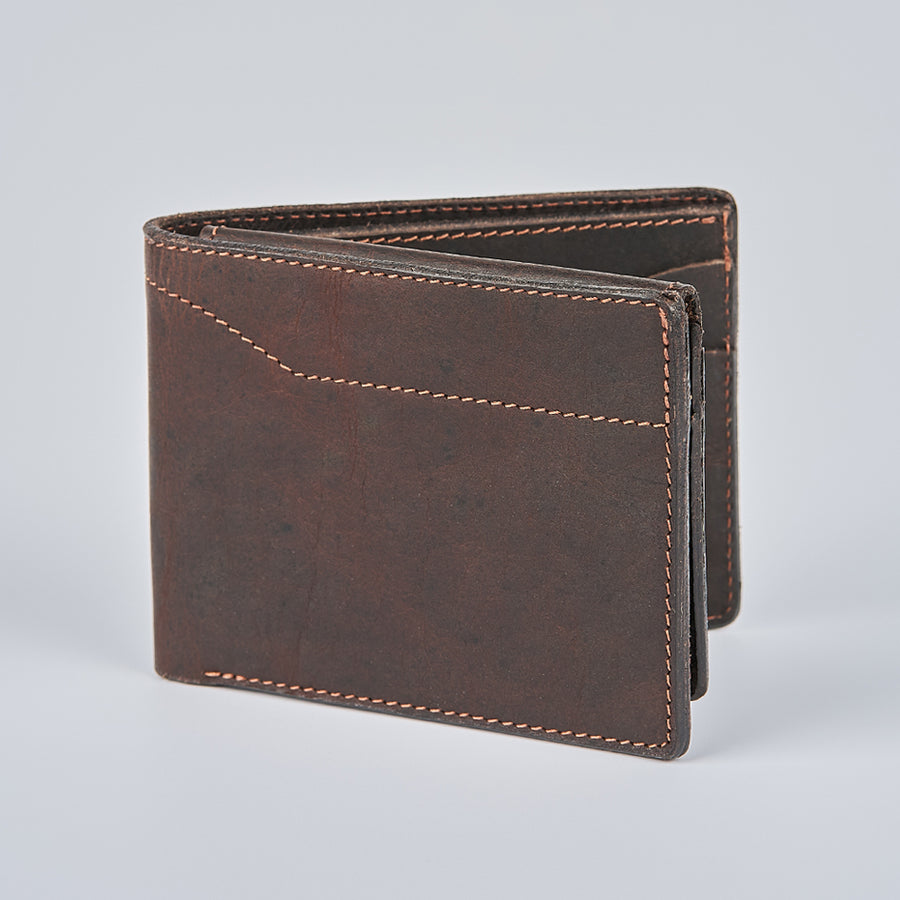
Rooted in Amish leatherworking tradition. Heavy-duty full-grain leather, traditional bifold layout, built for rugged daily carry. 100-year warranty. Officially rated to survive an accidental washing machine cycle.
Best for: Rugged environments, no-nonsense durability.
4. Trayvax Element

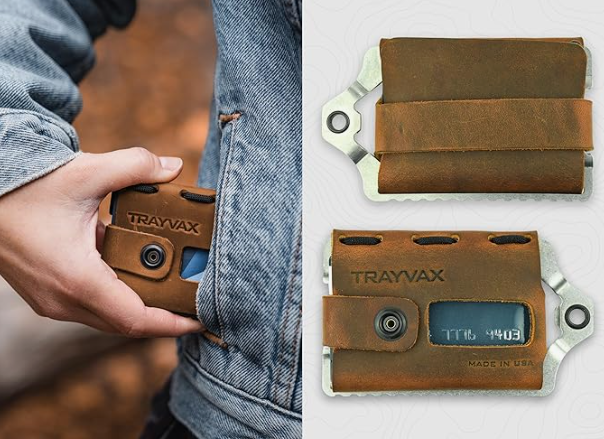
A hybrid: stainless steel frame wrapped in oil-tanned top-grain leather, secured with MIL-SPEC paracord. Includes an integrated bottle opener and a heavy-duty money clip. RFID blocking by virtue of its steel frame. 65-year heirloom warranty.
Best for: The outdoorsman, the EDC enthusiast, anyone who wants a wallet that feels like precision gear.
5. Bosca Old Leather Front Pocket Wallet
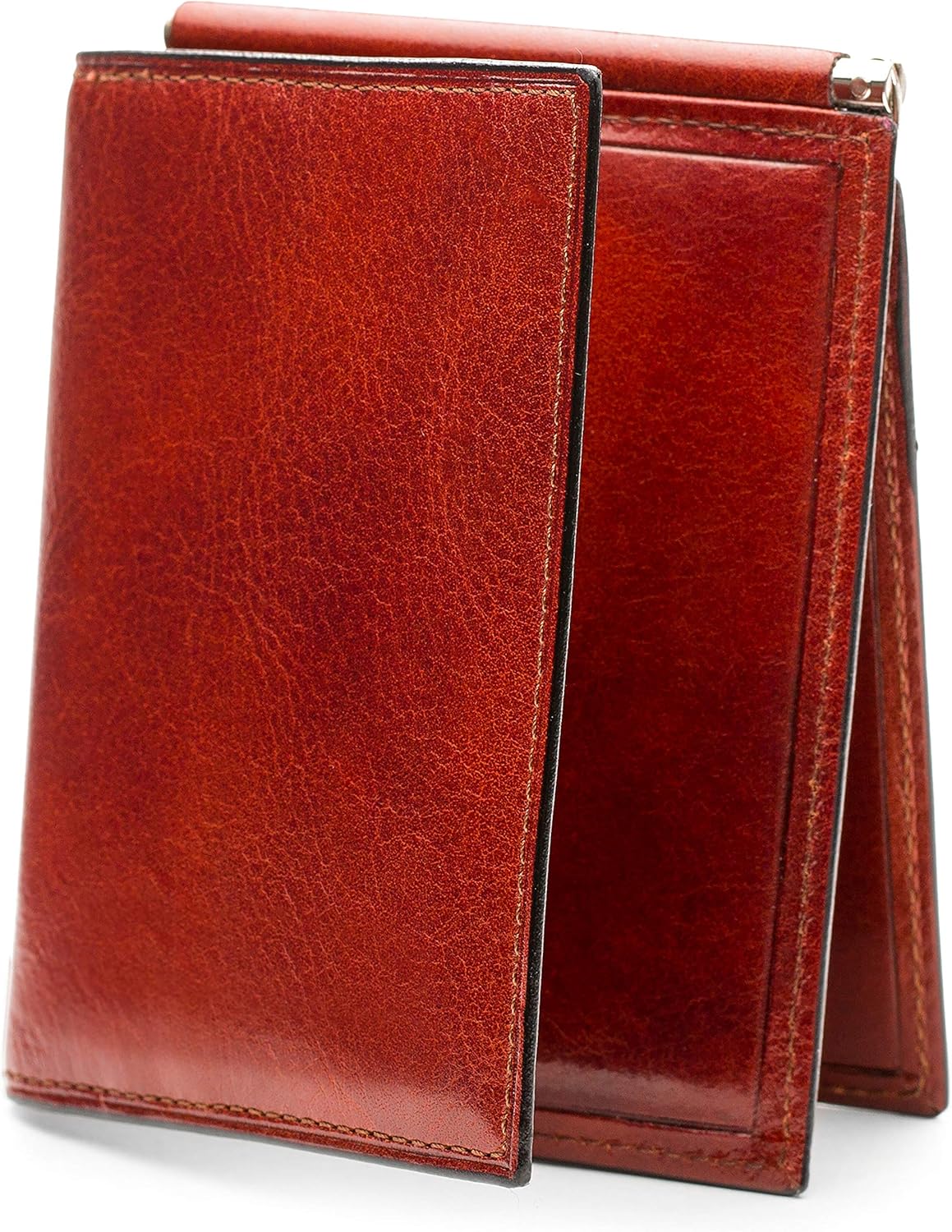
Hand-stained Italian vegetable-tanned leather with a high-gloss finish. Minimalist front-pocket design with a magnetic money clip. Bosca has been producing leather goods since 1911, and their “Old Leather” line is built to stay polished across decades.
Best for: Professional settings, European aesthetic.
6. American Bench Craft Frontier Wallet
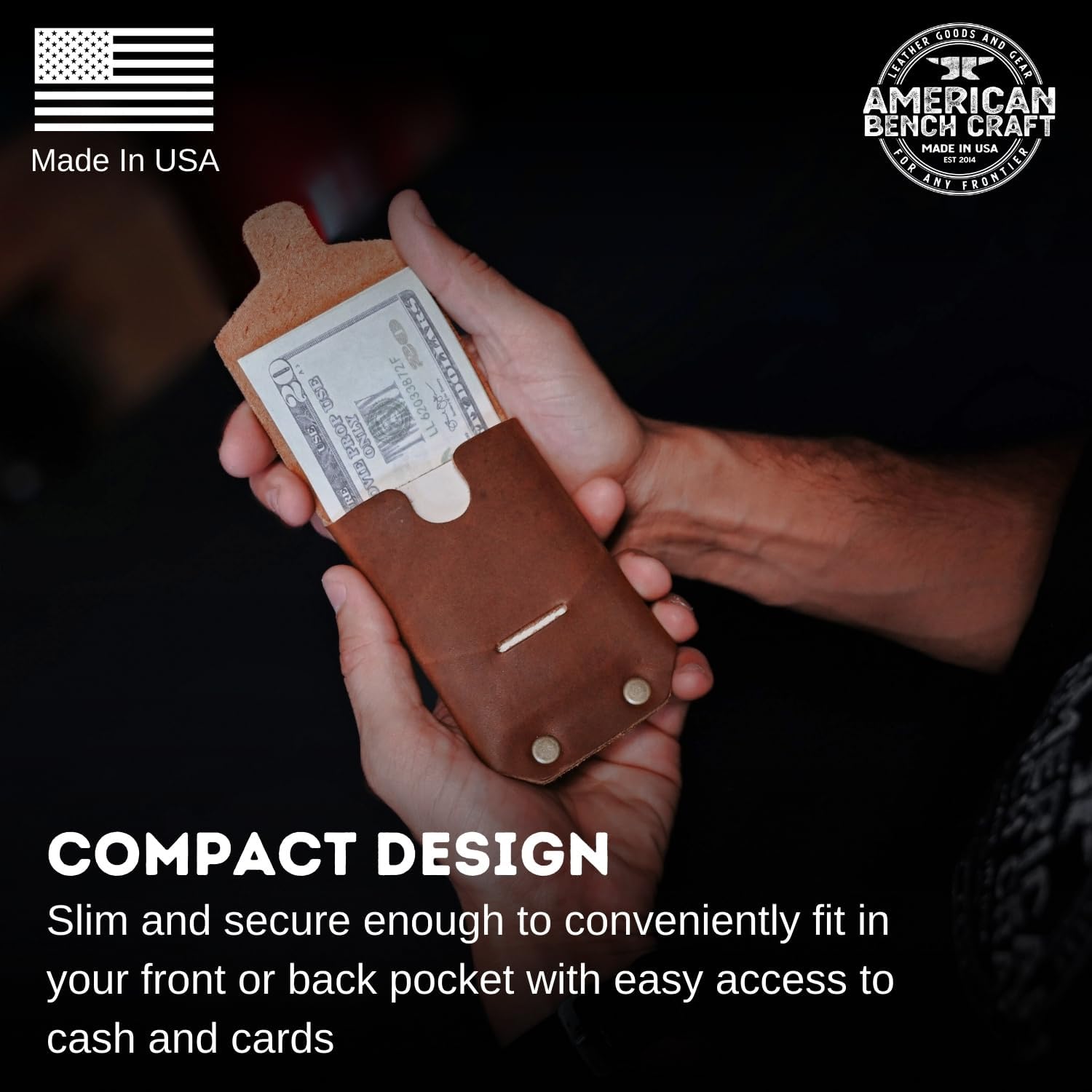
One piece of full-grain, vegetable-tanned leather folded and secured with solid brass or stainless steel rivets. No stitching means no thread to fray or rot. Handmade in the USA. Lifetime warranty.
Best for: Industrial strength, anyone who wants zero points of failure.
7. House of Jack Co. Wyatt Front Pocket Wallet
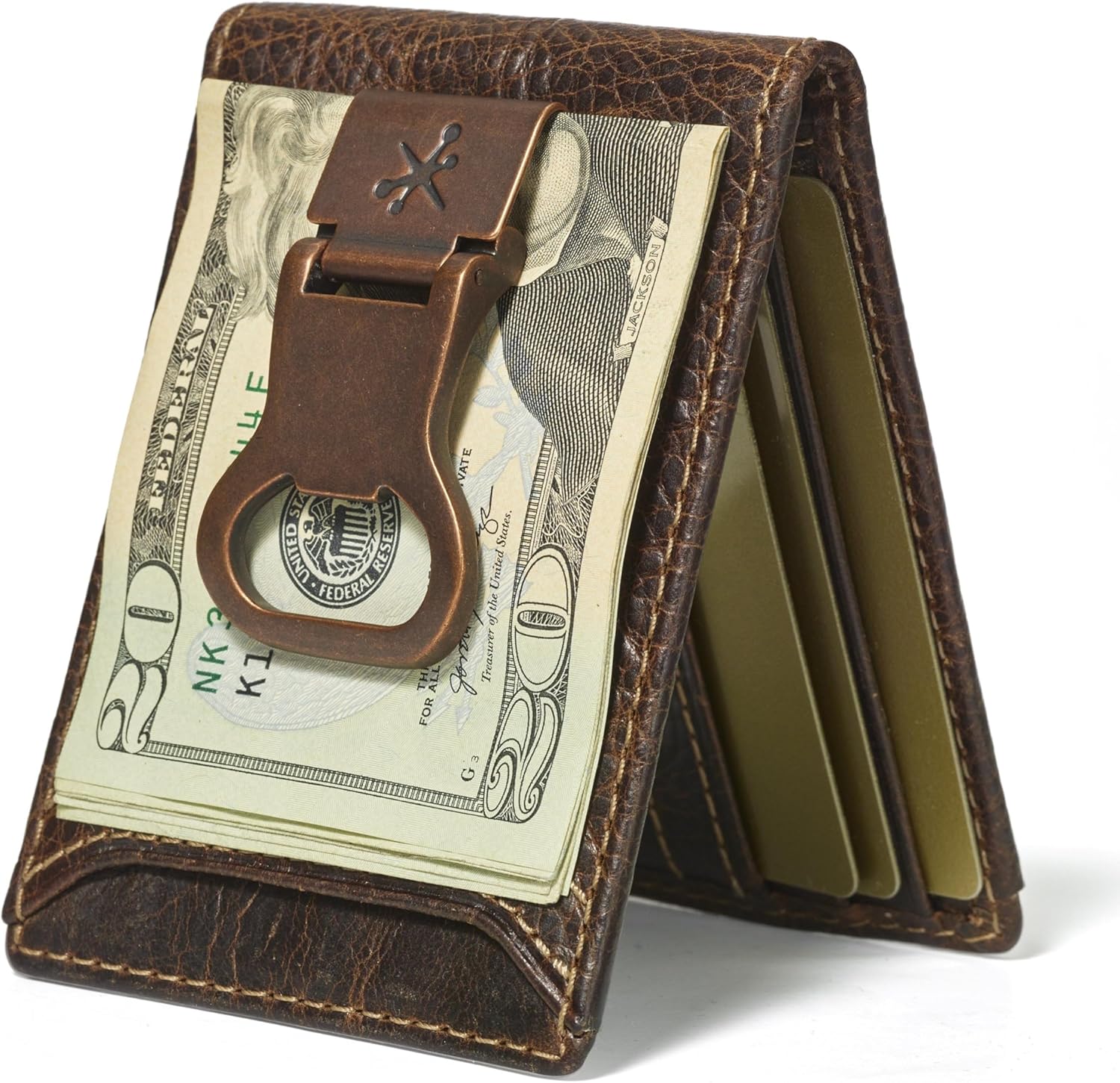
Full-grain cowhide with a hand-burnished finish. No synthetics. Offers distinctive designs that don’t sacrifice build quality — a rare combination. High quality-to-price ratio.
Best for: Value, front-pocket carry, buyers new to premium leather.
8. Main Street Forge “The Bootlegger” Bifold
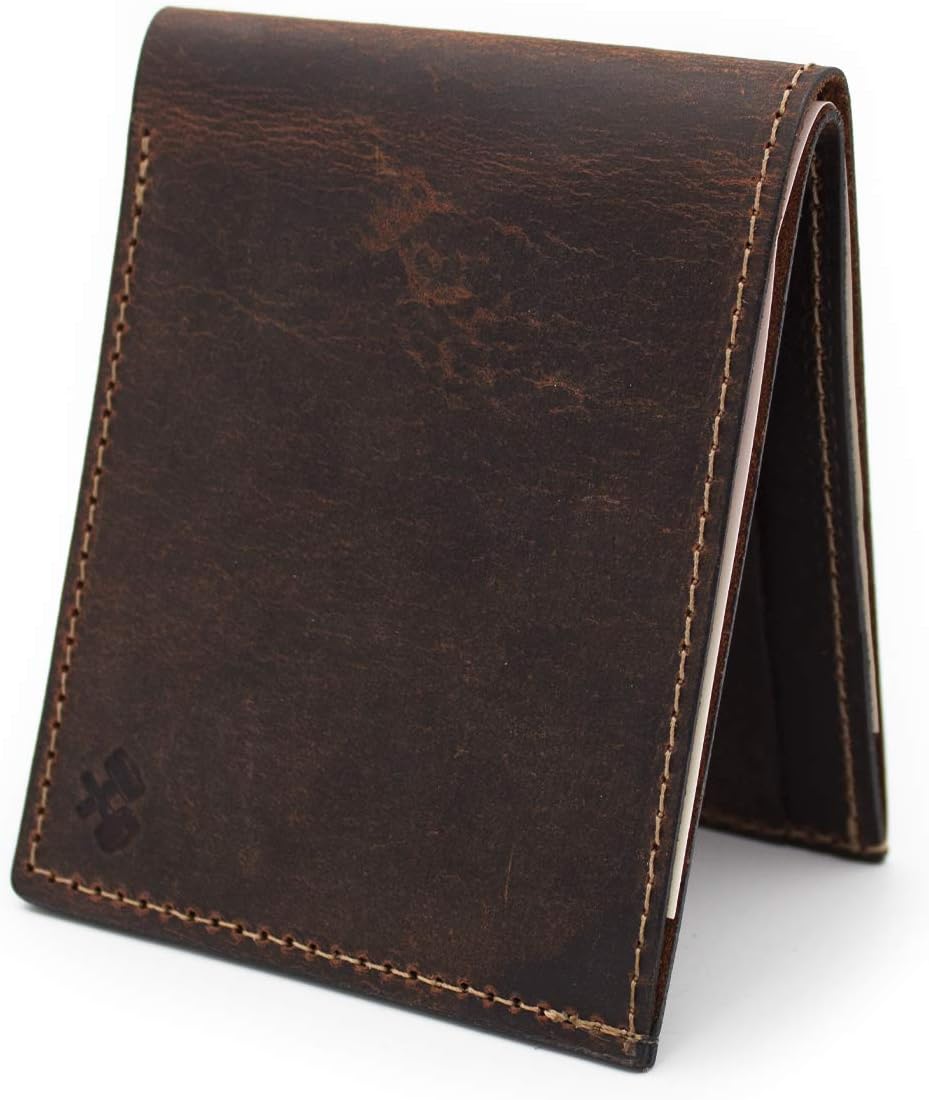
Single-piece construction from thick American full-grain leather. Stiff out of the box — like a good pair of boots, it molds to the owner’s pocket over time. Lifetime warranty. No-frills, high-performance.
Best for: Simple, honest carry with no moving parts.
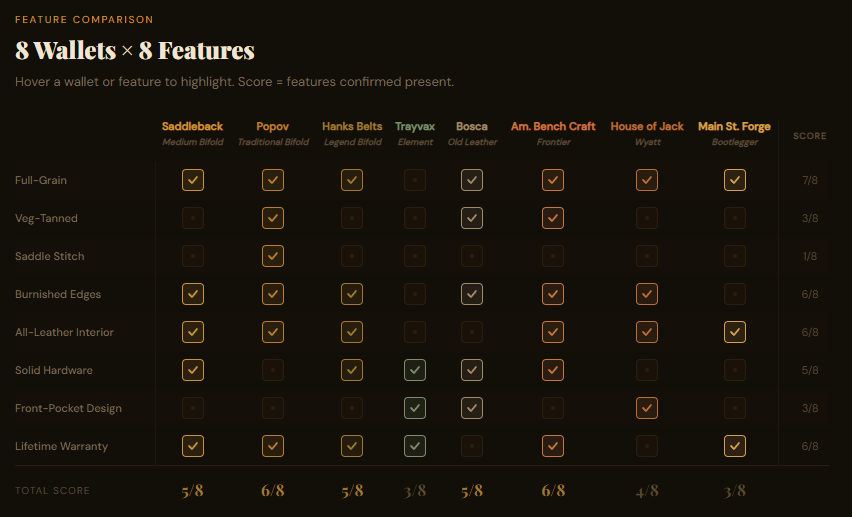
Brand Comparison at a Glance

The Real Cost of a Cheap Wallet
Price is not value. Here’s what the math actually looks like:
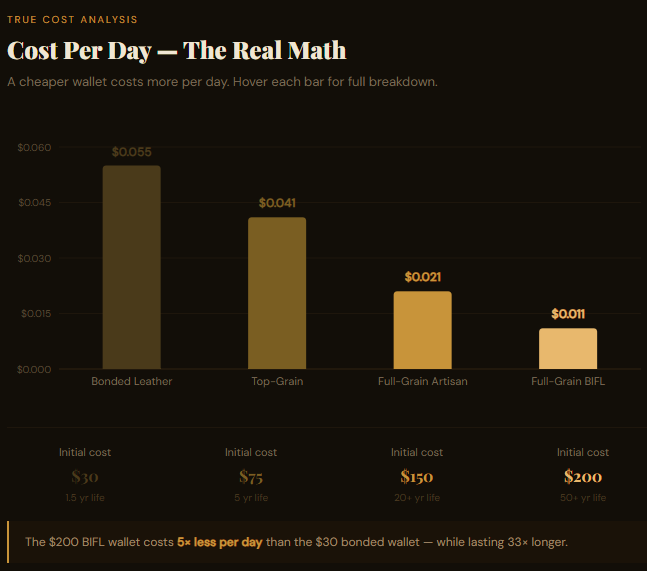
The $150 artisan wallet costs less per day than the $30 department store wallet. Over a lifetime, the “expensive” one is the economical choice.
How to Keep a 10-Year Wallet Looking Its Best
Even the best materials need basic care.
Condition once or twice a year. Leather contains natural oils that evaporate over time from body heat and air exposure. Apply a quality leather conditioner — a natural wax or cream — to replenish moisture and maintain suppleness. Dry leather cracks at high-stress points.
Audit the contents regularly. Overstuffing stretches the pockets past the leather’s elastic limit. It won’t return to shape. Keep only the essentials — the wallet is a daily carry tool, not a filing cabinet.
Air-dry if it gets soaked. If the wallet takes a beating from rain or an accidental laundry cycle, let it dry at room temperature. Heat — from a radiator or hair dryer — cooks the collagen fibers, causing shrinkage and brittleness. Follow up with conditioner once dry.
Frequently Asked Questions
What’s the difference between full-grain and top-grain leather? Full-grain keeps the entire outermost layer of the hide intact, including its natural fiber density and surface. Top-grain has the very top layer sanded off to remove imperfections, then is coated with an artificial finish. Full-grain is stronger, breathes better, and develops a patina. Top-grain is more uniform-looking but weaker and prone to cracking finish over time.
Is vegetable-tanned leather worth the extra cost? Yes, for a long-term carry. Vegetable tanning preserves the natural fiber bonds and allows the leather to develop a protective patina over years of use. Chrome-tanned leather ages without developing that patina — it simply fades and wears out.
Is RFID blocking necessary? RFID fraud is statistically rare because most modern contactless cards use encrypted, one-time-use codes that are useless if intercepted. Many buyers prefer it for peace of mind, but it shouldn’t be the primary reason to choose a wallet — especially if it adds unnecessary bulk or requires a metallic layer that stiffens the material.
How long before a stiff wallet breaks in? Wallets like the Saddleback and Main Street Forge take several months of daily carry to fully break in. The leather molds to the pocket and the contents. After break-in, they hold their shape better than softer wallets that were never stiff to begin with.
What’s the best style — bifold, trifold, or slim? For front-pocket carry and longevity, slim or bifold wallets are preferable. Trifolds add bulk and require a back-pocket carry that accelerates wear. Slim wallets encourage carrying only what’s necessary, which reduces overstuffing and extends the wallet’s structural life.
The guy who has everything doesn’t need more things. He needs fewer, better ones.
A wallet built from full-grain, vegetable-tanned leather with a saddle stitch and burnished edges will still be in his pocket in 10 years — looking better than it did on day one. That’s the point. That’s the gift.
Dora Decora is a biophilic interior design specialist and passionate blogger. With a deep commitment to integrating nature into living spaces, Dora specializes in creating environments that foster human-nature connections through thoughtful design elements. Her approach emphasizes sustainable materials, natural lighting, and organic patterns that enhance wellbeing and reduce environmental impact.
This post (https://homechroma.com/best-mens-leather-wallet) was originally published by Dora Decora on Home Chroma. As an Amazon Associates partner, we are compensated for all qualifying purchases.