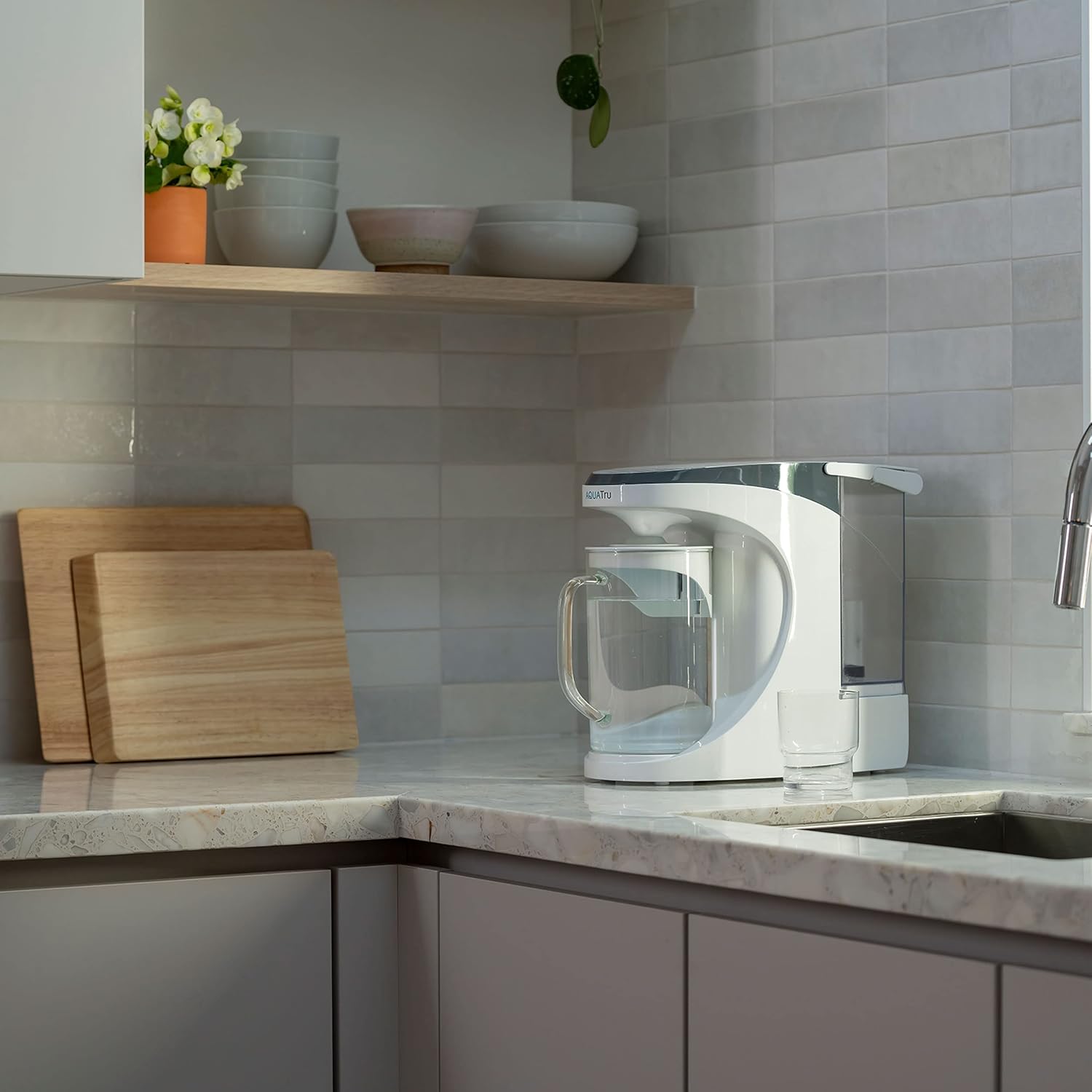
 When it comes to countertop reverse osmosis systems, two names dominate the conversation: AquaTru and BlueVua. Both claim superior water purification. Both come with attractive price tags. But which one actually delivers?
The answer isn’t simple. It depends on what matters most to you—and what’s in your water.
What You’re Really Buying
Before we dive into specifics, understand this: a reverse osmosis system removes dissolved solids, contaminants, and minerals from your tap water. The question isn’t whether these systems work—it’s whether they work completely, consistently, and efficiently.
AquaTru and BlueVua take fundamentally different approaches to proving this. One leans heavily on independent validation. The other bets on design and features. The difference matters more than you’d think.
The Head-to-Head Breakdown
Pricing: Nearly Identical, But Different Value Props
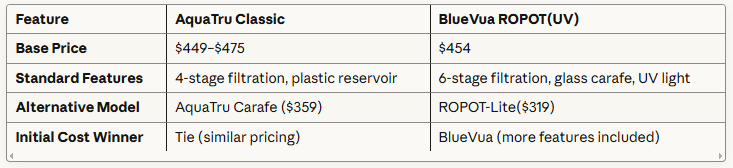
At first glance, BlueVua looks like the better deal. You’re getting a glass carafe and UV sterilization built in—features that cost extra on the AquaTru.
But here’s what that price tag really buys.
Filtration Performance: Numbers Don’t Lie
Independent laboratory testing tells a stark story.
AquaTru’s Performance: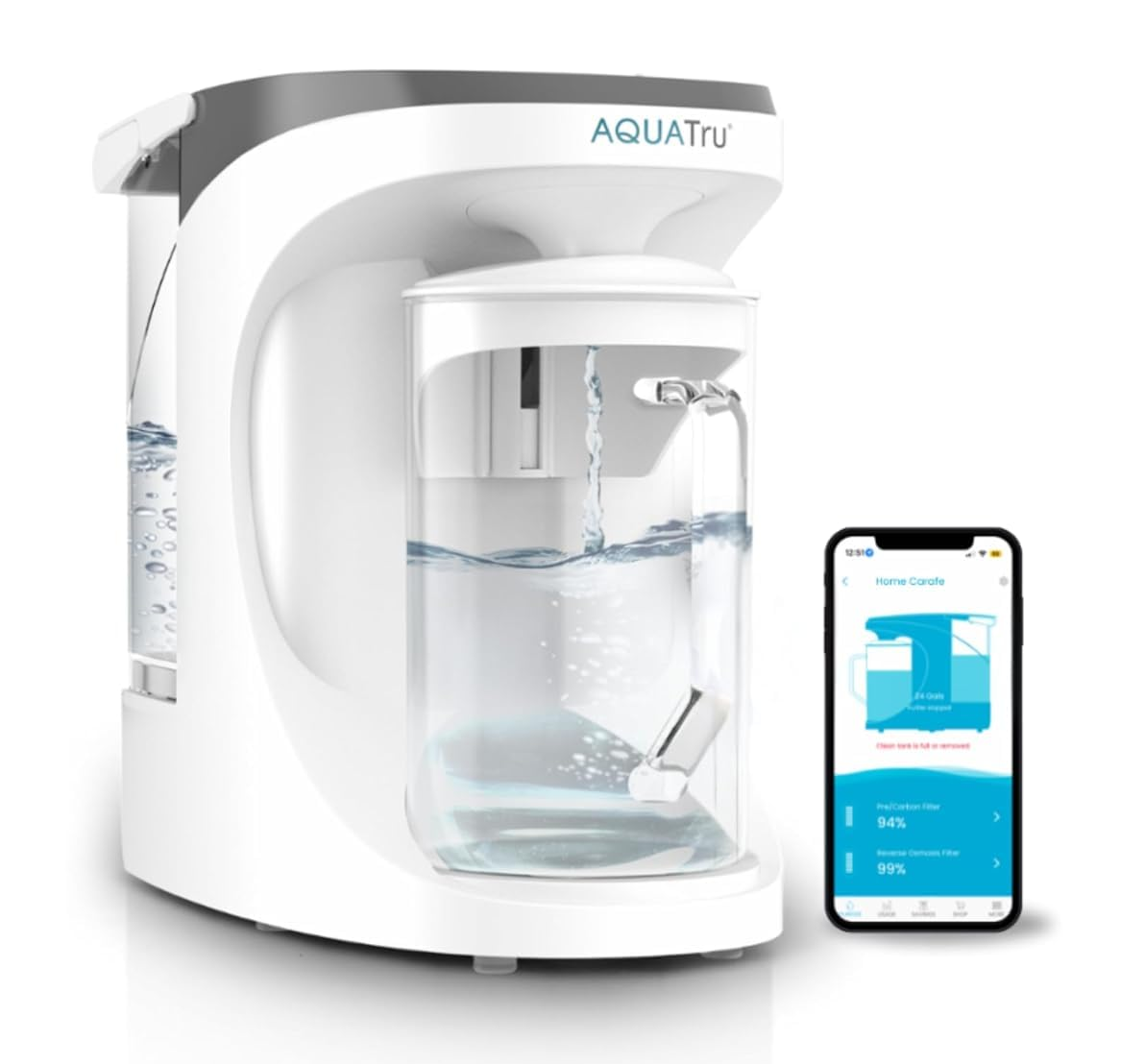
AquaTru Carafe Smart | Countertop Water Purifier [click to view…]
- Overall system score: 9.54 out of 10
- Contaminant removal rate: 100% on all 11 tested trace contaminants
- Specific wins: Lead, PFAS, fluoride (complete removal)
- System: 4-stage ultra reverse osmosis
BlueVua’s Performance:
- Overall system score: 8.68 out of 10
- Contaminant removal rate: Variable (strong on chlorine and uranium)
- Critical gap: 83% fluoride removal (vs. AquaTru’s 100%)
- System: 6-stage filtration with remineralization and UV
That 17-point gap on fluoride removal isn’t trivial. Fluoride is notoriously difficult to remove through reverse osmosis. When a system claims superiority but fails to hit 100%, it raises a fundamental question: what else isn’t it catching?
The irony? BlueVua uses more filtration stages than AquaTru—yet delivers lower performance. More stages doesn’t equal better results.
The Certification Divide: Where Trust Gets Built
Here’s where the story shifts dramatically.
AquaTru holds full system-level certification:
- NSF/ANSI Standard 42 (aesthetic effects: taste & odor)
- NSF/ANSI Standard 53 (health effects: lead, VOCs)
- NSF/ANSI Standard 58 (RO system performance & efficiency)
- NSF/ANSI Standard 401 (emerging contaminants: PFAS, pharmaceuticals, herbicides)
- Certified by: IAPMO (International Association of Plumbing and Mechanical Officials)
BlueVua’s certification story:
Bluevua RO100ROPOT Reverse Osmosis Countertop Water Filter [click to view…]
- No full system-level NSF/ANSI 58 certification
- Only component-level certification on the RO membrane itself
- Reason stated: “lengthy certification process”
This matters because a certified component doesn’t guarantee a certified final product. The seals, plumbing, housing, and water flow dynamics all influence real-world performance. BlueVua’s observed 83% fluoride removal strongly suggests that relying on component certification alone is insufficient.
Adding to the concern: BlueVua’s predecessor company (Kflow International LLC) was listed as an NSF violator for false certification claims. That history creates legitimate skepticism.
The bottom line: AquaTru says “We’ve been independently tested and verified end-to-end.” BlueVua says “Our filter is certified—trust us on the rest.”
Water Efficiency: A Forgotten Factor That Costs Real Money
Reverse osmosis systems waste water. The question is: how much?

AquaTru’s 4:1 ratio is genuinely impressive for a countertop system. BlueVua’s 2:1 is respectable—but it means you’re sending twice as much water down the drain for every gallon you drink.
Over a year, that difference compounds. Over five years, it’s significant. Over a decade, it’s substantial.
Flow rate advantage: BlueVua edges AquaTru slightly at 0.06 GPM vs. 0.04 GPM. Your carafe fills faster. But it wastes more while doing it. Choose your priority.
The Hidden Liability: Hard Water Can Break Your System
Here’s a critical detail AquaTru doesn’t advertise loudly enough: the system cannot handle hard water above 10 grains per gallon (gpg), equivalent to 171 ppm TDS (Total Dissolved Solids).
What happens if you exceed this?
Calcium and magnesium scale accumulates on the delicate RO membrane. Your filter lifespan gets cut in half—from the expected 2 years down to 1 year or less. Suddenly, your $49.95 membrane replacement becomes annual. Your cost advantage evaporates.
BlueVua doesn’t carry this explicit limitation. If you live in a hard water area, this matters.
The solution? Get your water tested. Seriously. Before committing to AquaTru, know your TDS level. If it’s above 171 ppm, either:
- Use a pre-treatment water softener (additional cost), or
- Consider BlueVua instead
This single factor can flip the entire recommendation for certain users.
Design & Materials: Glass vs. Plastic Matters
The plastic concern with AquaTru Classic:

AquaTru Carafe Alkaline Mineral Boost [click to view…]
- Uses Tritan plastic for the purified water reservoir
- While marketed as BPA-free, research shows other compounds (2-phenoxyethanol, dimethyl isophthalate) can migrate into water
- Migration amounts remain below legal thresholds—but they’re measurable
The glass advantage:
- Both AquaTru Carafe and BlueVua ROPOT feature high-quality borosilicate glass carafes
- Eliminates plastic leaching risk entirely
- Feels premium and looks better on counters
This is why the AquaTru Carafe model (despite smaller capacity at 64 oz) has achieved a 4.9-star rating on 300 reviews—compared to the Classic’s 4.6 stars on 1,023 reviews. Consumers demonstrate clear preference for glass.
The UV sterilization question:
BlueVua includes integrated UV light. Sounds like an advantage, right? Except independent users report “biofilm-like substance” forming inside the BlueVua container, even when water TDS tests as low as 6. This suggests:
- The UV feature attempts to solve a design problem rather than preventing it
- Some users resorted to secondary filtration (ZeroWater) to maintain quality
- AquaTru’s certified design avoids this issue without needing UV
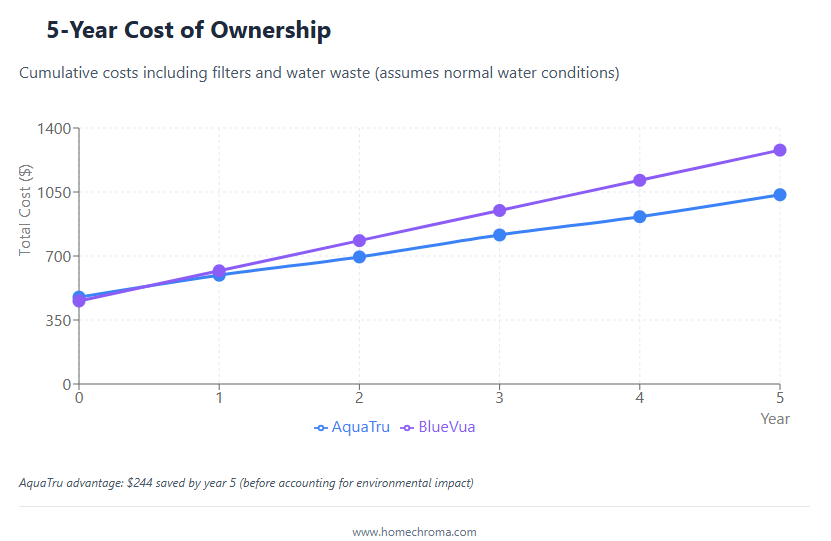
The Total Cost of Ownership: Five-Year Reality Check
Initial price is only part of the story.
AquaTru’s filter replacement costs:
- Pre-Carbon Filter: $22.95 every 6 months
- VOC Carbon Filter: $32.95 every 12 months
- RO Membrane: $49.95 every 24 months
- Annual operating cost: $100–$140 (assuming normal water conditions)
BlueVua’s filter replacement costs:
- Non-RO filters: $52–$65 every 12 months
- RO Membrane: $59.99 every 24 months
- Estimated per-gallon cost: $0.27 (varies by usage)
Over five years on typical daily usage:
- AquaTru: ~$650–$750 in maintenance (plus lower water waste)
- BlueVua: ~$850–$950 in maintenance (plus double the water waste)
But here’s the catch: This assumes AquaTru stays within its hard water limit. If you exceed 10 gpg and need annual membrane replacements, AquaTru’s cost advantage flips completely.
What Independent Experts Actually Say
Leading water quality reviewers (Water Filter Guru, AquaProfessor, and others) generally reach this consensus:
AquaTru wins on:
- Verified performance (100% contaminant removal)
- System-level certification (comprehensive NSF/ANSI validation)
- Water efficiency (4:1 ratio means lower utility costs)
- Predictable long-term costs (in normal water conditions)
- Peace of mind (independent validation of every claim)
BlueVua wins on:
- Feature-richness (glass carafe + UV standard)
- Compact design (takes up less counter space)
- Microbial control (if that’s your specific concern)
- Harder water resilience (no explicit TDS limitation)
- Initial feature value (you’re getting more “stuff” included)
Some reviewers call it a tie, depending on priorities. The disagreement is legitimate—it reflects real trade-offs between verified safety and appealing design.
The Decision Framework: How to Choose
Choose AquaTru if:
- You prioritize certified, verified health protection above all else
- Your source water TDS is below 171 ppm (get it tested first)
- You want the lowest long-term cost per gallon
- You’re willing to accept plastic on the Classic model, or spring for the Carafe
- Environmental efficiency matters (less water waste)
Choose BlueVua if:
- You live in a hard water area (above 10 gpg)
- Glass carafe is non-negotiable and matters more than certified performance
- You want more features included out of the box
- Compact design is important for your kitchen
- You’re comfortable with unverified system-level performance
The uncomfortable truth: Neither choice is “wrong.” They’re different answers to different questions.
The Final Word
AquaTru represents the industry standard for verified countertop RO performance. Its comprehensive NSF/ANSI certification means every claim has been independently tested and validated. You’re buying confidence.
BlueVua represents the practical alternative for people who prioritize design and features over regulatory validation. The glass carafe is real. The UV light works. You’re buying appeal.
The performance gap is measurable. The certification gap is undeniable. But for some users—particularly those in hard water regions—BlueVua’s lack of strict limitations makes it more reliable in the real world.
Before you decide: Test your water. Check your TDS level. This single piece of information eliminates most of the uncertainty. Armed with that knowledge and this comparison, you’ll make the right choice for your specific situation.
The best water filter isn’t the one with the most features. It’s the one that actually works for your water, in your home, at a price you can maintain long-term.
That’s usually AquaTru—but not always.
Dora Decora is a biophilic interior design specialist and passionate blogger. With a deep commitment to integrating nature into living spaces, Dora specializes in creating environments that foster human-nature connections through thoughtful design elements. Her approach emphasizes sustainable materials, natural lighting, and organic patterns that enhance wellbeing and reduce environmental impact.
This post (https://homechroma.com/aquatru-vs-bluevua-reverse-osmosis-systems-water-filter) was originally published by Dora Decora on Home Chroma. As an Amazon Associates partner, we are compensated for all qualifying purchases.