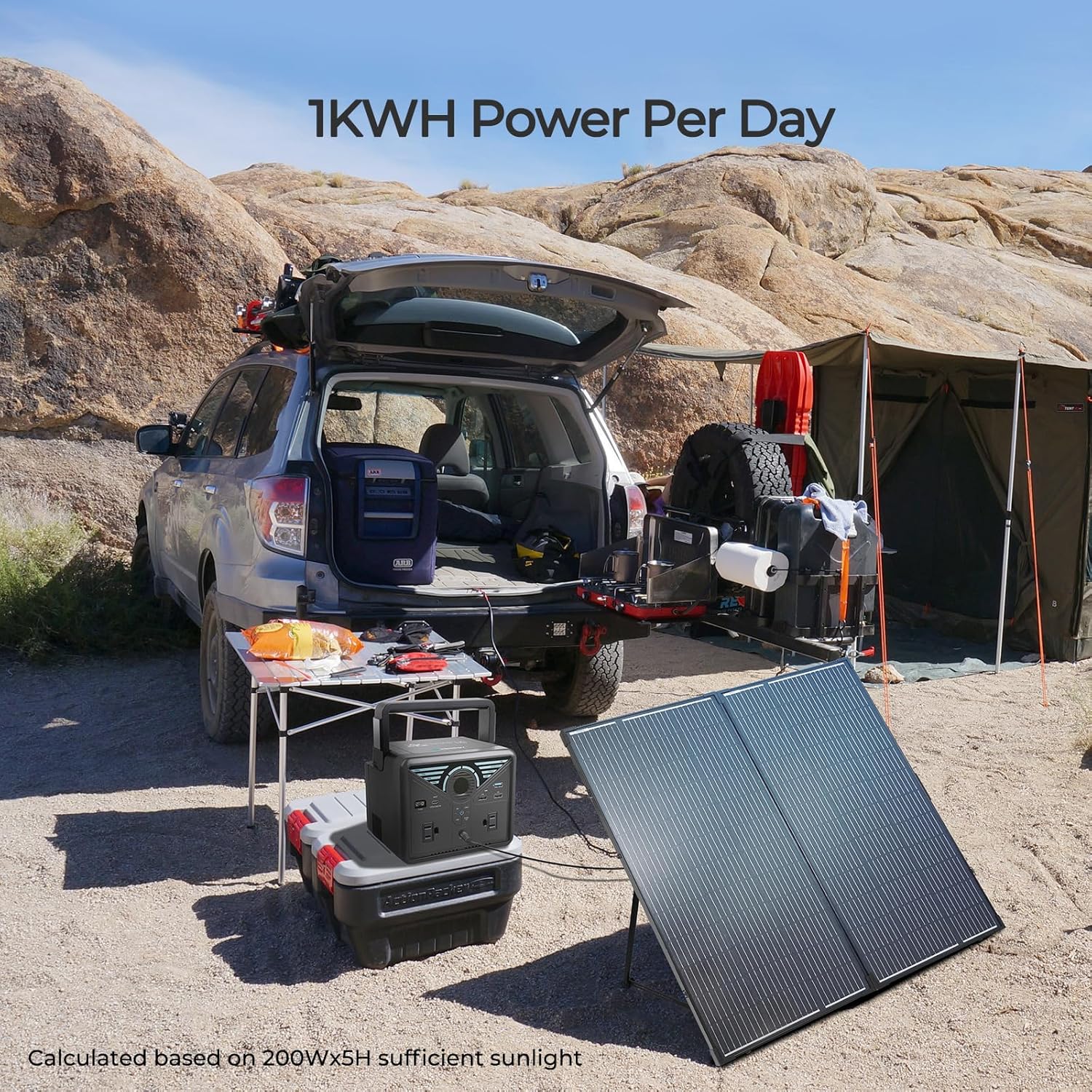
 Full-hookup RV sites cost $55-$150 per night at private campgrounds. If you camp just 4-5 nights per month, you’re spending $1,650-$2,700 annually on electrical hookups alone. A quality portable solar system costs $1,800-$2,500 and eliminates this recurring expense entirely through free boondocking.
The math is straightforward: invest in solar panels that enable off-grid camping, avoid $70+ nightly fees, and recoup your entire system cost in roughly six months of consistent use. After that, every night spent camping is pure savings.
This isn’t theoretical. Thousands of full-time RVers have validated this approach using high-efficiency panels paired with lithium power stations—systems proven to deliver reliable off-grid power for years.
The Real Cost of Grid Dependence
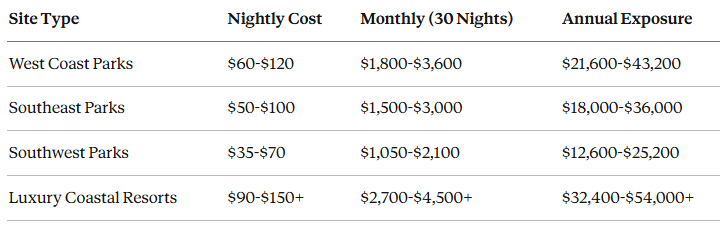
Full-hookup sites at private campgrounds vary dramatically by region. West Coast locations (California, Oregon, Washington) average $60-$120 per night. Southeast parks run $50-$100, with Florida Keys luxury sites exceeding $150 during peak season. Even budget-friendly Southwest campgrounds charge $35-$70.
Hidden costs add up fast:
- 50-amp service fees: $5-$15 extra
- Pet fees: $3-$10 per night
- Premium WiFi: $5-$10 daily
For full-time travelers, the average exceeds $70 per night. That’s $2,100 monthly or $25,200 annually just for electrical hookups.
Boondocking (dry camping) on public lands or through networks like Harvest Hosts costs $0-$20 nightly. The difference—your daily savings—is what makes solar panels pay for themselves.
Regional RV Hookup Costs (2025)
Validating the 6-Month Payback
The payback calculation is simple: divide system cost by monthly savings.
Formula: Total System Cost ÷ Monthly Savings = Payback Period (months)
A quality 400W-600W portable solar setup with a 2,000Wh+ power station costs $1,800-$2,500. To achieve a six-month payback on a $2,100 investment:
- $2,100 ÷ 6 months = $350 monthly savings required
- $350 ÷ 30 days = $11.67 average daily savings
Real-World Scenarios
Full-Time Nomad (High-Cost Region)
If you camp in areas averaging $90/night (typical West Coast rates), you need just 23 avoided hookup nights to recoup $2,100:
- $2,100 ÷ $90 = 23.3 nights
- That’s 4-5 boondocking nights per month
- Six-month payback achieved
Weekend RVer (Mid-Cost Region)
At $55/night (Midwest/Mountain States average), you need 38 nights:
- $2,100 ÷ $55 = 38.2 nights
- About 6.4 boondocking nights monthly
- 10-12 month payback for weekend warriors
The critical factor: you must actually use the system to enable boondocking. Cheap $500 systems with unreliable output force you back to hookups or generators, delaying payback indefinitely.
Why Quality Systems Matter
Budget solar kits often use PWM (Pulse Width Modulation) charge controllers and older battery chemistry. These systems deliver 70% or less of rated output in real-world conditions—cloudy skies, partial shade, or non-optimal angles.
When your solar system can’t reliably power essential appliances, you’re forced to:
- Run noisy, fuel-burning generators ($4-$8/day in gas)
- Return to expensive hookup sites
- Limit appliance use (refrigerator, water pump, electronics)
Six months without solar while paying $70/night costs $1,260. That’s money lost that could have purchased a quality system from the start.
Premium systems using MPPT (Maximum Power Point Tracking) controllers and LiFePO₄ batteries extract 20-30% more energy from panels, even in suboptimal conditions. They charge faster, last longer (3,000-6,000+ cycles vs. 500-1,000), and provide genuine off-grid independence for 8-16 years.
Top Portable Solar Panels for RVs
High-Output Category (220W-350W)
Bluetti PV350 (350W)
- Peak power: 350W at 23.4% efficiency
- Weight: 30.61 lbs folded
- Construction: ETFE coating, IP65 water-resistant, fiberglass backing
- Operating voltage: 37V (requires MPPT controller)
- Price: ~$799
- Best for: Maximum daily energy capture, heavy appliance loads
The PV350 delivers the highest wattage in a portable format. Its ETFE coating resists UV degradation 3x better than standard PET panels, extending lifespan even in harsh Southwest sun. Four adjustable kickstands ensure optimal angle positioning.
Real-world output: 84% of nameplate rating (294W typical vs. 350W rated)
EcoFlow 220W Bifacial
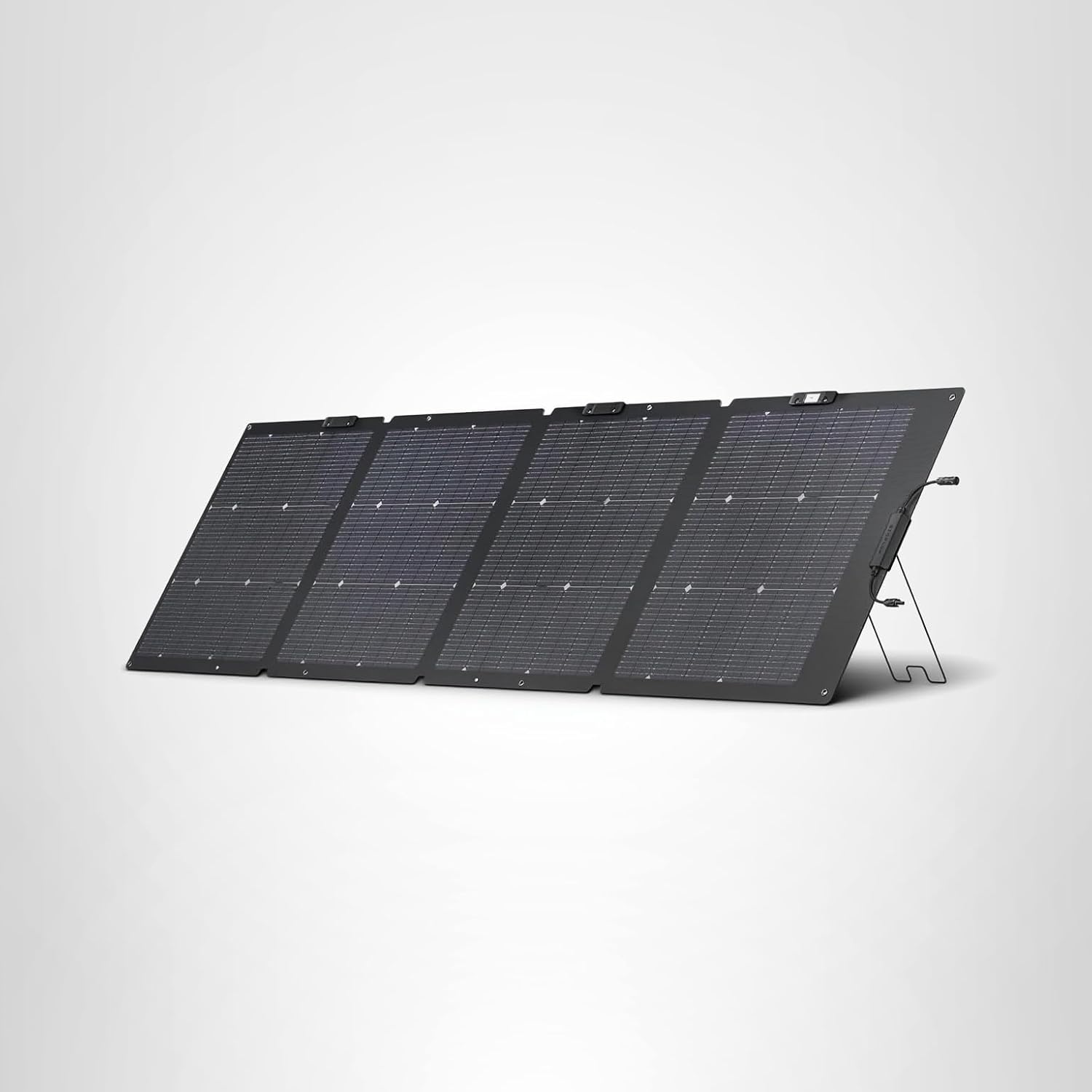
EcoFlow 220W Bifacial [click to view…]
- Front: 220W at 25% efficiency
- Rear side: Captures reflected light for 5-25% bonus output
- Weight: 15.4 lbs
- Construction: Tempered glass, ETFE coating, IP68 waterproof
- Price: ~$549
- Best for: Desert/snow environments with high ground reflection
The bifacial design captures ambient light from surfaces beneath the panel. Place on reflective sand or snow, and total daily output increases significantly. The thin tempered glass is 5x stronger than comparable panels while remaining lightweight.
Real-world testing shows 25% higher daily watt-hours in high-reflection environments compared to traditional single-sided panels.
Mid-Range Category (200W)
Jackery SolarSaga 200W
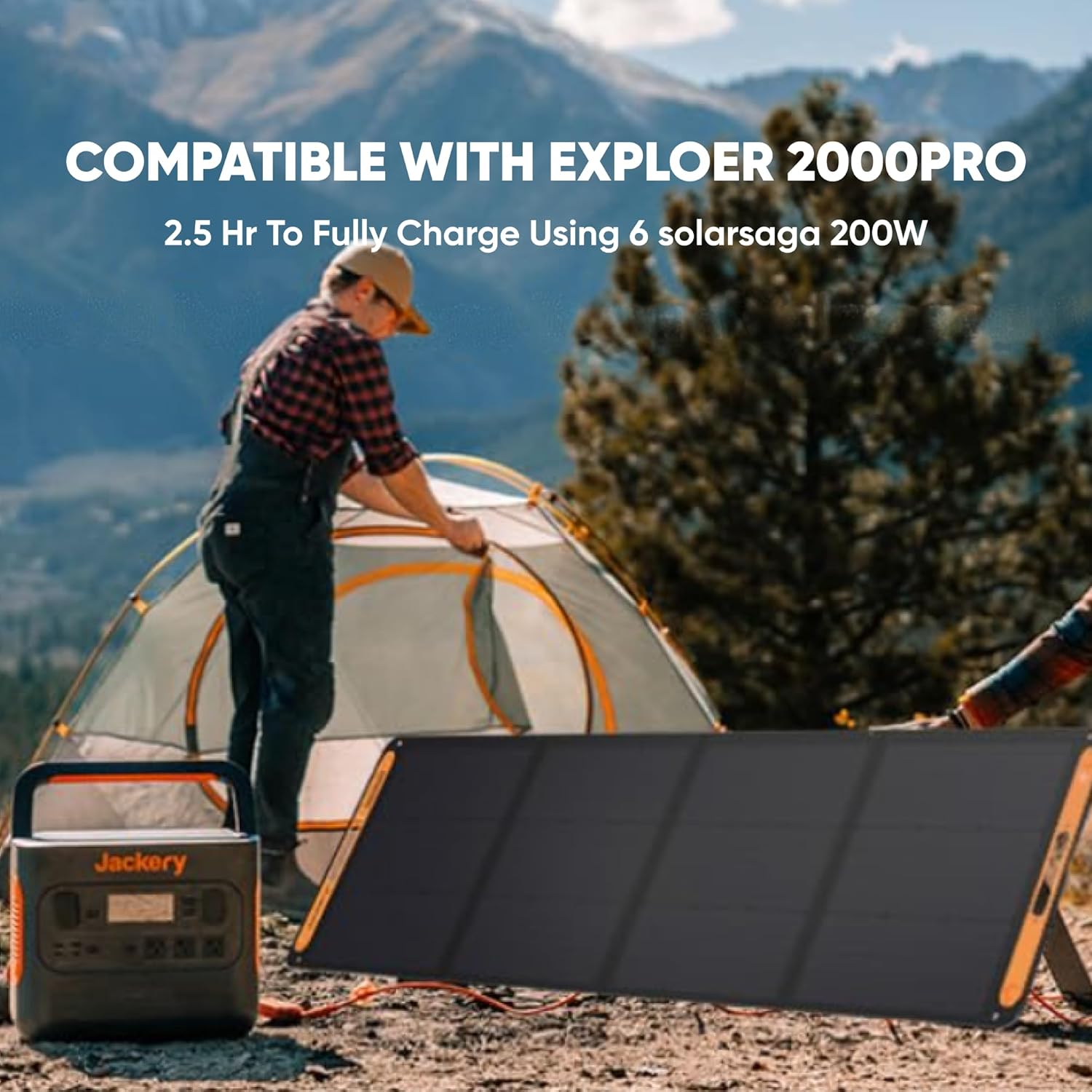
Jackery SolarSaga 200W [click to view…]
- Peak power: 200W at 24.3-25% efficiency
- Weight: 13.67-14.3 lbs (lightest in class)
- Construction: Monocrystalline with IBC technology, IP68 waterproof
- Direct USB charging: Built-in USB-A and USB-C ports
- Price: ~$379-$699 on Amazon USA (sales vary)
- Best for: Maximum portability, frequent moves
The SolarSaga prioritizes weight savings. At under 15 lbs, it’s nearly 5 pounds lighter than competing 200W panels. The smart solar optimization adjusts voltage automatically when clouds reduce sunlight intensity, maintaining consistent charging.
Real-world output: 86% of nameplate rating (172W typical)
Direct device charging via USB ports means you can charge phones, tablets, and laptops without routing through the power station—saving battery capacity for larger appliances.
Renogy 200W Eclipse Kit
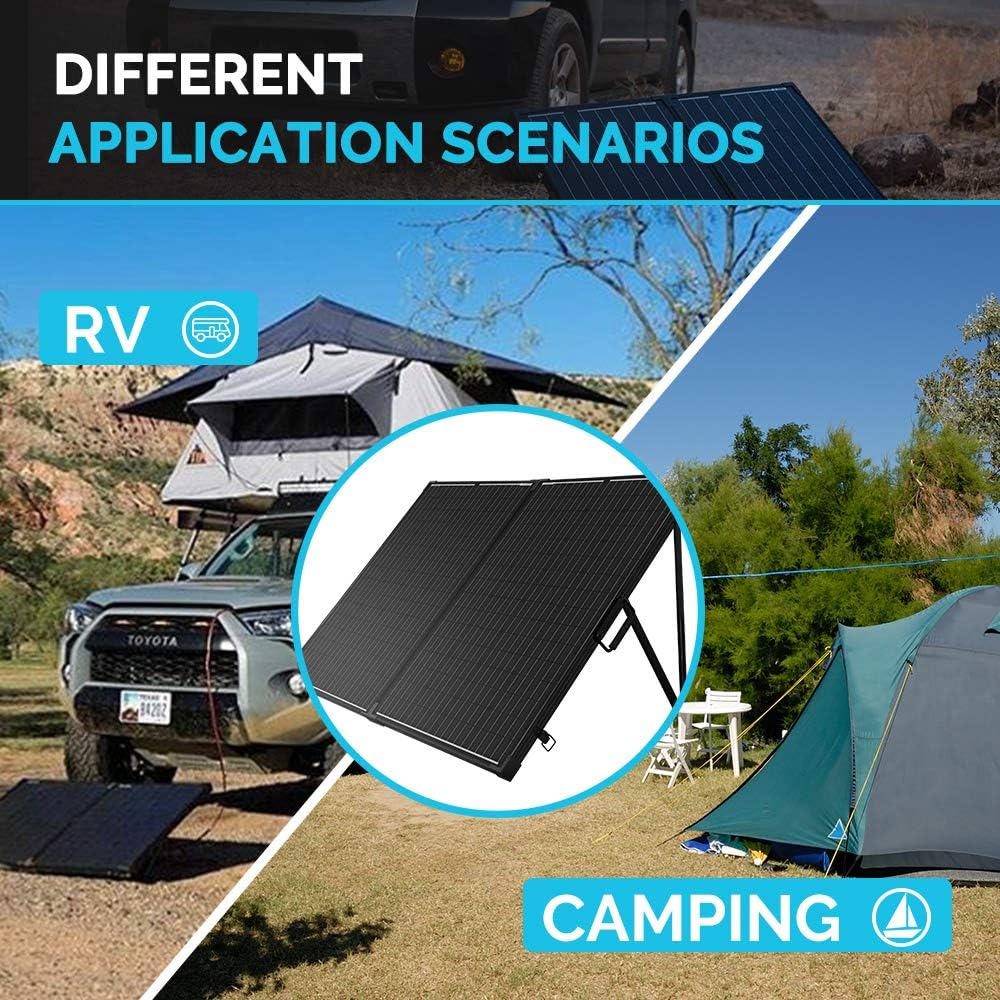
Renogy 200W Eclipse Kit [click to view…]
- Peak power: 200W (two 100W panels) at 20-22% efficiency
- Weight: 36-38 lbs (includes charge controller)
- Construction: Tempered glass, corrosion-resistant aluminum frame
- Included: 20A PWM controller, cables, Z-brackets, alligator clips
- Price: ~$469 on Amazon USA
- Best for: Complete starter kit, fixed installations
The Eclipse Kit arrives ready to install with all necessary components. Tempered glass construction resists microcracks better than budget panels. The integrated kickstands and protective case simplify transport and setup.
Real-world output: 80% of nameplate rating (160W typical)
Critical limitation: Standard kits include PWM controllers. In wooded campgrounds with partial shade, output drops dramatically. Upgrading to an MPPT controller ($150-$250) is highly recommended for consistent performance.
Entry-Level Options (100W-120W)
For minimal power needs—charging devices, running LED lights, small fans:
Rockpals 100W Foldable
- Power: 100W at 22% efficiency
- Weight: 9.3 lbs
- Features: USB-C Power Delivery (60W) for laptops
- Price: ~$219 on Amazon USA
Oupes 100W Portable
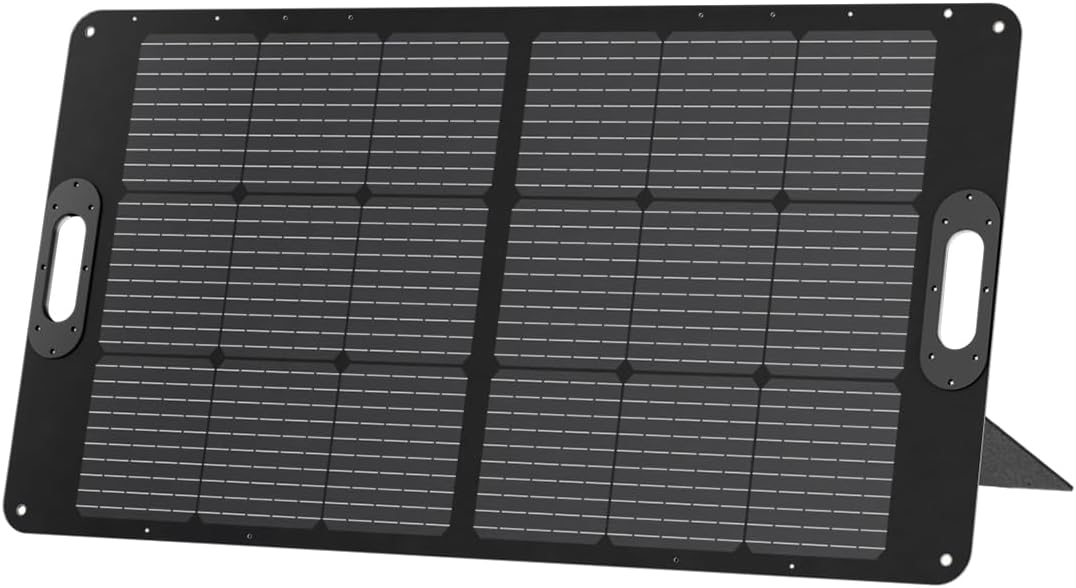
Oupes 100W Portable [click to view…]
- Power: 100W
- Weight-to-power ratio: 12.5W per pound (best in class)
- Price: ~$199 on Amazon USA
These panels suit solo campers or weekend warriors with low energy demands (400-700 Wh daily). They won’t support refrigerators or heavy appliances but excel at keeping devices charged during short trips.
Solar Panel Technical Comparison
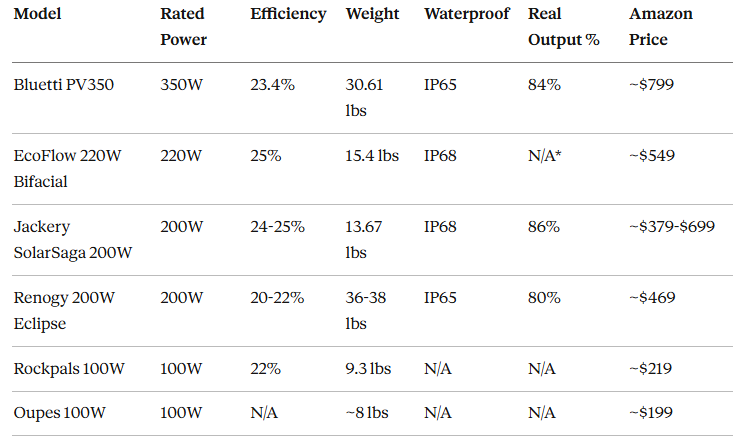
*Bifacial gains vary by environment (5-25% bonus from rear side)
Portable Power Stations: Completing Your System
Solar panels generate electricity but can’t store it. Portable power stations (solar generators) provide the battery bank, inverter, and MPPT charge controller needed for continuous operation.
Why Battery Chemistry Matters
LiFePO₄ (Lithium Iron Phosphate)
- Cycle life: 3,000-6,000+ cycles to 80% capacity
- Lifespan: 8-16 years of daily use
- Safety: Superior thermal stability, less prone to thermal runaway
- Warranty: Typically 5 years
- Weight: Heavier than NMC
- Cost: Higher upfront ($900-$2,000+)
NMC (Nickel Manganese Cobalt)
- Cycle life: 500-1,000 cycles
- Lifespan: 2-3 years of daily use
- Safety: Good but requires more thermal management
- Warranty: Typically 2-3 years
- Weight: Lighter
- Cost: Lower upfront ($500-$1,200)
For full-time RVers targeting six-month payback through daily use, LiFePO₄ is non-negotiable. After recouping the initial cost, these systems continue delivering $50-$150 daily savings for a decade or more. NMC batteries, while cheaper initially, require replacement in 2-3 years—negating long-term savings.
Top Power Station Recommendations
EcoFlow DELTA 3 Plus
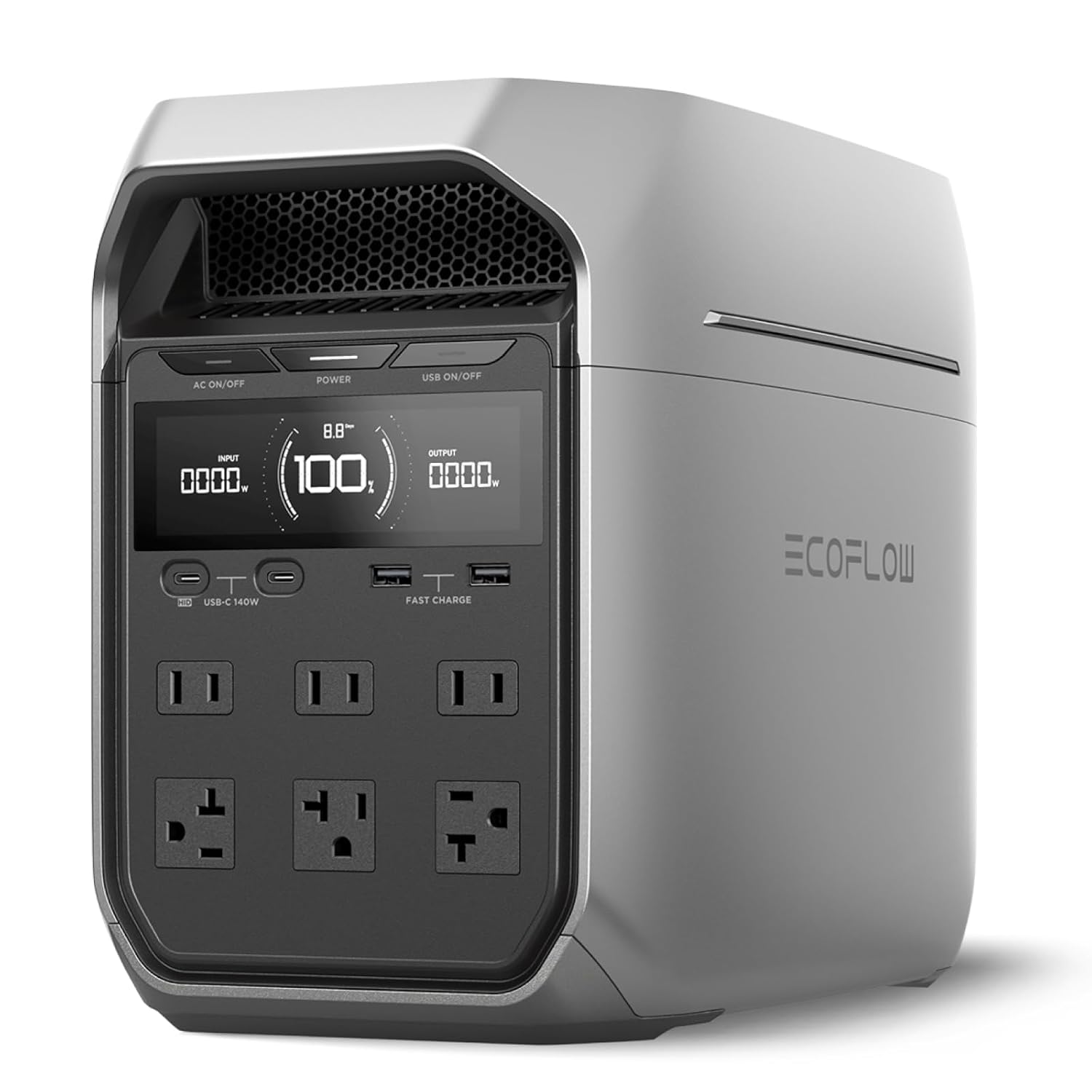
EcoFlow DELTA 3 Plus [click to view…]
- Capacity: 1,024 Wh
- Continuous output: 1,800W AC
- Max solar input: 1,000W
- Battery: LiFePO₄ (3,000+ cycles)
- Recharge time: <2 hours with 1,000W solar input
- Warranty: 5 years
- Price: ~$616 on Amazon USA
- Best for: Fast recharging, high solar input capacity
The DELTA 3 Plus accepts up to 1,000W solar input via XT60i connection. Connect four 250W panels (or two Jackery 200W + one EcoFlow 220W) for maximum charging speed. In peak sun conditions, it recharges from empty to full in under 2 hours.
Bluetti Elite 200 V2

Bluetti Elite 200 V2 [click to view…]
- Capacity: 2,073.6 Wh
- Continuous output: 2,600W AC (3,900W surge)
- Max solar input: 1,000W
- Battery: Automotive-grade LiFePO₄ (6,000+ cycles)
- Expected lifespan: 17 years
- Warranty: 5 years
- Price: ~$999 on Amazon USA
- Best for: Heavy appliances, long-term durability
The Elite 200 V2 runs microwaves, coffee makers, power tools—anything under 2,600W continuous. With 6,000+ rated cycles, it’s the longest-lasting system available. Pair with two Bluetti PV350 panels (700W total) for maximum off-grid capability.
Jackery Explorer 1000 V2
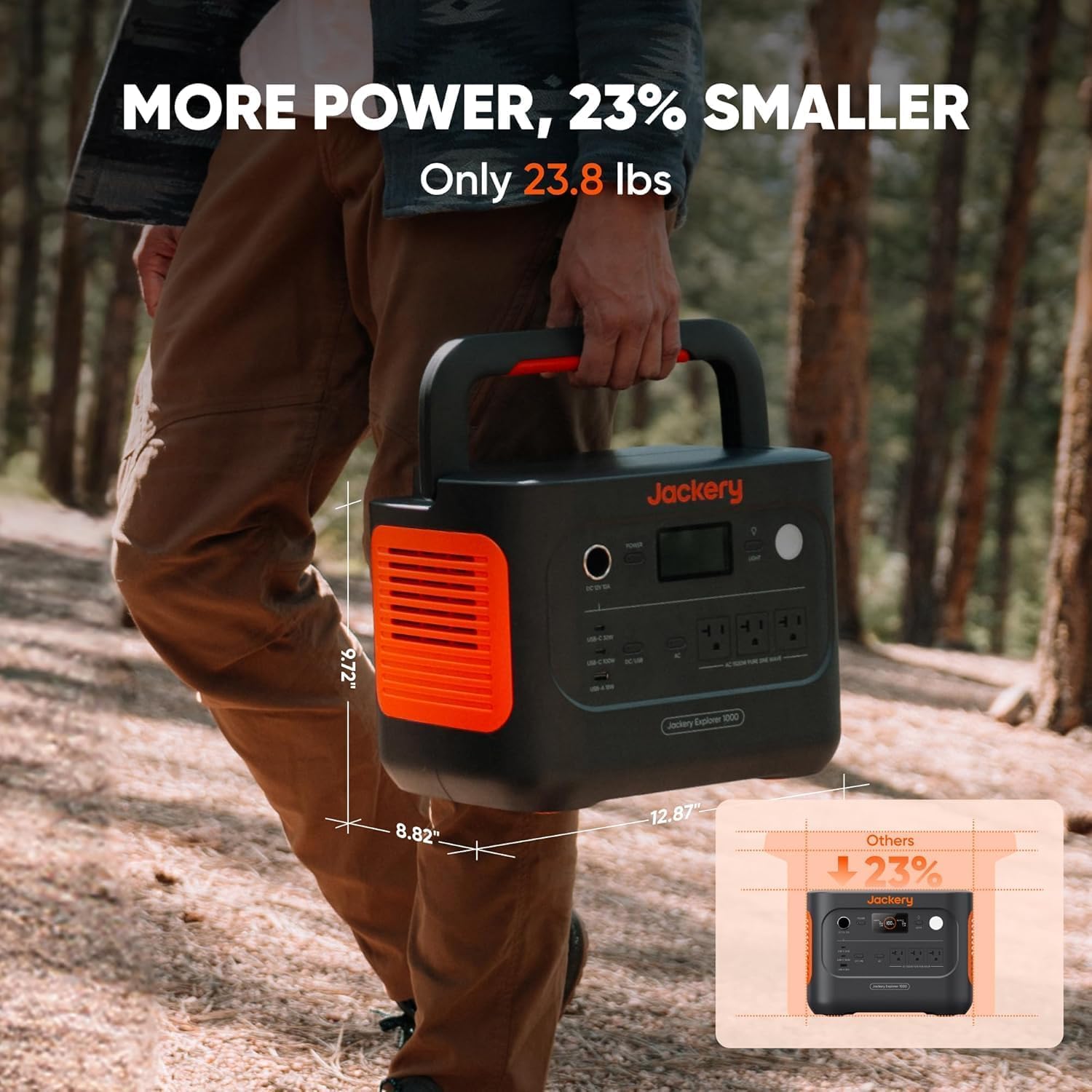
Jackery Explorer 1000 V2 [click to view…]
- Capacity: 1,070 Wh
- Continuous output: 1,500W AC
- Max solar input: 400W
- Battery: NMC (500-1,000 cycles)
- Weight: 23.8 lbs
- Price: ~$799 (estimated)
- Best for: Weekend RVers prioritizing light weight
The Explorer 1000 V2 balances capacity and portability. At 23.8 lbs, it’s significantly lighter than LiFePO₄ competitors. The 400W solar input limitation means longer recharge times (2.5-3 hours with two 200W panels) but remains adequate for weekend use.
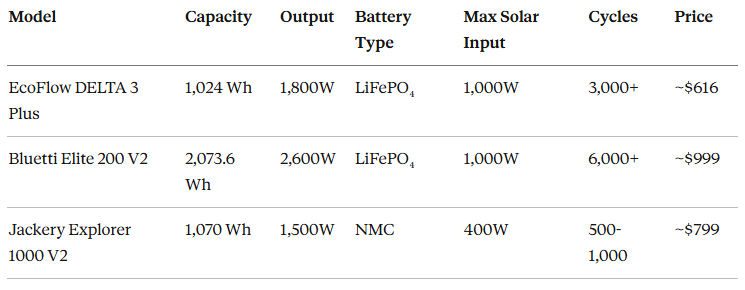
Portable Power Station Comparison
MPPT vs PWM: Why Controller Type Determines ROI
Charge controllers manage solar panel voltage and current to safely charge batteries. The technology matters significantly.
PWM (Pulse Width Modulation)
- Clamps panel voltage to battery voltage (typically 12-14V)
- Wastes excess voltage potential
- Performance drops 50-80% in partial shade
- Cost: $30-$100
- Efficiency: 75-80% in ideal conditions
MPPT (Maximum Power Point Tracking)
- Converts excess voltage into additional current
- Maintains performance in clouds, shade, cold weather
- Extracts 20-30% more energy from same panels
- Cost: $150-$300
- Efficiency: 95-98% across conditions
RV camping involves trees, buildings, and varying sun angles. MPPT controllers adapt continuously, maintaining power flow even when branches cast shadows on panel sections. PWM systems fail entirely—output drops to near-zero.
For reliable boondocking (and faster payback), MPPT is mandatory. All recommended power stations above include integrated MPPT controllers.
Panel Durability Features
ETFE Coating Ethylene Tetrafluoroethylene (ETFE) provides superior UV resistance compared to older PET (polyethylene terephthalate) coatings. ETFE panels maintain 95% efficiency after 25 years of sun exposure. PET panels degrade to 80-85% efficiency in 10-15 years.
Bluetti PV350 and EcoFlow 220W both use ETFE, justifying their higher prices through extended operational lifespan.
IP Ratings (Ingress Protection)
- IP68: Fully dust-tight, protected against continuous water immersion
- IP65: Dust-tight, protected against water jets/splashing
- IP54 or lower: Minimal protection, indoor use only
IP68-rated panels (Jackery SolarSaga, EcoFlow 220W) can withstand rain, snow, and accidental submersion. IP65 panels (Bluetti PV350, Renogy Eclipse) resist splashing but should not be left in heavy rain or snow.
Real-World Output Expectations
Manufacturers test panels under Standard Test Conditions (STC): 77°F temperature, 1,000 W/m² irradiance, perfect perpendicular angle. Real-world conditions rarely match these ideals.
Expected performance:
- Optimal angle, clear sky: 80-86% of rated output
- Suboptimal angle (10-20° off): 75-80%
- Partial clouds: 50-70%
- Heavy clouds: 20-40%
- Partial shade (PWM controller): 10-30%
- Partial shade (MPPT controller): 40-60%
Temperature affects output. Panels lose ~0.5% efficiency per degree Celsius above 77°F. In 100°F desert heat, expect 10-12% reduction from heat alone.
This is why panel wattage should exceed your average daily consumption by 30-50%. If you need 1,000 Wh daily, install 400-600W of panels to account for efficiency losses.
System Recommendations by User Type
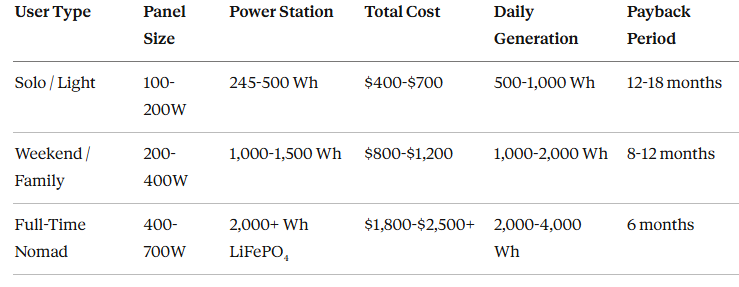
Solo Camper / Light User
Daily consumption: 400-700 Wh
Needs: Device charging, LED lights, small fans, portable cooler
Recommended Setup:
- Panels: Rockpals 100W or Oupes 100W
- Power station: EcoFlow River 3 (245 Wh capacity)
- Total investment: $400-$700
- Focus: Ultra-portability, simplicity
This setup won’t replace hookups entirely but dramatically reduces reliance on grid power. Perfect for weekend warriors who primarily want to keep phones, laptops, and cameras charged.
Weekend / Family Camper
Daily consumption: 1,000-1,500 Wh
Needs: 12V refrigerator, water pump, multiple devices, occasional microwave
Recommended Setup:
- Panels: Two Jackery SolarSaga 200W (400W total)
- Power station: Jackery Explorer 1000 V2 (1,070 Wh)
- Total investment: $800-$1,200
- Focus: Balanced power and portability
Four hundred watts of solar provides ~2,000-2,400 Wh daily production (summer conditions, good sun). This supports essential RV systems for extended weekends without hookups, achieving 8-12 month payback for regular campers.
Full-Time Nomad / Heavy User
Daily consumption: 2,000+ Wh
Needs: Microwave, coffee maker, laptops, monitors, CPAP, refrigerator, water heater
Recommended Setup:
- Panels: Two Bluetti PV350 (700W total) OR Three EcoFlow 220W Bifacial (660W total)
- Power station: Bluetti Elite 200 V2 (2,073.6 Wh)
- Total investment: $1,800-$2,500+
- Focus: Maximum capacity, fastest ROI
Seven hundred watts of solar produces 3,500-4,200 Wh daily (summer) and 2,100-2,800 Wh (winter). The Elite 200’s massive 1,000W solar input recharges the 2,073 Wh battery in 2.5-3 hours of peak sun.
This system enables genuine off-grid living. Run all appliances freely, avoid $70+ hookup fees nightly, and achieve six-month payback through consistent boondocking.
System Investment Comparison
Long-Term Value Beyond Payback
After achieving six-month payback, every subsequent boondocking night generates pure savings. The numbers compound dramatically over years.
5-Year Savings Projection (Full-Time Nomad)
- Initial investment: $2,100
- Average nightly savings: $70 (avoiding hookups)
- Boondocking frequency: 20 nights/month
- Monthly savings: $1,400
- Annual savings: $16,800
- 5-year total savings: $84,000
- Net profit after investment: $81,900
LiFePO₄ systems rated for 6,000 cycles mean 16+ years of daily use. Even accounting for gradual capacity loss (80% remaining at 6,000 cycles), these systems continue delivering value for over a decade.
Solar panels themselves degrade minimally—most retain 80% efficiency after 25 years. The panel investment pays dividends for your entire RVing career.
Final Verdict: Freedom vs. Fees
The six-month payback claim is valid—but only if you commit to using the system. Purchase quality components (MPPT controllers, LiFePO₄ batteries, high-efficiency panels), then actually boondock consistently instead of defaulting to hookup convenience.
For full-time travelers in high-cost regions, avoiding just 4-5 hookup nights monthly recoups a $2,100 investment in six months. After that, every night camping costs $0 for electricity instead of $70-$150.
The alternative: continue paying $25,200 annually (or more) for electrical hookups while your solar-equipped neighbors camp for free beside you.
Calculate your potential savings:
- Multiply your average hookup cost by camping nights per month
- Compare to quality solar system cost ($1,800-$2,500)
- Divide system cost by monthly savings
The math rarely lies. Solar independence isn’t just about environmental benefits or off-grid adventure—it’s a proven financial strategy that pays for itself faster than almost any RV upgrade.
Your panels are waiting on Amazon. The only question: how much will you spend on hookups before you make the switch?
Dora Decora is a biophilic interior design specialist and passionate blogger. With a deep commitment to integrating nature into living spaces, Dora specializes in creating environments that foster human-nature connections through thoughtful design elements. Her approach emphasizes sustainable materials, natural lighting, and organic patterns that enhance wellbeing and reduce environmental impact.
This post (https://homechroma.com/best-portable-solar-panels-for-rv) was originally published by Dora Decora on Home Chroma. As an Amazon Associates partner, we are compensated for all qualifying purchases.