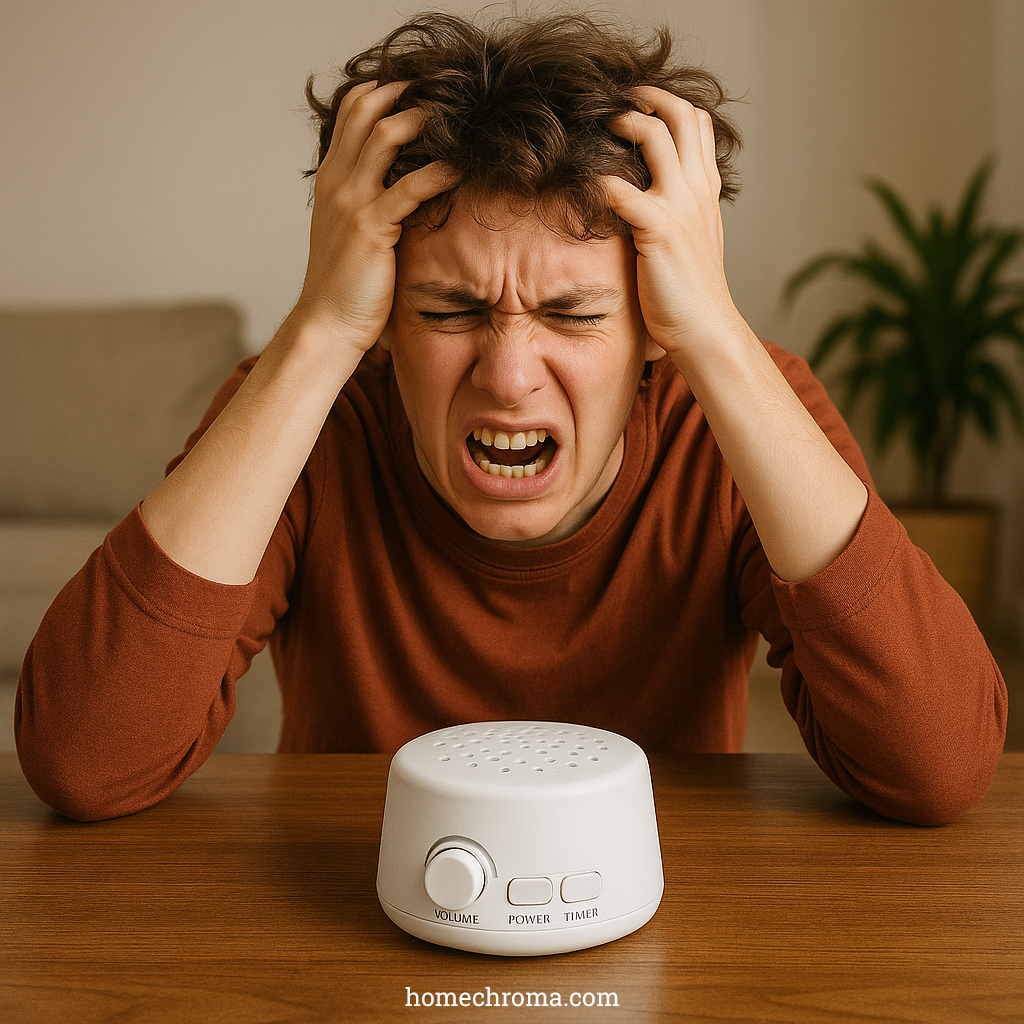
So, you bought a white noise machine to help your ADHD brain focus better.
But instead of the promised calm concentration.
You’re getting more distracted, anxious, or frustrated than before.
What if the machine you thought would be your productivity secret weapon is actually sabotaging your success?
Understanding which white noise machines and practices work against ADHD brains can save you money, frustration, and actually help you find solutions that work.
Here’s your complete guide to identifying the least helpful white noise approaches for ADHD – and what to do instead.
The White Noise Paradox: When “Helpful” Technology Hurts
White noise machines have exploded in popularity as ADHD management tools. Social media is full of success stories, and the science seems promising. But here’s what most people don’t realize: for roughly one-third of people with ADHD, white noise actually makes focus worse.
The problem isn’t that white noise doesn’t work – it’s that it doesn’t work universally. And when it doesn’t work for your specific brain, it can create new problems instead of solving existing ones.
The Science: Why Your ADHD Brain Might Reject White Noise
The Goldilocks Zone Problem
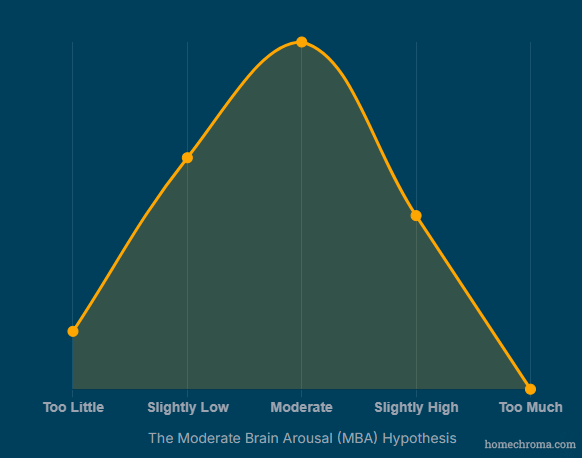
Your brain operates on what scientists call the Moderate Brain Arousal (MBA) hypothesis. Think of it like a volume dial for your attention:
- Too quiet: Your brain doesn’t get enough stimulation to focus
- Just right: Optimal attention and cognitive performance
- Too loud: Overstimulation leads to distraction and anxiety
This creates an “inverted U-curve” where cognitive performance peaks at moderate noise levels but crashes on either side.
The ADHD Subtype Split
Research reveals a crucial distinction:
Inattentive ADHD (the “space cadet” type):
- Usually benefits from white noise
- Needs external stimulation to reach optimal brain arousal
- Shows improved vigilance and reduced off-task behavior
Hyperactive/Impulsive ADHD (the “can’t sit still” type):
- Often performs WORSE with white noise
- Already generating internal stimulation through movement
- Gets pushed beyond optimal arousal into overstimulation
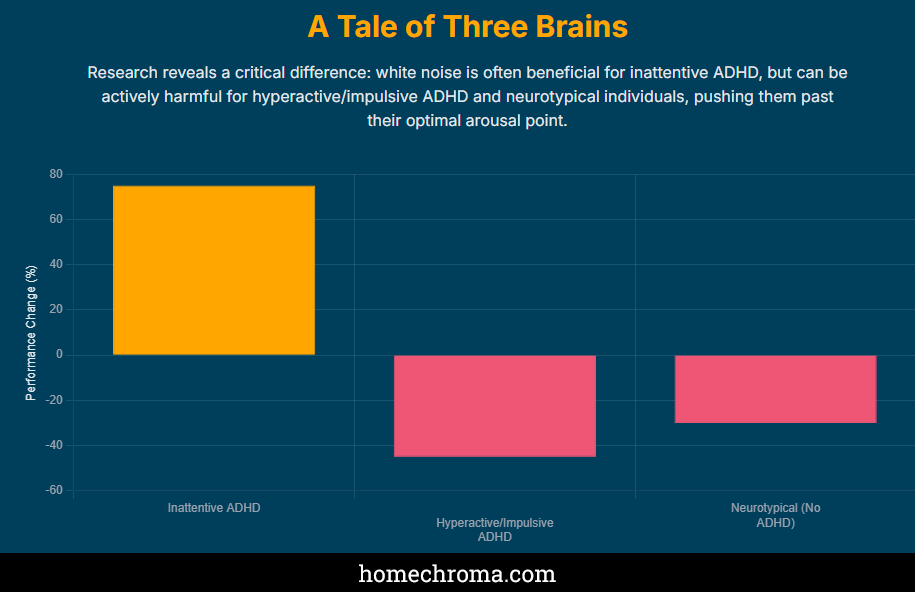
If you have predominantly hyperactive symptoms and white noise makes you feel agitated or more scattered, this isn’t a personal failing – it’s your brain responding exactly as research predicts.
The Worst Sound Types for ADHD Focus
1. Pure White Noise (Static-Like Sounds)
That classic “shhhh” sound might seem neutral, but many ADHD brains find pure white noise:
- Harsh and grating
- Irritating rather than soothing
- Too high-pitched for comfort
Real user experience: “White noise just sounds like static to me and makes me feel on edge rather than calm.”
2. High-Frequency Noises
Blue and violet noise pack more high-frequency content, making them:
- Unpleasant and sharp-sounding
- Less effective at masking distractions
- More likely to trigger sensory sensitivity
3. Looped Natural Sounds
Here’s where many machines fail spectacularly. Short, repeating loops of:
- Rain sounds
- Ocean waves
- Forest ambience
The ADHD brain’s pattern-seeking tendency locks onto these loops, creating:
- Anticipation anxiety waiting for sounds to repeat
- Hyperfocus on the loop instead of your work
- New distractions instead of masked ones
Key insight: What should fade into the background becomes the main attraction for ADHD brains prone to hyperfocus.
4. Content-Heavy Sounds
Any noise with recognizable content becomes problematic:
- Music with lyrics: Your brain processes language instead of focusing on tasks
- Familiar melodies: You mentally sing along or anticipate changes
- Distinguishable speech: Even quiet conversation pulls attention away
Machine Features That Make ADHD Worse
Limited Volume Control
Why it matters: Finding your exact “Goldilocks Zone” requires precise adjustment. Machines with only 3-5 volume levels make this impossible.
The result: You’re stuck with “too quiet to help” or “too loud and overwhelming” – no middle ground.
What to avoid: Basic machines with simple low/medium/high settings
Poor Sound Quality and Weak Bass
Cheap speakers produce:
- Thin, tinny sounds that irritate rather than soothe
- Inadequate bass that fails to mask low-frequency distractions
- Harsh audio quality that draws attention to the machine itself
Bottom line: If the machine sounds unpleasant, it becomes another distraction source.
Short, Obvious Sound Loops
The problem: Most budget machines use 30-60 second audio clips on repeat.
For ADHD brains: This triggers pattern recognition and loop-spotting, turning your focus aid into a mental puzzle.
Specific examples of problematic features:
- Nature sounds that clearly restart every minute
- Rain patterns that repeat identically
- Ocean waves with obvious beginnings and endings
Single Sound Type Only
Machines offering only pure white noise miss the mark because:
- Many ADHD brains prefer brown noise (deeper, like a waterfall)
- Others respond better to pink noise (softer, like rainfall)
- Some need nature sounds without obvious loops
Flexibility matters: What works changes based on your task, mood, and environment.
What Actually Works Better
Sound Alternatives to Try
Instead of pure white noise, experiment with:
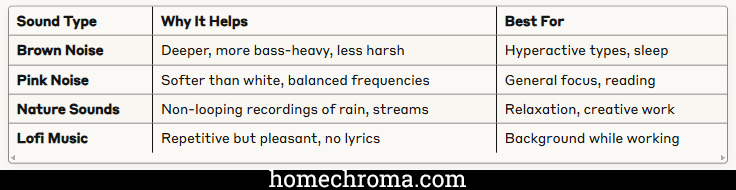
Machine Features That Actually Help
Look for machines with:
- Precise volume control (digital controls with many levels)
- Multiple sound options (white, pink, brown, nature)
- High-quality speakers with good bass response
- No visual distractions (dimmable or no displays)
- Real fan sounds or true random noise generation
Personalization Strategies
- Test systematically: Try different sounds for 15-30 minutes each
- Monitor your response: Note anxiety, focus quality, and comfort levels
- Adjust by task: Use different sounds for different activities
- Consider headphones: Noise-cancelling headphones with brown/pink noise often work better than room-based machines
- Track patterns: Keep notes on what works when and why
Here’s Two ADHD-Friendly White Noise Machines
After understanding what makes white noise machines problematic for ADHD brains, you might wonder: are there any that actually get it right? The good news is yes – but they’re specifically designed to address the exact issues we’ve discussed.
LectroFan Series: The Precision Solution
Models to consider: LectroFan Evo, LectroFan High Fidelity
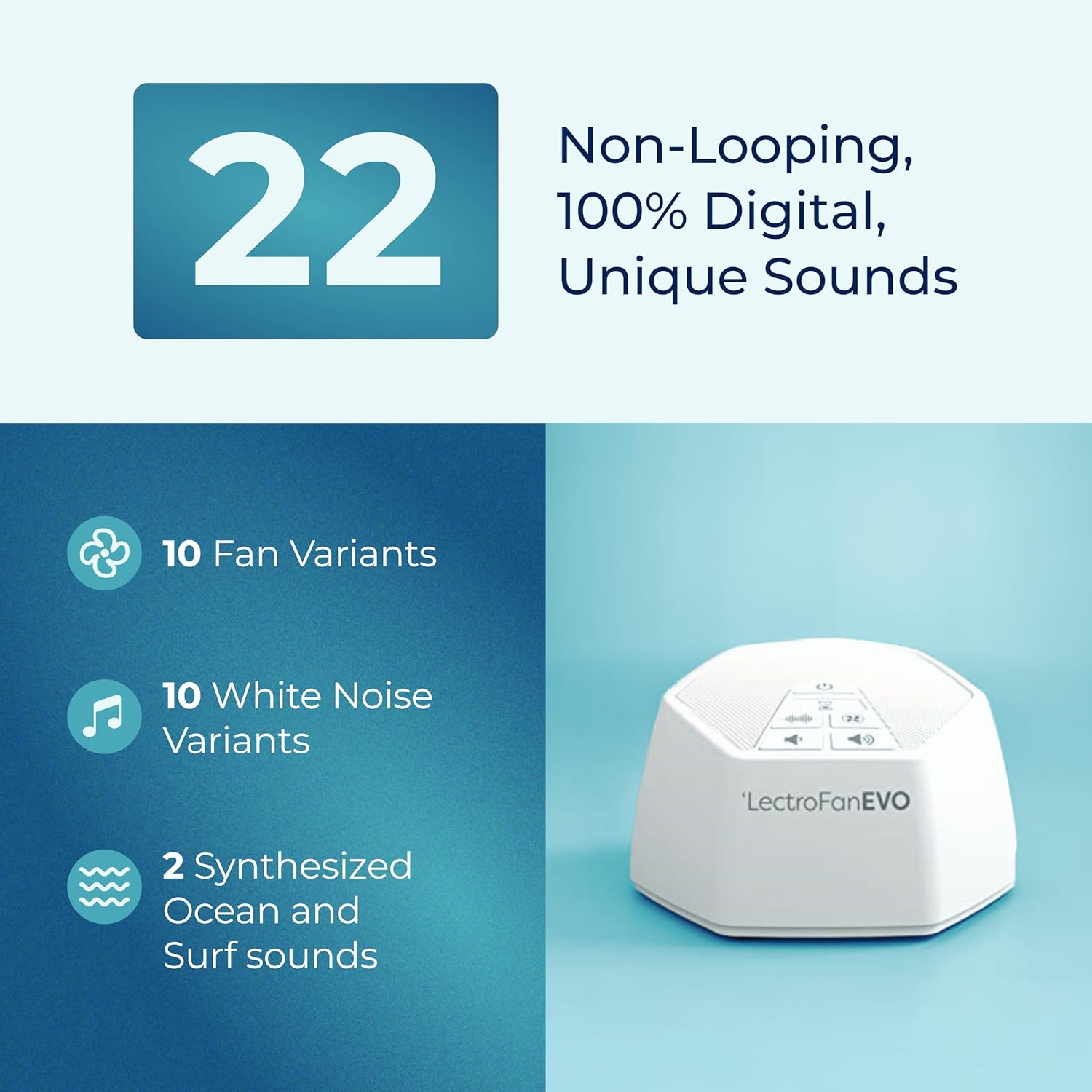
LectroFan EVO [click to view…]
The LectroFan series tackles the two biggest ADHD white noise problems head-on: limited sound options and poor volume control.
Why it works for ADHD brains:
- Non-looping sound generation: Uses digital algorithms instead of recorded clips, eliminating the pattern-recognition trap that catches ADHD brains
- Precise volume control: Fine-tune to your exact “Goldilocks Zone” without jumping between too-quiet and too-loud
- Sound variety beyond white noise: Includes pink noise, brown noise, and multiple fan sounds so you can find what actually works for your brain
- Headphone jack (Evo model): Create a controlled auditory environment for focused work sessions
ADHD-specific benefits: If you’re the type who gets distracted by sound loops or finds pure white noise irritating, the LectroFan’s algorithm-generated sounds and variety of noise colors can be transformative.
SNOOZ: The Real Deal
Models to consider: SNOOZ Smart White Noise Sound Machine, SNOOZ Breez
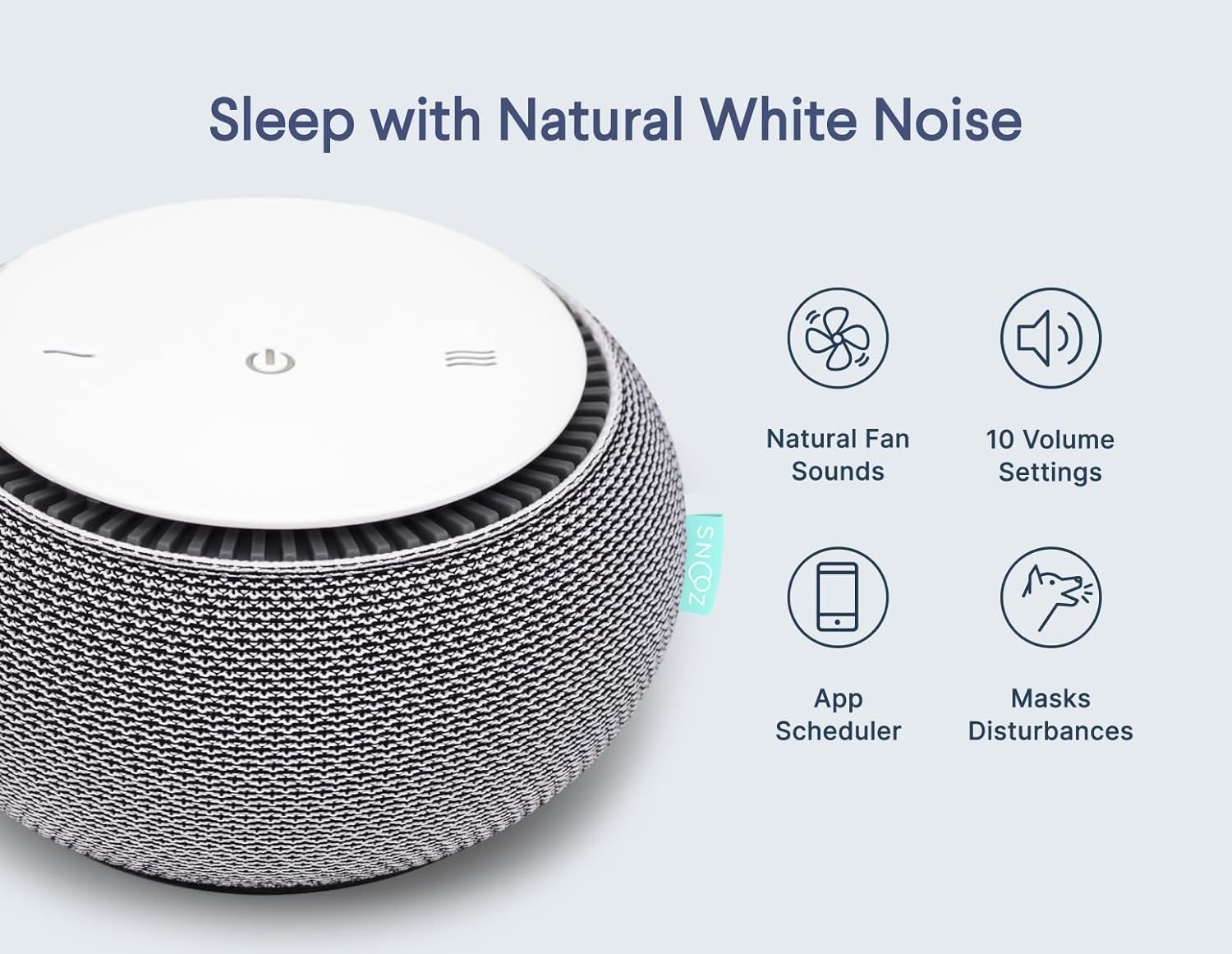
SNOOZ Smart White Noise Sound Machine [click to view…]
SNOOZ takes a completely different approach by going back to basics – but in the smartest possible way.
Why it works for ADHD brains:
- Actual fan inside: Uses a real, physical fan to generate sound, making loops literally impossible
- Authentic ambient noise: The sound naturally varies slightly, providing the consistency ADHD brains crave without the monotony that triggers hyperfocus on patterns
- Adjustable tone and volume: Fine-tune both the pitch and loudness to match your sensory preferences
- No digital artifacts: Eliminates the harsh, synthetic quality that makes some people with ADHD feel agitated
ADHD-specific benefits: Perfect for people whose brains immediately lock onto digital loops or who find electronic white noise too “artificial” or stimulating. The natural variation keeps it interesting enough to mask distractions without becoming a distraction itself.
The Bottom Line: Your Brain, Your Rules
The “least helpful” white noise machine for ADHD isn’t necessarily a specific brand or model – it’s any approach that ignores your individual neurological needs.
Key takeaways:
✅ If you have hyperactive ADHD symptoms: Be extra cautious with white noise – it might work against you
✅ Pure white noise isn’t automatically best: Brown and pink noise often work better for ADHD brains
✅ Avoid obvious loops: Short, repeating sound clips become fixation targets
✅ Volume precision matters: Coarse controls prevent finding your optimal level
✅ One size doesn’t fit all: What helps others might hurt you, and that’s normal
Most importantly: If white noise increases your anxiety, agitation, or distractibility, stop using it immediately. Your negative response isn’t a character flaw – it’s valuable information about how your specific brain works.
The best ADHD tool is the one that actually helps YOUR brain function better. Sometimes that’s white noise, sometimes it’s brown noise, and sometimes it’s complete silence. Trust your experience over popular recommendations, and don’t be afraid to experiment until you find what truly works for you.
Ready to find your perfect sound solution? Start by identifying your ADHD subtype, test different noise colors at moderate volumes, and pay close attention to how each makes you feel. Your brain will tell you what works – you just need to listen.
Dora Decora is a biophilic interior design specialist and passionate blogger. With a deep commitment to integrating nature into living spaces, Dora specializes in creating environments that foster human-nature connections through thoughtful design elements. Her approach emphasizes sustainable materials, natural lighting, and organic patterns that enhance wellbeing and reduce environmental impact.
This post (https://homechroma.com/least-helpful-white-noise-machine-for-adhd) was originally published by Dora Decora on Home Chroma. As an Amazon Associates partner, we are compensated for all qualifying purchases.