 You’re standing in the grocery aisle, scanning labels on salad dressings. The bottle says “Made with Olive Oil.” Sounds clean. Sounds healthy. But flip it around, and the first ingredient listed? Soybean oil.
That “olive oil” claim? Marketing. The olive oil is buried six ingredients deep, making up a tiny fraction of the bottle. The rest is cheap, industrially processed seed oil that your body was never designed to handle in the amounts most Americans consume.
Here’s the uncomfortable reality: roughly 9 out of 10 commercially sold salad dressings — including many brands positioned as “healthy,” “organic,” or “natural” — use soybean, canola, or sunflower oil as their primary fat source. These oils undergo heavy industrial processing with chemical solvents, bleaching agents, and deodorizers before they ever touch your food.
The good news? A growing number of brands have ditched seed oils entirely. They use avocado oil or extra virgin olive oil as the base, with short ingredient lists you can actually read. Below is a fact-checked breakdown of the best options currently available, what to watch out for on labels, and how to tell a genuinely clean dressing from a cleverly marketed fake.
Why Seed Oils Are a Problem
The term “seed oil” refers to oils extracted from crops like soybeans, corn, cottonseed, rapeseed (canola), sunflower seeds, and safflower seeds. Unlike olive oil or avocado oil — which come from the fruit and can be extracted with simple mechanical pressing — seed oils require heavy industrial processing to produce.
The standard process involves hexane extraction (a petroleum-derived solvent), followed by refining, bleaching, and deodorizing (called the RBD process). The deodorization step alone uses temperatures exceeding 400°F, which can generate small amounts of trans fats. The FDA allows products with less than 0.5g of trans fat per serving to be labeled “zero grams” — so those trace amounts add up silently across a diet heavy in processed foods.
The bigger concern is the fatty acid profile. Seed oils are loaded with linoleic acid, an omega-6 polyunsaturated fat. Polyunsaturated fats have multiple double bonds in their carbon chains, making them highly prone to oxidation when exposed to heat, light, or air. When they oxidize, they form lipid peroxides and reactive oxygen species that can damage cell membranes and DNA.
Your body also converts linoleic acid into arachidonic acid, a precursor to pro-inflammatory compounds. Some inflammation is normal and healthy. Chronic excess omega-6 intake — without adequate omega-3 to balance it — is linked to systemic inflammation, cardiovascular issues, and metabolic dysfunction.
Fatty Acid Comparison: Seed Oils vs. Fruit Oils
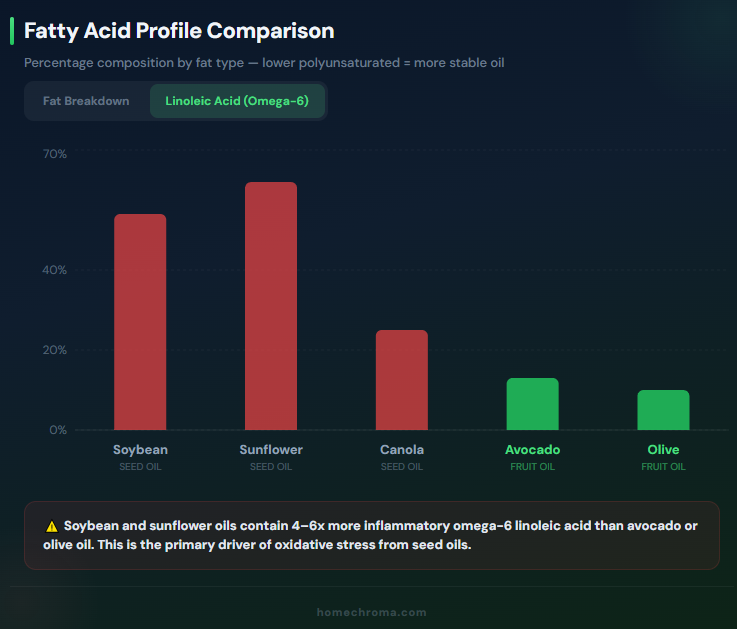
The contrast is stark. Avocado oil and olive oil are primarily monounsaturated fat (oleic acid), which is chemically stable and resistant to oxidation. Soybean and sunflower oils are dominated by polyunsaturated fat that breaks down easily under normal kitchen and storage conditions.
The Label Trick: How “Made With Olive Oil” Fools You
Food companies exploit a simple loophole: they can plaster “Made with Olive Oil” or “Avocado Oil Blend” on the front of the bottle, even if the primary oil is soybean or canola. The front label is marketing. The ingredient list on the back is the truth.
Here’s how to read it correctly:
- Ingredients are listed by weight, largest first. If soybean oil, canola oil, or “vegetable oil” appears before olive oil or avocado oil, the dressing is primarily seed oil.
- “Vegetable oil” is a generic term that almost always means soybean oil, corn oil, or a blend of cheap seed oils.
- Watch for “and/or” language like “canola and/or soybean oil” — this means the manufacturer uses whichever is cheaper at the time of production.
A genuinely clean dressing will list avocado oil or extra virgin olive oil as the first or second ingredient (after water or vinegar). No guessing required.
Best Avocado Oil-Based Dressings
1. Primal Kitchen

Primal Kitchen Ranch Dressing [click to view…]
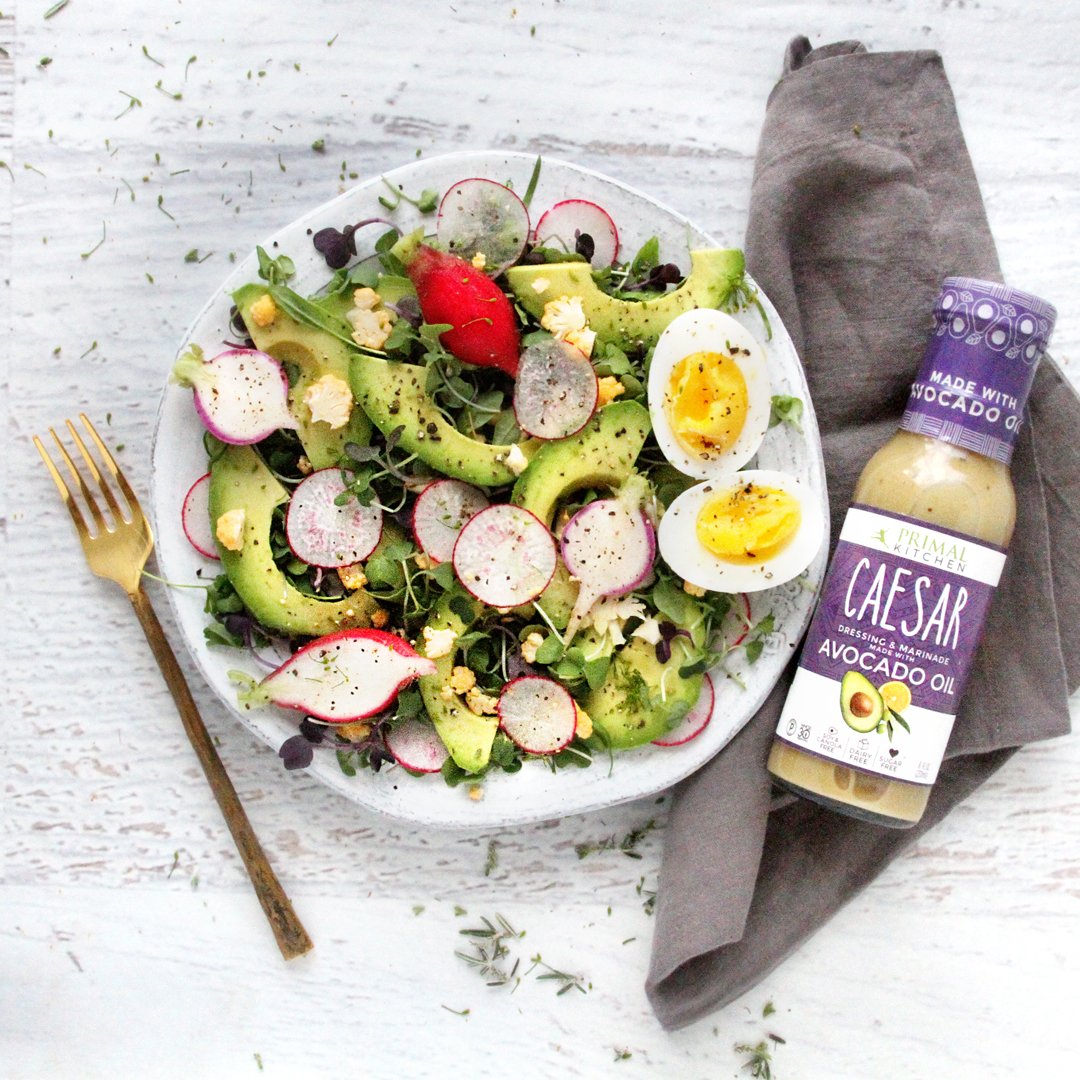
Founded by Mark Sisson, Primal Kitchen has become the benchmark brand for seed oil-free condiments. Every dressing uses 100% pure avocado oil as its fat base. No soybean, canola, or sunflower oil touches the bottle.
Their ingredient lists are short and readable: avocado oil, organic vinegar, apple cider vinegar, egg yolks, herbs, and spices. No artificial sweeteners, no MSG, no synthetic preservatives.
Standout flavors: No-Dairy Ranch, Caesar, Greek Vinaigrette, Honey Mustard, Italian Vinaigrette, Balsamic Vinaigrette, and Buffalo Ranch.
Certifications: Keto Certified, Paleo Friendly, Whole30 Approved, Non-GMO Project Verified, Certified Gluten-Free.
Price: ~$8.00–$8.89 per 8 fl oz bottle.
Quick tip: Avocado oil naturally thickens and can partially solidify in the refrigerator. This is normal and actually confirms the oil’s purity — refined seed oils stay liquid at cold temps because of their higher polyunsaturated fat content. Pull the bottle out 5–10 minutes before use and give it a good shake.
2. Chosen Foods

Chosen Foods 100% Avocado Oil-Based Classic Mayonnaise [click to view…]
Chosen Foods is America’s #1 avocado oil brand, and their dressing line matches that standard. Every variety uses 100% pure avocado oil with no dilution.
The Steakhouse Caesar is a standout. It blends avocado oil with lemon juice, garlic, Dijon mustard, anchovy paste, and Parmesan for a traditional Caesar profile without a drop of seed oil. It’s garlicky, creamy, and works equally well as a marinade on grilled chicken or shrimp.
Other flavors include: Classic Ranch, Lemon Garlic, Zesty Italian, Homestyle Balsamic, and Greek Artichoke.
Certifications: Non-GMO, Gluten-Free, Glyphosate Residue Free, Kosher. Free of soy and canola oils.
Price: ~$4.98–$6.99 per 8 fl oz bottle. Generally $1–$2 less per bottle than Primal Kitchen, making it the best value option in the avocado oil category.
3. SideDish by Alex Snodgrass
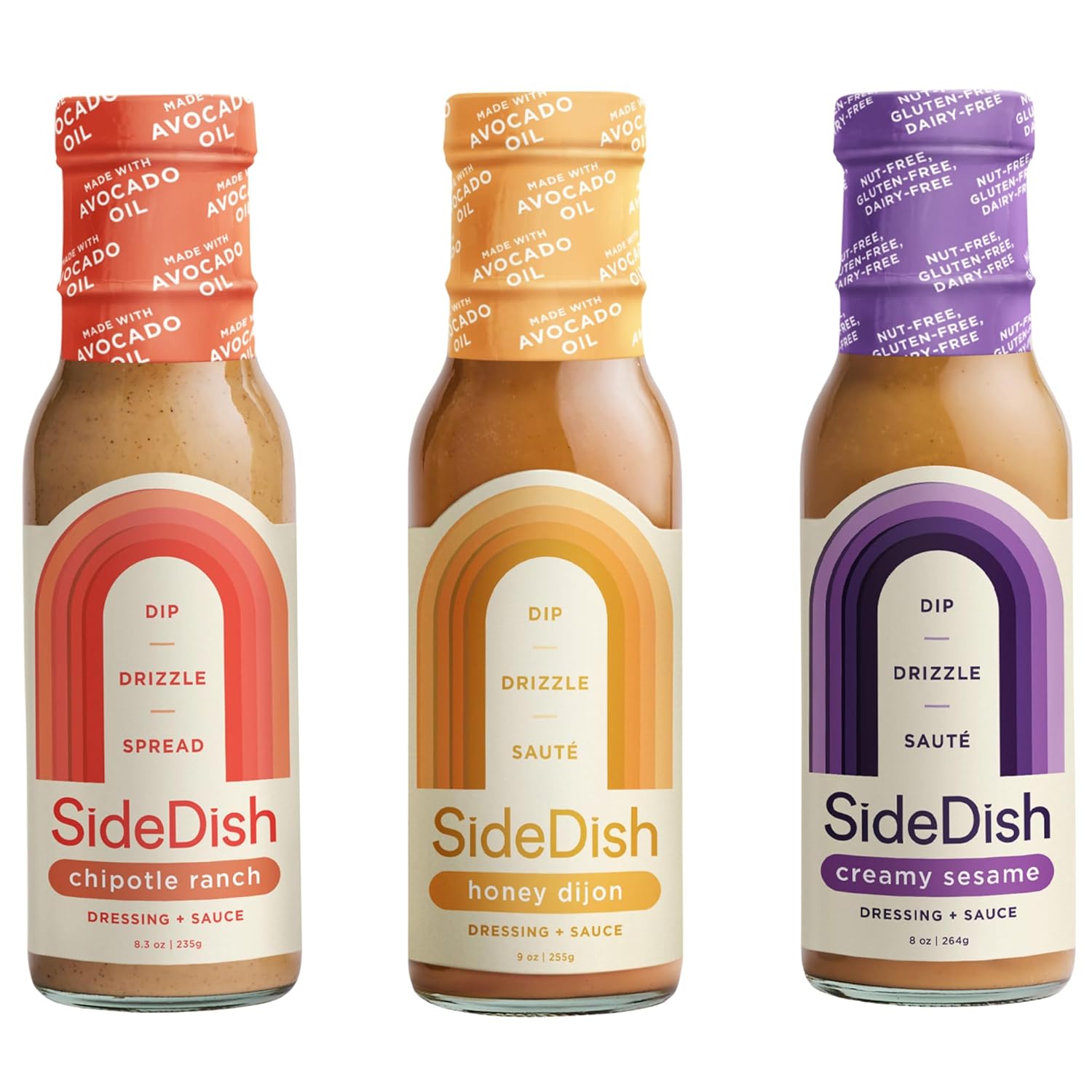
SideDish Salad Dressing [click to view…]
SideDish was created by Alex Snodgrass, the recipe developer and cookbook author behind The Defined Dish (a 3x New York Times bestseller). She built the line specifically because she couldn’t find dressings with both great flavor and clean ingredients.
Every SideDish dressing is 100% avocado oil-based and free of seed oils, refined sugar, gluten, dairy, and preservatives. Several varieties carry the Seed Oil Safe® certification.
Standout flavors: Miso Caesar (with chickpea miso and nutritional yeast for a savory umami depth without dairy), Greek Vinaigrette (red wine vinegar base with garlic and oregano), Chipotle Ranch (Whole30 Approved), Honey Dijon, Classic Ranch, and Creamy Sesame.
Price: ~$9.99 per 8 fl oz bottle individually, with better value in multi-packs.
SideDish dressings tend to thicken in the fridge. The brand recommends removing them 5–10 minutes before use and shaking vigorously.
Best Extra Virgin Olive Oil-Based Dressings
4. Mother Raw

Italian Dressing [click to view…]
Mother Raw takes a different approach. Their tagline is “Never Heated, Mistreated or Depleted,” and every dressing is cold-blended to preserve the polyphenols and antioxidants in their organic extra virgin olive oil.
The ingredient lists read like a farmer’s market haul: cold-pressed EVOO, filtered water, lemon juice, unfiltered apple cider vinegar, hemp seeds, nutritional yeast, minced garlic, white chia seeds, and organic herbs. No seed oils. No fillers. No preservatives.
Standout flavors: Caesar (uses capers and garlic for depth without dairy), Ranch (hemp and chia seeds for creaminess), Mediterranean (sundried tomatoes and kalamata olives), and Lemon Garlic.
Certifications: Certified Vegan, Organic, Non-GMO, Gluten-Free, Soy-Free.
Where to find them: Mother Raw dressings are sold refrigerated in the produce section at Whole Foods, Target, and Sprouts. Because they’re cold-blended with no preservatives, they have a 30-day shelf life after opening — a trade-off for truly fresh, unprocessed ingredients.
Best for: Vegans and anyone who wants the highest-quality olive oil dressing with zero compromises on processing.
5. Bragg
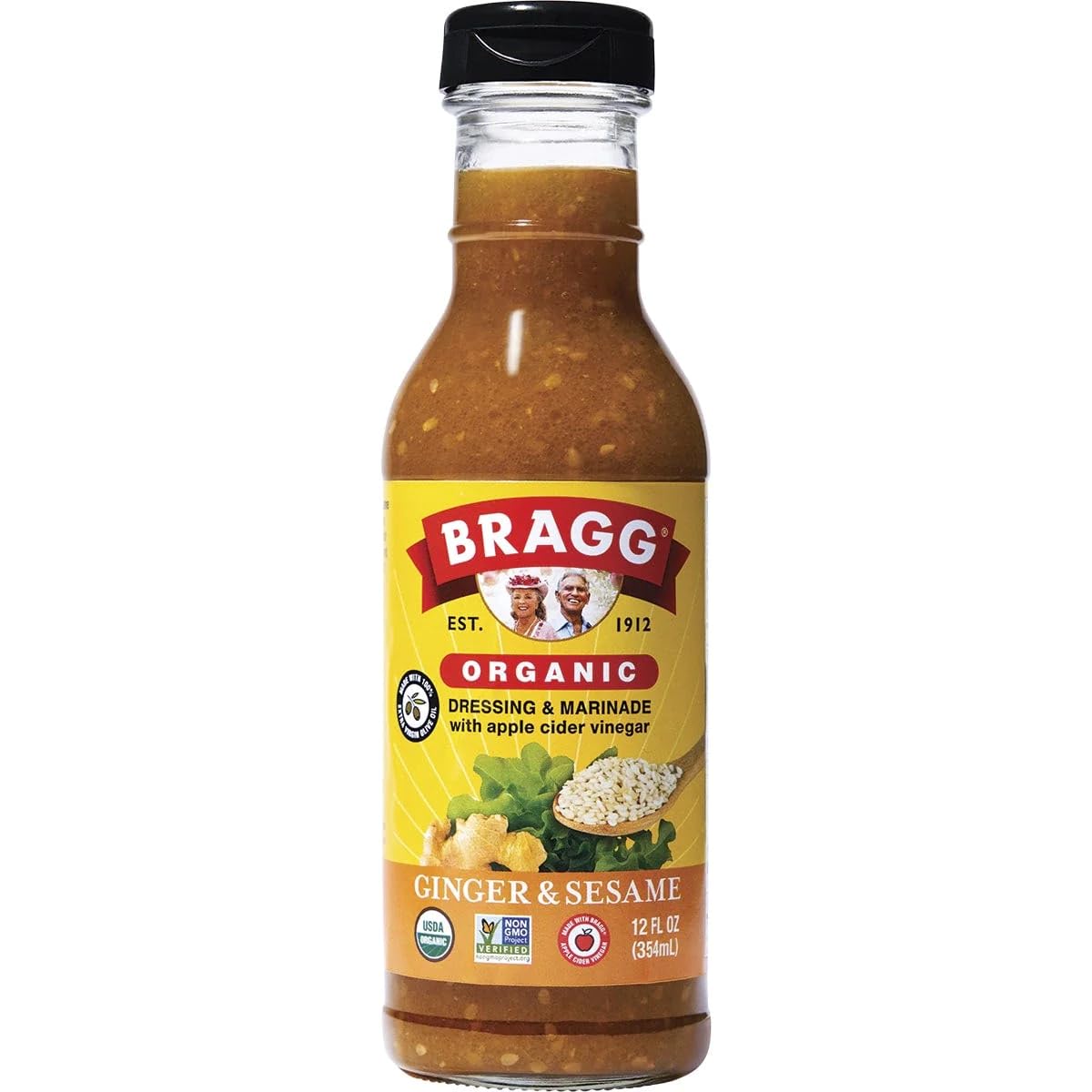
Bragg Organic Ginger and Sesame Salad Dressing [click to view…]
Bragg has been a household name in health food for decades, primarily through their raw apple cider vinegar. Their Healthy Vinaigrette line pairs olive oil with their signature ACV, liquid aminos, and honey.
The appeal here is dual-purpose: you’re flavoring your salad while getting the metabolic benefits of acetic acid (the active compound in ACV), which clinical research has linked to healthier blood sugar regulation after meals.
The flavor leans vinegar-forward, which works well on hearty greens like kale and spinach but may be too sharp for more delicate lettuces. It’s a simple, no-frills option with a short ingredient list and a price point lower than most specialty brands.
Specialty and Gut-Friendly Options
6. Fody Foods (Best for IBS and Digestive Sensitivity)

Fody Foods Vegan Maple Dijon Salad Dressing [click to view…]
Fody Foods makes dressings specifically for people with Irritable Bowel Syndrome (IBS) and other digestive conditions. Their products are certified Low-FODMAP, meaning they exclude garlic and onion — two of the most common digestive triggers.
Most Fody vinaigrettes use extra virgin olive oil as the primary fat source. Their Balsamic Vinaigrette and Lemon Herb varieties are clean picks.
One caution: Check individual labels carefully. Some Fody varieties include expeller-pressed sunflower oil to achieve a milder flavor. If you’re strictly avoiding all seed oils, read the back of each specific bottle before buying.
7. Noble Made (Best for Bold, Sauce-Style Flavors)
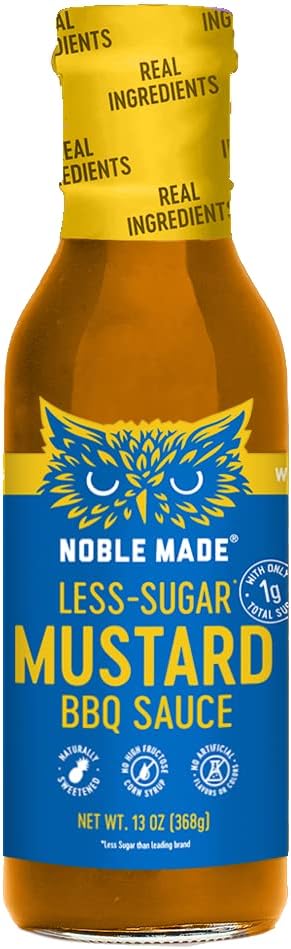
Noble Made, Mustard barbecue Sauce [click to view…]
Noble Made (formerly The New Primal) fills a niche that most clean dressing brands miss: bold, sauce-forward flavors like Buffalo Ranch and Garlic Parmesan. These use avocado oil as the base and are strictly keto-certified and gluten-free.
If you’re tired of standard vinaigrettes and want wing-sauce-level flavor on your salad without the inflammatory oils found in traditional buffalo sauces, Noble Made is the pick.
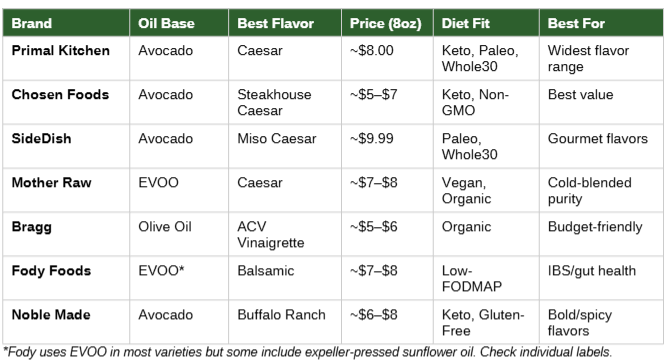
Quick Comparison: All Brands at a Glance
The High-Oleic Sunflower Oil Gray Area
If you’ve looked at Tessemae’s dressings, you may have noticed something: they used to be 100% olive oil-based but have since switched to organic high-oleic sunflower oil in many of their formulas.
High-oleic sunflower oil is bred to contain over 80% oleic acid (monounsaturated fat), which makes its fatty acid profile much closer to avocado oil or olive oil than to standard sunflower oil. It’s far more oxidatively stable than regular sunflower oil and has a low omega-6 content.
So is it “safe”? It depends on how strict your definition is:
- If your standard is “fruit oils only” (avocado and olive), Tessemae’s no longer qualifies.
- If your standard is “low omega-6, high monounsaturated fat,” high-oleic sunflower oil is biochemically similar to the fruit oils and a reasonable middle ground.
The bottom line: if you want absolute certainty, stick with Primal Kitchen, Chosen Foods, SideDish, or Mother Raw. If you’re comfortable with the nuance, high-oleic sunflower oil is a significant step up from standard seed oils.
How to Spot Fake “Clean” Dressings: A 30-Second Label Check
Use this quick system every time you pick up a bottle:
- Flip the bottle. Ignore the front label entirely.
- Read the first 3 ingredients. If soybean oil, canola oil, sunflower oil, or “vegetable oil” appears anywhere in the top three, put it back.
- Confirm the oil type. The first oil listed should be avocado oil or extra virgin olive oil — with no seed oil hiding further down.
- Check for “and/or” phrasing. This signals the manufacturer uses whichever oil is cheapest at production time.
- Consider the packaging. Dark glass or opaque containers protect oils from light-induced oxidation. Clear plastic bottles offer the least protection.
Frequently Asked Questions
Why does my avocado oil dressing get thick in the fridge?
Monounsaturated fats naturally thicken at cold temperatures. This is actually a sign of purity. Refined seed oils stay liquid at refrigerator temps because of their higher polyunsaturated fat content. Let the bottle sit at room temperature for 5–10 minutes and shake well.
Are seed oil-free dressings worth the higher price?
A conventional dressing costs $2–$4 for 16 oz. A clean dressing costs $5–$10 for 8 oz. That’s roughly 3–4x the cost per ounce. The question is whether reducing chronic omega-6 overload and avoiding industrially processed fats is worth an extra $0.50 per salad to you. For most health-conscious shoppers, the answer is yes.
What about making my own dressing at home?
That’s the cheapest and cleanest option of all. A simple vinaigrette — 3 parts extra virgin olive oil, 1 part acid (lemon juice or vinegar), salt, pepper, and a touch of Dijon mustard — takes 60 seconds and costs pennies per serving. The brands listed above are for convenience when you don’t have time to make your own.
Is canola oil as bad as soybean oil?
Canola oil has a better monounsaturated-to-polyunsaturated ratio than soybean or sunflower oil (63% mono vs. 28% poly). It’s not in the same category of concern. That said, it still undergoes heavy RBD processing and contains more omega-6 than avocado or olive oil. If your goal is to minimize processed seed oils, canola is still on the “avoid” list.
Can I cook with these dressings as marinades?
Yes. Avocado oil has one of the highest smoke points of any cooking oil (around 520°F), making avocado oil-based dressings excellent for marinating and then grilling or roasting. Olive oil-based dressings work well for lower-heat applications and cold dishes.
What does “Seed Oil Safe” certification mean?
Seed Oil Safe® is a third-party certification that verifies a product contains zero seed oils. Brands like SideDish carry this certification on specific flavors. It removes the guesswork of reading labels and gives you immediate confidence in the product.
Dora Decora is a biophilic interior design specialist and passionate blogger. With a deep commitment to integrating nature into living spaces, Dora specializes in creating environments that foster human-nature connections through thoughtful design elements. Her approach emphasizes sustainable materials, natural lighting, and organic patterns that enhance wellbeing and reduce environmental impact.
This post (https://homechroma.com/best-seed-oil-free-salad-dressing) was originally published by Dora Decora on Home Chroma. As an Amazon Associates partner, we are compensated for all qualifying purchases.