You want more natural light in your home, but your budget has limits. The question isn’t whether natural light improves your living space—it absolutely does. The real question is: which solution gives you the biggest bang for your buck?
Two main options compete for your attention: solar tubes and traditional skylights. One costs significantly less upfront but offers limited functionality. The other demands a larger investment but delivers broader benefits.
This comparison cuts through the marketing fluff to show you exactly what each option costs, what you get for your money, and which choice makes the most financial sense for your specific situation.
Solar Tubes: Maximum Light, Minimum Investment
Solar tubes (also called sun tunnels or tubular skylights) work through a simple but effective design. A clear dome on your roof captures sunlight, which travels down a highly reflective tube through your attic, then disperses into your room through a ceiling-mounted diffuser.
Where Solar Tubes Work Best

Solatube® Skylight Kit with Dome Collector [click to view…]
These compact systems excel in specific situations:
- Small spaces: Hallways, closets, bathrooms, stairways
- Windowless rooms: Interior spaces with no external walls
- Utility areas: Laundry rooms, pantries, storage areas
- Focused lighting needs: Areas requiring functional light rather than ambiance
Solar Tube Costs: The Numbers That Matter
Material Costs:
- 10-inch tube (up to 150 sq ft): $150-$400
- 14-inch tube (up to 300 sq ft): $350-$600
- 18-inch tube (up to 500 sq ft): $400-$750
- 21-inch+ tube (up to 650 sq ft): $500-$1,150+
Installation Costs:
- Professional installation: $600-$1,100 total
- Labor only: $250-$300
- Total installed cost: $400-$1,100
Cost Variables:
- Roof material (tile/metal adds $70-$150)
- Climate considerations (humid areas need extra insulation: +$50-$100)
- Complex installation paths around attic obstacles
- Multiple tube discounts available
Long-Term Financial Benefits
Energy Efficiency: Solar tubes deliver consistent energy savings without the thermal issues that plague skylights. Their design minimizes heat transfer, meaning your HVAC system works less to maintain comfortable temperatures year-round.
Tax Credits: Solar tubes with integrated solar components qualify for 26-30% federal tax credits, potentially reducing a $1,200 system to $840-$888 net cost.
Maintenance: Minimal upkeep required. Professional installation typically lasts 10-20+ years with virtually no maintenance needs.
Solar Tube Limitations
- No views: Pure function, no sky visibility
- No ventilation: Light only (vent kits available as add-ons)
- Limited aesthetic impact: Utilitarian rather than decorative
- Size restrictions: Not suitable for large rooms requiring extensive illumination
Traditional Skylights: Premium Light, Premium Price

Mounted, Self-Flashed Skylight [click to view…]
Traditional skylights are essentially roof windows made from glass, acrylic, or polycarbonate. They provide expansive natural light, direct sky views, and can include ventilation capabilities.
Skylight Types and Applications
Fixed Skylights: Non-opening units focused solely on light admission Vented Skylights: Operable units providing both light and ventilation
- Manual operation (crank/rod)
- Electric operation (switch/remote)
- Solar-powered operation
Best Applications:
- Large living spaces requiring dramatic lighting
- Rooms where sky views enhance the experience
- Areas needing both light and ventilation
- Spaces where architectural interest is desired
Skylight Costs: The Complete Picture
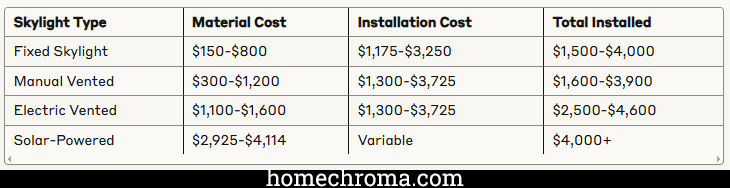
Additional Cost Factors
Size Impact:
- 25×25 inches: $150-$500
- 49×49 inches: $500-$1,900
Frame Materials:
- Vinyl: $150-$1,000
- Aluminum: $200-$1,500
- Wood: $300-$2,500
Glazing Options:
- Acrylic: $150-$1,000
- Tempered glass: $200-$1,500
- Double-pane glass: $300-$3,500
Long-Term Skylight Considerations
Energy Performance Issues: Unlike solar tubes, skylights can create significant energy challenges:
- Heat loss: 35-45% more heat loss than other roof areas
- Heat gain: Direct solar radiation increases cooling costs
- Mitigation costs: Low-E glass, proper insulation, and shading add to total investment
Maintenance Requirements:
- Regular cleaning necessary
- Seal and flashing inspections
- Moving parts (vented models) require service
- Common repairs: $100-$1,000+ depending on issue
Lifespan:
- Glass skylights: 20+ years
- Acrylic/polycarbonate: 10-15 years
Head-to-Head Budget Comparison
Upfront Investment Analysis
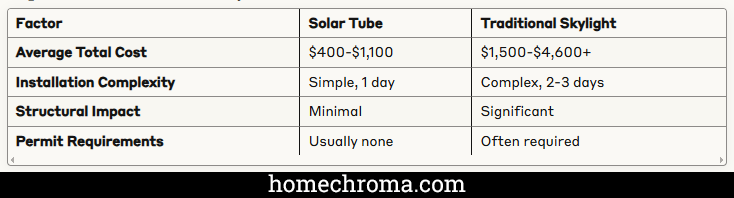

Making Your Budget-Smart Decision
Key Questions to Ask Yourself
- What’s your primary goal?
- Functional lighting → Solar tube
- Dramatic ambiance + views → Skylight
- What’s your space size?
- Under 300 sq ft → Solar tube likely sufficient
- Over 300 sq ft → Consider skylight
- Do you need ventilation?
- Light only → Solar tube works perfectly
- Light + airflow → Vented skylight necessary
- What’s your total budget?
- Under $1,500 → Solar tube is realistic choice
- $2,000+ → Skylight options open up
Budget Optimization Strategies
For Solar Tubes:
- Choose standard sizes (10″ or 14″) to avoid rafter cutting
- Install multiple tubes simultaneously for bulk discounts
- Consider DIY installation (with warranty considerations)
- Apply for federal tax credits on solar-integrated models
For Skylights:
- Time installation with roof replacement to save labor costs
- Stick to standard rectangular shapes
- Choose fixed over vented if ventilation isn’t critical
- Invest in proper insulation and Low-E glass upfront
Universal Tips:
- Get multiple contractor quotes
- Verify all permits and warranty implications
- Consider your climate’s specific thermal challenges
- Factor in long-term maintenance costs
The Bottom Line: Your Best Budget Choice
Choose Solar Tubes If:
- Budget under $1,500
- Need lighting in smaller, functional spaces
- Want minimal installation disruption
- Prefer predictable, low-maintenance performance
- Heat gain/loss concerns are high
Choose Skylights If:
- Budget allows $2,000+ investment
- Want dramatic lighting transformation
- Need ventilation capabilities
- Value aesthetic and architectural enhancement
- Plan to stay in home long-term for resale benefit
The Hybrid Approach: Consider solar tubes for utility areas and bathrooms, with one statement skylight in your main living space. This maximizes natural light throughout your home while controlling total investment.
Your budget doesn’t have to limit your access to natural light—it just determines which solution delivers the best value for your specific needs. Solar tubes provide exceptional functional value per dollar spent, while skylights offer broader lifestyle benefits that justify their higher cost.
The right choice is the one that brightens your home while keeping your finances comfortable. Both options will transform dark spaces into welcoming areas; the question is simply which transformation fits your budget and lifestyle best.
Start by measuring your spaces, defining your priorities, and getting quotes for both options. You might be surprised at what your budget can actually accommodate when you know exactly what you’re comparing.
Dora Decora is a biophilic interior design specialist and passionate blogger. With a deep commitment to integrating nature into living spaces, Dora specializes in creating environments that foster human-nature connections through thoughtful design elements. Her approach emphasizes sustainable materials, natural lighting, and organic patterns that enhance wellbeing and reduce environmental impact.
This post (https://homechroma.com/solar-tubes-vs-skylights-which-is-best-for-your-budget) was originally published by Dora Decora on Home Chroma. As an Amazon Associates partner, we are compensated for all qualifying purchases.